
ChatGPT Stopped Citing Blogs. It Cites Docs Now.
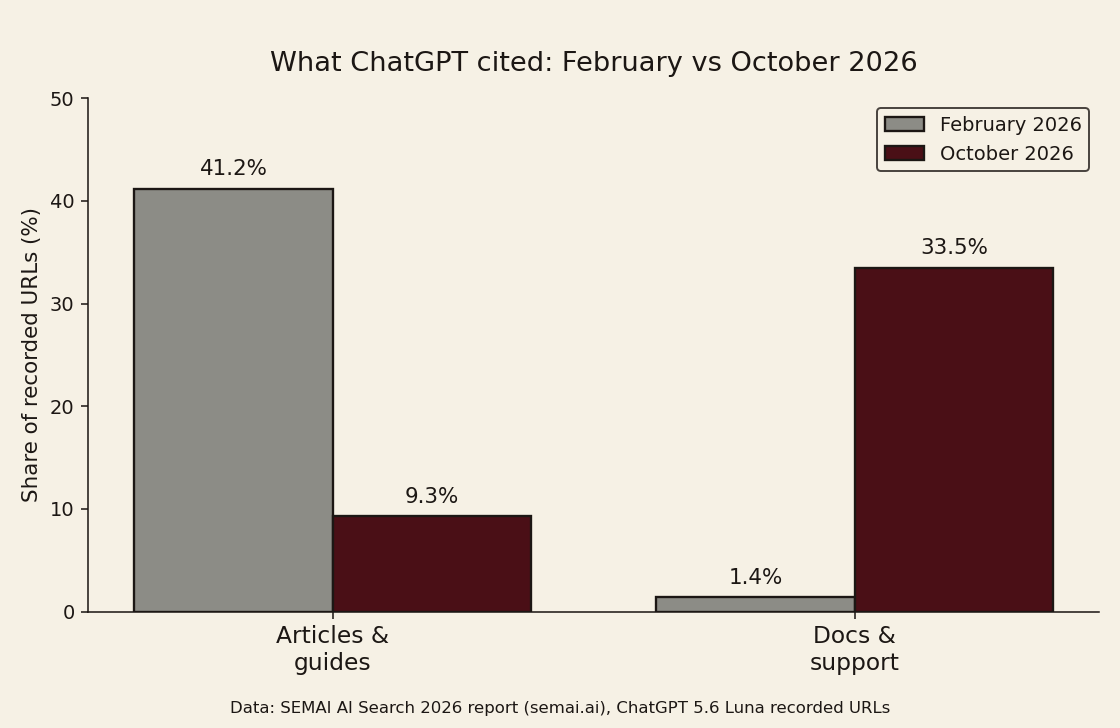
ChatGPT's citations flipped: blogs and articles fell 41.2% to 9.3% of recorded URLs; documentation and support pages rose 1.4% to 33.5%.
In February, 41.2% of the URLs ChatGPT recorded in its answers were blogs and articles. In October, that number is 9.3%. Documentation and support pages went from 1.4% to 33.5% over the same window.
Those numbers come from SEMAI's AI Search 2026 report, released this week, built on more than 250,000 recorded URLs across ChatGPT, Gemini, Perplexity, and Google AI Overviews. SEMAI ran the same queries, measured the same way, in February and again in October. Gemini and Perplexity barely moved. Only ChatGPT changed.
The obvious read is "write docs, not blogs." That is the wrong lesson. The right one is stranger: a model change rewrote what ChatGPT cites, which means every "what ChatGPT cites" playbook written this year has a shelf life measured in model releases.
What the report actually measured
Caveats first, because this is the kind of data that gets flattened into a headline and misused.
SEMAI's LLM sample is an anonymous telecom-software query set, matched across engines on the same queries, countries, and tracked sites. Content types are estimated from URL paths. The report is explicit: "recorded links are not independently verified final-answer citations," these are "observed source patterns, not proven engine preferences," and "no causal or market-wide claim is made." Google's AI Overview docs and PDF types were not classified at all. It is a snapshot, not doctrine. Here is the direction it points.
ChatGPT 5.6 Luna is the outlier. Documentation and support pages are 33.5% of recorded URLs, PDFs another 12.2%, articles and guides just 9.3%. Standards and professional bodies appear in 56.9% of matched queries, public and government bodies in 46.4%. Company websites appear in 79.4% of queries.
Gemini looks like a different internet. Company websites appear in 91.4% of matched queries, articles and guides are 50.6% of recorded URLs, documentation just 2.7%.
Perplexity leans social and publishing: those platforms appear in 56.4% of queries, articles and guides at 49.1%, documentation at 3.4%.
Google AI Overviews are the most article-friendly surface of the four: articles and guides are 44.4% of recorded links, with company sites appearing in 66.9% of Overview searches that had sources recorded.
The engines disagree about everything except one thing: company websites are the most common source type on every LLM. Your site is in the consideration set on all four engines. But read the report's own line on this carefully: "their cited pages are not necessarily product pages." A company domain appearing in 79.4% of queries tells you nothing about which pages are doing the work.
A model change did this, SEMAI says
SEMAI attributes the flip to a model change: after ChatGPT moved to a new model, its citation mix rewrote itself. The other engines barely moved. Blogs did not get worse between February and October, on SEMAI's reading. The model reading them did.
Earlier this week I wrote about Gemini 4 Argon landing in AI Mode's model picker and the hidden model variable changing what gets cited in AI Mode. That post was about the measurement problem. This is about the content strategy problem.
If citation mixes move with model releases, then "optimize for what ChatGPT cites" is a moving target you cannot optimize against with content calendars. You optimize against it with coverage. The stable part of the report is not any single engine's mix. It is the structure: different engines want different page types, company sites appear everywhere, and which pages get cited matters more than whether the domain appears.
Why docs, probably
Nobody outside OpenAI knows the mechanism, and I will not pretend to. But the shape of the data fits how answer engines work. A citation in an AI answer backs a claim or an instruction. Documentation pages answer narrow questions directly: one page, one task, no narrative arc. Blog posts argue and explore. The models are not judging quality. They are matching answer shape to question shape.
That reading also fits the institutional skew. Standards bodies in 56.9% of Luna's queries and public authorities in 46.4% are not marketing sources. They state things plainly with authority markers. ChatGPT's citation layer is behaving like a cautious researcher: cite the manual, cite the standard, cite the government page.
Gemini still cites articles at 50.6% and docs at 2.7%. Perplexity is article-heavy too. So "write docs" is not the answer on three of four engines. The answer is per-engine coverage of the page types each one cites, which I broke down earlier this month.
What I am doing about it
At First Rank, our +98% LLM-traffic GEO campaign runs on a fixed prompt panel: the same questions, the same four engines, logged in and out, repeated on a schedule, with recurrence scoring instead of one-shot visibility numbers. I built that method because one-shot AI visibility scores are lying to you. This report is the strongest argument for it I have seen from someone else. A dashboard reporting a single visibility score would have shown this flip as a dip or a spike. A panel that logs the cited URL and the page type would have shown exactly what happened: the same questions, new model, different pages.
Audit your docs, help center, and support pages as citation surfaces. Are they crawlable? Docs behind login walls, JS-only support centers, and PDFs with no text layer cannot be cited. Check that first. These pages exist for almost every company and almost no SEO team touches them for visibility.
Score at the page-type level per engine, not the domain level. Your domain appearing in an engine's sources is the start of the measurement, not the end. Log which page types get cited on which engine. If Gemini cites your articles and ChatGPT cites your docs, you know where the next hundred hours of content work should go.
Keep the blog, but know what it is for. Blog citations did not collapse everywhere. They collapsed in one model on one engine. Gemini at 50.6% and AI Overviews at 44.4% still reward long-form content. Write blogs for the engines and readers that use them, and write docs for the engine that now lives on them.
Watch the next model change, not the next playbook. When ChatGPT's next model ships, re-run your fixed questions and diff the cited page types. The February-to-October move was 24x on documentation. Nobody published a guide predicting it because it was not predictable.
The headline version of this story is "blogging is dead in AI search." It is wrong in exactly the way most AI search advice is wrong: it takes one engine's snapshot and sells it as the future. The better story is in the report's fine print. Citation behavior moves with models. Coverage and measurement are the durable edges. Everything else is a snapshot with an expiry date.
I publish these breakdowns on dalindegraff.com, where I write about search, AI, and marketing from the agency floor at First Rank.

About the author
Dalin de Graff is a digital marketing expert based in Winnipeg, Canada, with 9 years of experience across SEO, GEO, and AI search. At First Rank, he built the agency's GEO practice and leads its work on AI search and LLM visibility. His results include +311% organic clicks, +300% calls, and +98% AI search traffic in 30 days. He writes about search, AI, and marketing at dalindegraff.com.