AI Is Taking Over Search Because Google Built the Data Centers First
Ask why AI answers sit on top of Google searches now and you will hear the product answers: better answers, faster answers, the future of search.
Ask why AI answers sit on top of Google searches now and you will hear the product answers: better answers, faster answers, the future of search. I think the real answer sits one floor down, in the earnings report, and it is measured in concrete and megawatts.
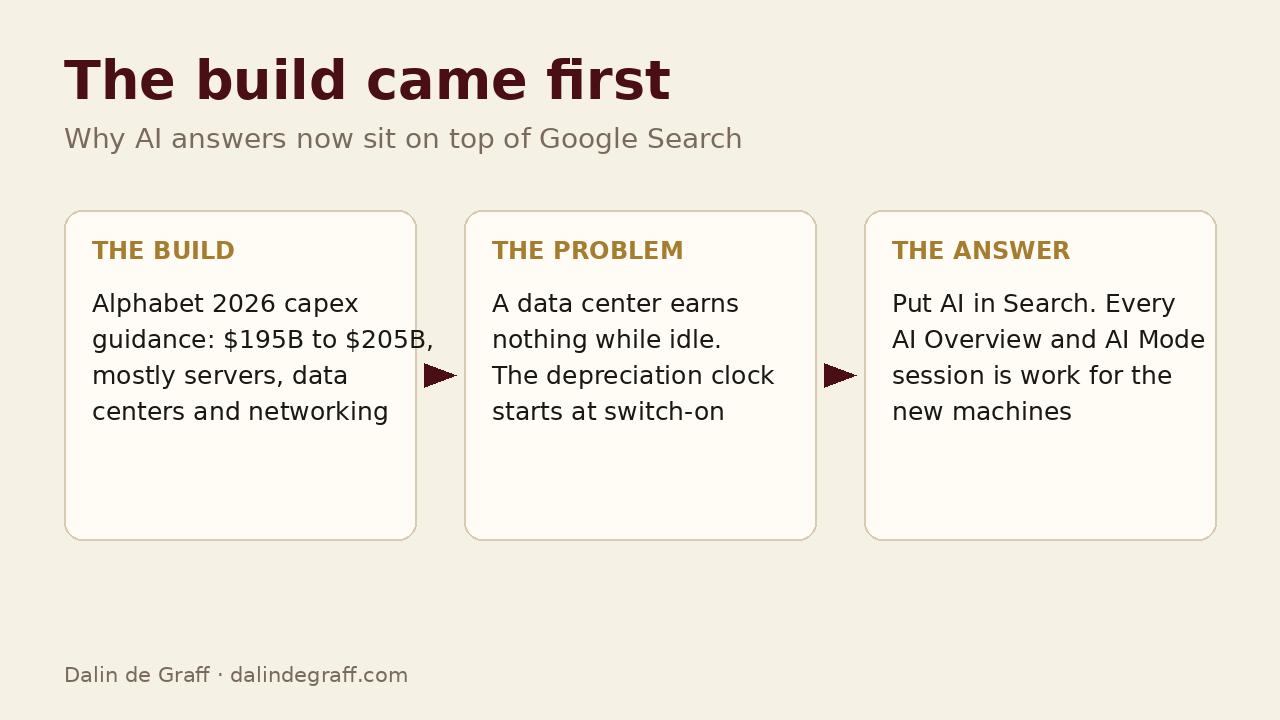
In the second quarter of 2026, Alphabet spent $44.9 billion on capital expenditure in three months, roughly double the year before (CNBC's Q2 coverage, via FinanceBuzz). Its operating cash flow was $39.1 billion. Spending passed cash generation, and free cash flow went negative $5.9 billion, the first negative quarter since the company went public in 2004. Management then raised full-year 2026 capex guidance to between $195 billion and $205 billion, the second raise in three months, and said 2027 will be significantly higher again (the Q2 numbers, broken down).
That is the context AI search lives in. Google is not sprinkling AI over Search because a product team won an argument. Google has committed to the largest infrastructure build in its history, and a build that size has to be fed.
A data center earns nothing while it sits idle
Most of the money is servers, data centers, and networking (Alphabet's guidance, summarized). The company is spending at least €13 billion on AI infrastructure in Finland, new data centers plus grid upgrades and clean-energy projects, its largest single investment in Europe, spread over 2027 and 2028 (The Trading Report). It signed a dark fiber deal with Verizon worth more than $1 billion just to move data between Google facilities, reported by Reuters off Verizon's earnings call (AI Weekly).
A data center is a fixed-cost machine. The building, the power contract, and the chips cost roughly the same whether the machines run at 20 percent or 90 percent, and the depreciation clock starts the day they switch on. Idle capacity is not neutral. It is a loss with a power bill. The only way a $200 billion a year build pays back is utilization, which means work. In AI terms, work means tokens.
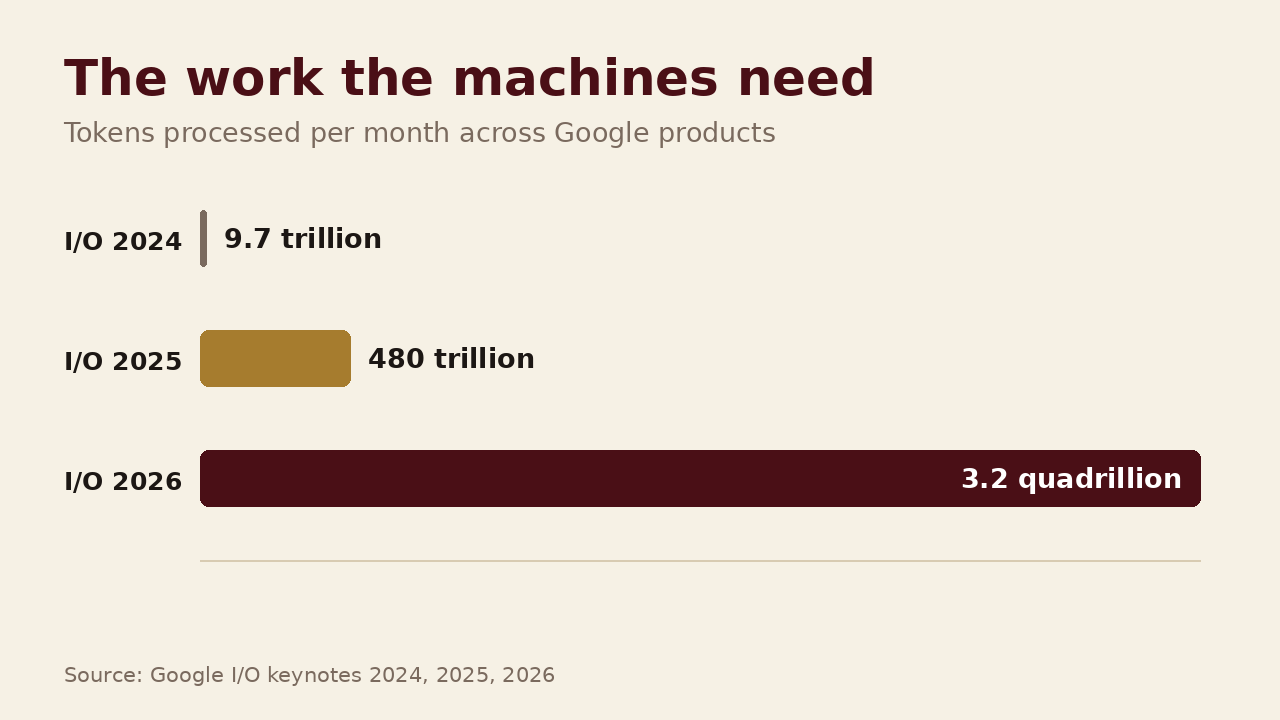
So look at the token curve and ask where the work comes from. Two years ago Google processed 9.7 trillion tokens a month across its products. Last year it was 480 trillion. At I/O in May, Sundar Pichai put the figure at over 3.2 quadrillion tokens a month, up seven times year over year (the I/O 2026 figures, traced to their sources). Enterprise customers supply some of that. Search supplies the flood.
Search is the biggest faucet Google owns
No other surface on earth can manufacture AI demand the way Google Search can. AI Overviews, the generated summary above the results, now reach over 2.5 billion people a month. AI Mode, the chat-style tab inside Search, passed more than a billion monthly users in its first year, and Google says its query volume is more than doubling every quarter (I/O 2026 numbers, summarized). Last quarter, as I wrote yesterday, Google's query growth was the fastest in five years (/blog/google-q3-earnings-seo-local-business).
Read those numbers next to the capex line and a pattern shows. Every AI Overview is compute. Every AI Mode session is a long string of tokens running on machines Alphabet just spent a fortune installing. Putting AI at the top of Search does three jobs at once. It fills the data centers, which counters the cost of building them. It grows total queries, which grows the ad business that funds the whole program. And it keeps the question inside Google, answered by Gemini, instead of losing that person to a chatbot across town.
The honest counterweight
The build is not empty capacity hunting for a purpose, and I do not want to overclaim. Google Cloud grew 82 percent in the second quarter to $24.8 billion (Q2 2026 analysis), with an order backlog reported at $514 billion in contracted revenue awaiting capacity (FinanceBuzz). Alphabet's CFO attributed the capex raise to faster delivery of capacity for demand already booked (everything-pr). On the Cloud side, the demand is real and it is waiting.
But Cloud contracts do not explain why a search for a plumber, a pasta recipe, or a symptom now opens with a generated essay. Enterprise demand explains the size of the build. It does not explain AI answers on billions of ordinary consumer queries, each one a fresh generation job running on the new machines. The Search rollout is the volume engine. Cloud sells capacity by the contract. Search creates capacity demand by the keystroke, and it reports back as the engagement and query-growth numbers that make a negative free cash flow quarter defensible on an earnings call.
What this means if your business lives on Google
If AI in Search were a feature experiment, it could be rolled back the way Google rolls back features every year. Instead it is the demand side of a $200 billion a year infrastructure program, with 2027 spending guided higher still. Programs of that size do not get switched off because publishers are unhappy or because click-through rates fell. The AI layer stays. The only open question is how much of the answer your business gets to be.
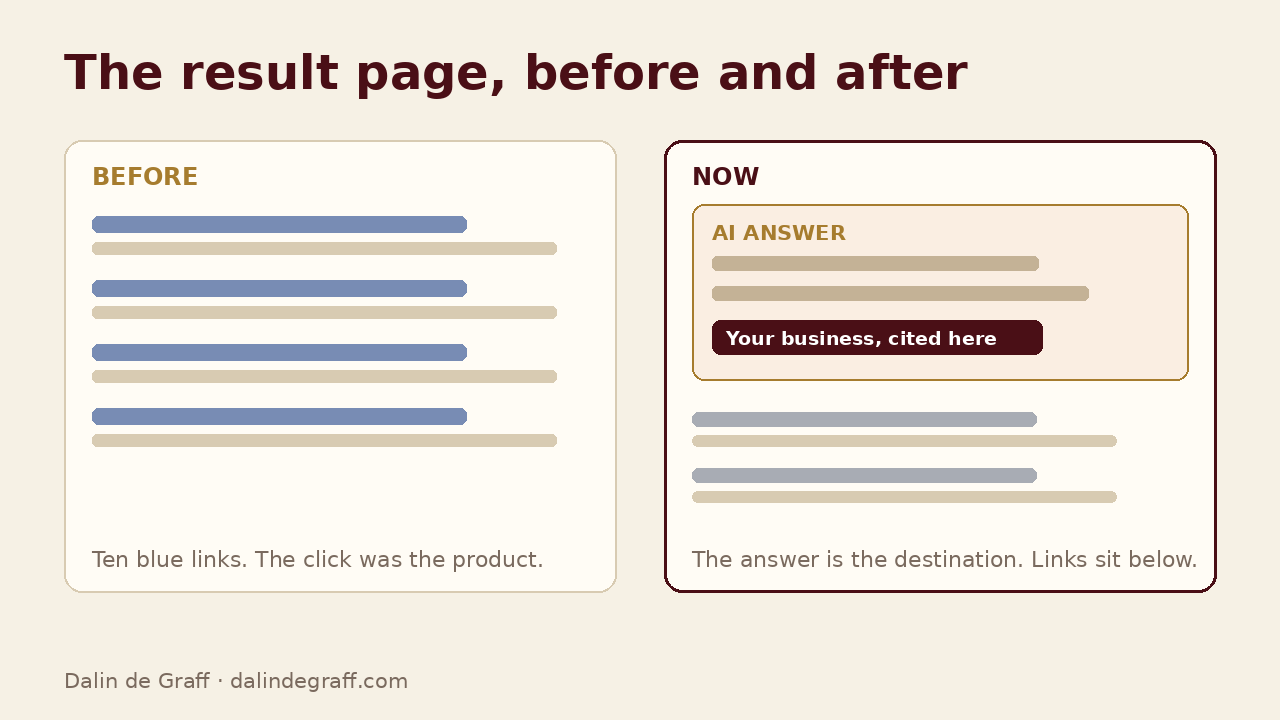
That is the shift I keep coming back to with clients. When I open AI Mode on a client's behalf now, I run the questions their customers actually ask and write down who the answer names, who it quotes, and where it sends the booking. Rankings alone tell you none of that. The click is becoming the leftover. The citation inside the answer is the shelf space now, the same way Reddit threads shape what AI says about a business while the visit never happens. Google is even wiring tasks and bookings into the answer itself (/blog/google-connected-apps-tasks-in-search), which tells you the answer is meant to be the destination, not the doorway.
So plan on the build being permanent. Be the source the answer is built from. Make your facts easy to lift, your name consistent everywhere it appears, and your reputation strong in the places the models read. Google is building the machine that answers your customers at a pace of $195 billion to $205 billion a year. The work now is making sure the machine answers with you in it.

About the author
Dalin de Graff is a digital marketing expert based in Winnipeg, Canada, with 9 years of experience across SEO, GEO, and AI search. At First Rank, he built the agency's GEO practice and leads its work on AI search and LLM visibility. His results include +311% organic clicks, +300% calls, and +98% AI search traffic in 30 days. He writes about search, AI, and marketing at dalindegraff.com.