Google Is Testing Writing Your Citation Card
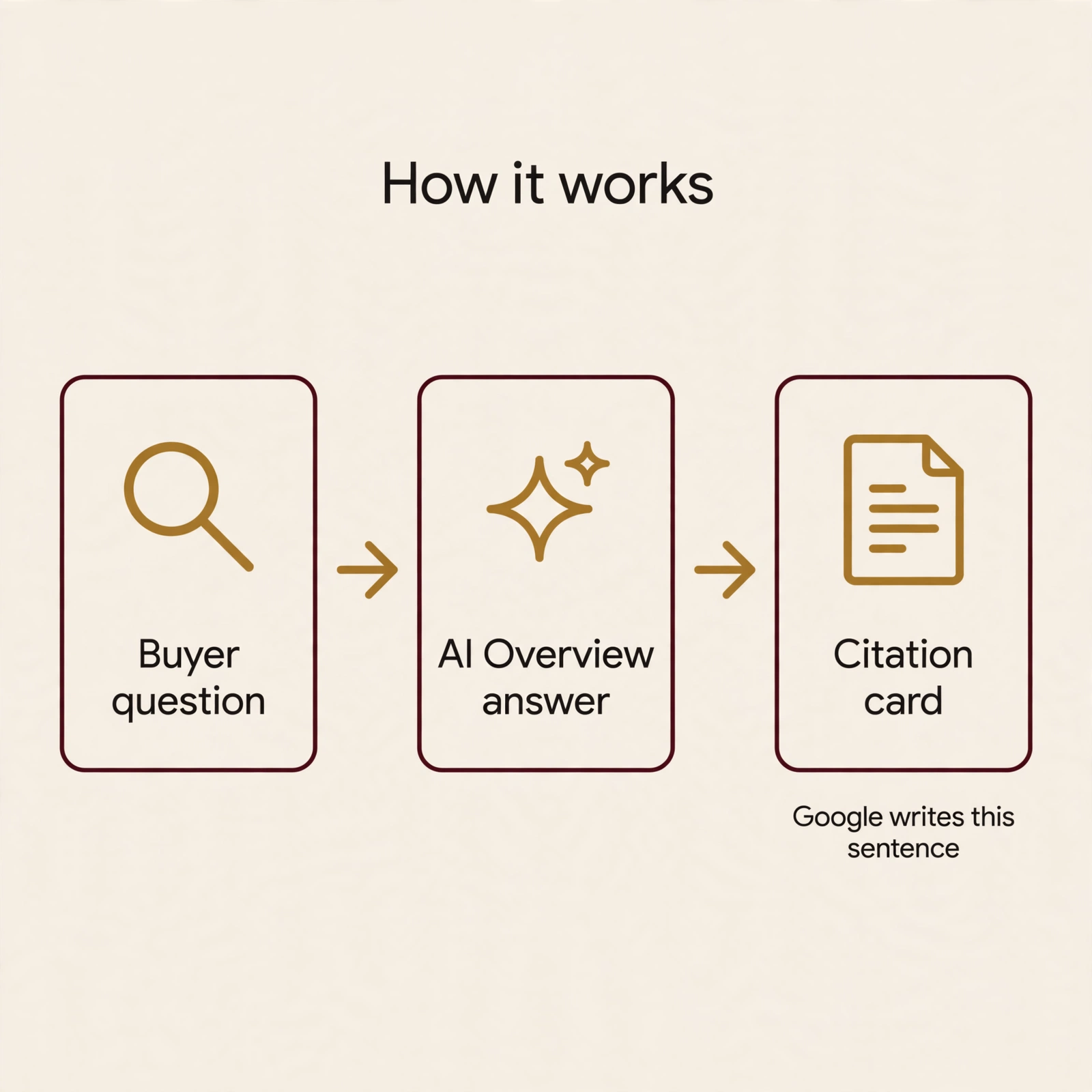
Google is testing AI-written summaries in AI Overview citation cards. Where the test appears, the sentence introducing your site is written per query.
The sentence introducing your site is no longer yours
On October 23, 2026, SEO consultant Brodie Clark spotted something new in Google's AI Overviews: the citation cards beside the answer had started showing text Google's AI wrote itself. Search Engine Roundtable's Barry Schwartz reproduced the behavior on some test queries the same day and reported it.
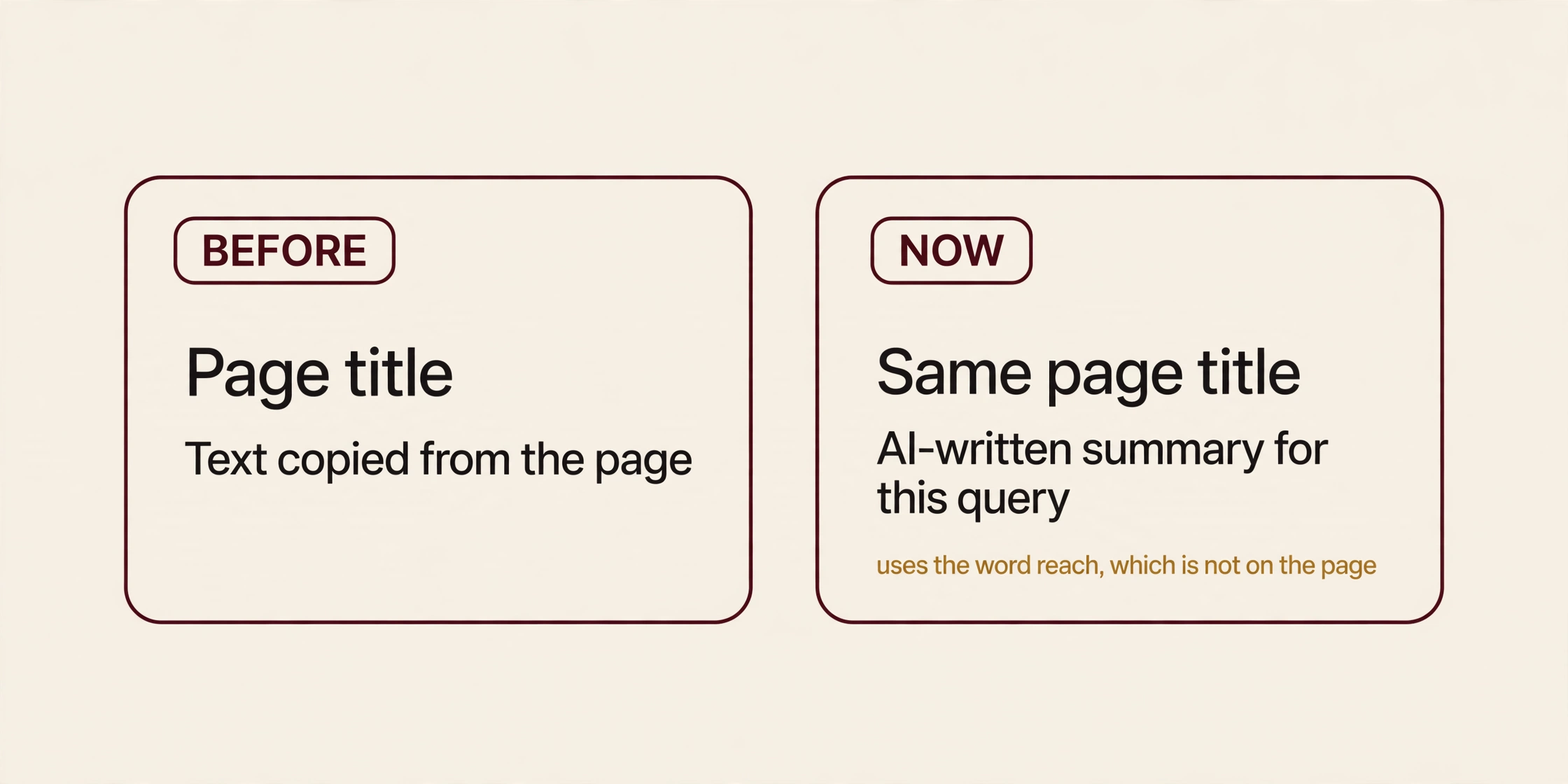
The card describing Clark's own homepage used the word "reach." That word does not appear on his page, according to coverage of the example he shared. It was a new sentence Google wrote for that query, in words his page never used.
Until now, the card text readers saw was normally drawn from the linked page. In the cases Clark and Schwartz documented, the last piece is replaced by a summary Google generates from what it thinks is most relevant about your page for the question being asked.
Search Engine Roundtable's report mentions no Google announcement for this test. Schwartz saw it on some queries and not others, so this is a test or a partial rollout, not a finished feature. Tests can vanish in a week, but the direction matches Google's other recent citation-surface changes.
The card itself is not guaranteed either
Five days later, Clark found something worse. On some queries, the citation cards were missing in his screenshots. His October 28 screenshots showed an AI Overview with its usual cards on one query and none on another, and he wrote that a drop in impressions could be explained by it. Schwartz could not replicate it and noted the card loaded later in his tests, raising the possibility of a bug rather than a deliberate removal; he asked Google's Rajan Patel whether it was a bug and had no answer at the time of writing. Clark then reported seeing it consistently across many test queries.
In one test, the card text is rewritten per query. In another, the card sometimes does not appear. Neither is confirmed as a rollout, and neither has been shown to happen to the same card. You cannot treat the card as stable inventory: it can carry different words for different queries, and may not appear at all for some, through no change you made to your page.
Separately, Google did announce link changes on October 15. In a post from Hema Budaraju, summarized in a November roundup, five changes to links in AI Mode and AI Overviews were listed: more inline links placed higher in answers, a test of a top section for the one or two official sites for a task, wider news carousels, image thumbnails on related-article links, and a test of clickable creator names on AI Mode video results, linking to Google Search profiles. Google gave no link counts, placement data, or click data for any of it. Search Console's generative AI report still shows impressions only, with AI clicks pooled inside ordinary Web search numbers. I covered that gap in my post on the 40% click loss: Google is redesigning the surface that sends you traffic with no way to measure what it does to your clicks.
What this means for a page you own
I run a fixed prompt panel every Monday for the clients I work with at First Rank: five money questions, four engines (ChatGPT, Gemini, Perplexity, Claude), logged in and logged out, repeated samples. I have not run a card-text check yet; it is the next column I am adding to that panel. I write up what the panel finds on dalindegraff.com.
For each question, write down what the citation card says about your page, then compare it against what the page says. If it invents a claim, softens a specific offer into a generic one, or describes a different service than the one the page sells, the page needs rewriting. A vague page gets summarized vaguely, and a page that buries its point risks a summary built from whatever Google judges most relevant, which may not be the point you would choose.
I learned this on a local campaign that grew calls 300% for a Winnipeg therapy clinic. The service pages that performed did not open with brand language or a mission statement. They opened with who the service was for and what it did, in the first two sentences: a specific claim, stated early. That is the kind of opening a summarizer has the most to work with, though I have not yet measured that transfer on a citation card. Where the test appears, the card does not quote the page, so the opening lines are the raw material for a sentence you will never get to approve.
If the card can disappear, a citation is not a traffic channel you can plan around; it is exposure that may or may not convert into a visit. That sits alongside my official-site box post, whose point was different: winning that box is an identity problem, making Google certain you are the official site, not a content-quality problem. The card check below is about the separate problem of what Google says about you once it does cite you.
The four-step card check
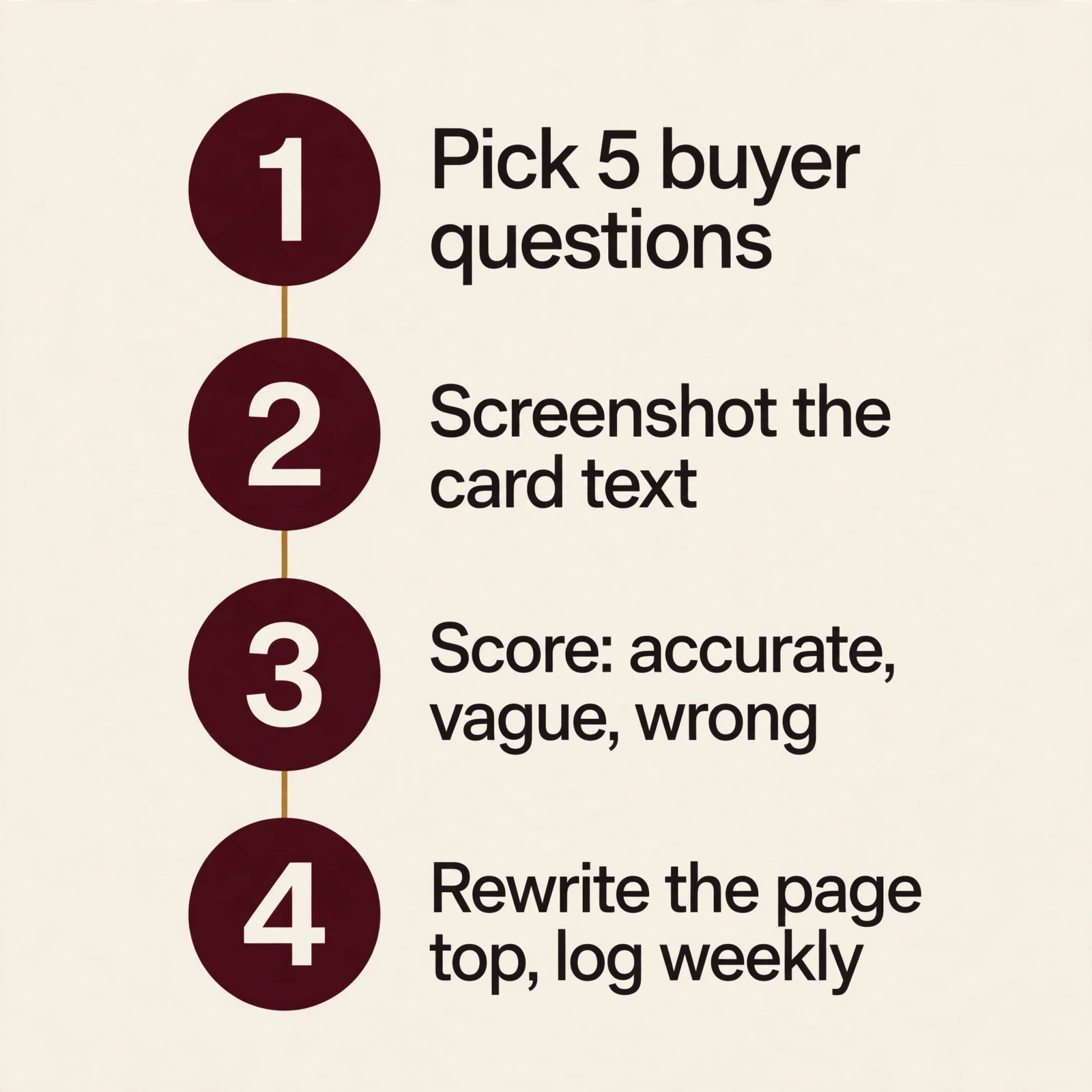
First, pick five questions your buyers actually ask, the ones tied to revenue rather than the ones you rank for. Run them through Google, open every citation card that names your site, and screenshot what each card says.
Second, read each card sentence against the page it links to. Mark three outcomes: accurate, vague, or wrong. Vague means the card describes a generic version of your offer; wrong means it states something the page does not support. Fix the page for both.
Third, rewrite the first two paragraphs of any page that scored vague or wrong: one sentence that says what the page is about and who it is for, then the specific claim or offer, then the supporting detail. The summarizer works from what Google judges most relevant, so putting the point first gives it its clearest candidate material.
Fourth, repeat the check weekly and log it. Card text changes per query and the card may or may not appear, so a single check is a snapshot. A four-week log tells you whether your rewrite moved the card text and whether the card shows up for the questions that matter.
Stop polishing the sentence you no longer own
Meta descriptions were the closest thing to a sentence you wrote for searchers, and even those were often rewritten. The citation-card test extends that loss of control inside AI Overviews. The sentence a searcher reads about your site in these tests is written by Google, for their query, from your page, and it can change or vanish without notice.
Move the work to the page itself, the one place it still pays. Write the first two paragraphs so clearly that any summary of them comes out accurate. Then check the card every week and fix what it gets wrong at the source.
Check what the card says about your site this week. If it is wrong, the fix is on your page, not in your meta description.

About the author
Dalin de Graff is a digital marketing expert based in Winnipeg, Canada, with 9 years of experience across SEO, GEO, and AI search. At First Rank, he built the agency's GEO practice and leads its work on AI search and LLM visibility. His results include +311% organic clicks, +300% calls, and +98% AI search traffic in 30 days. He writes about search, AI, and marketing at dalindegraff.com.