ChatGPT Sends 0.6% of Google's Traffic. And Converts 4.5x Better.
Marie Haynes studied 145M sessions: ChatGPT sent 0.62% of Google's traffic, but converted at 13.8% vs 3.02%. What both camps get wrong about the data.
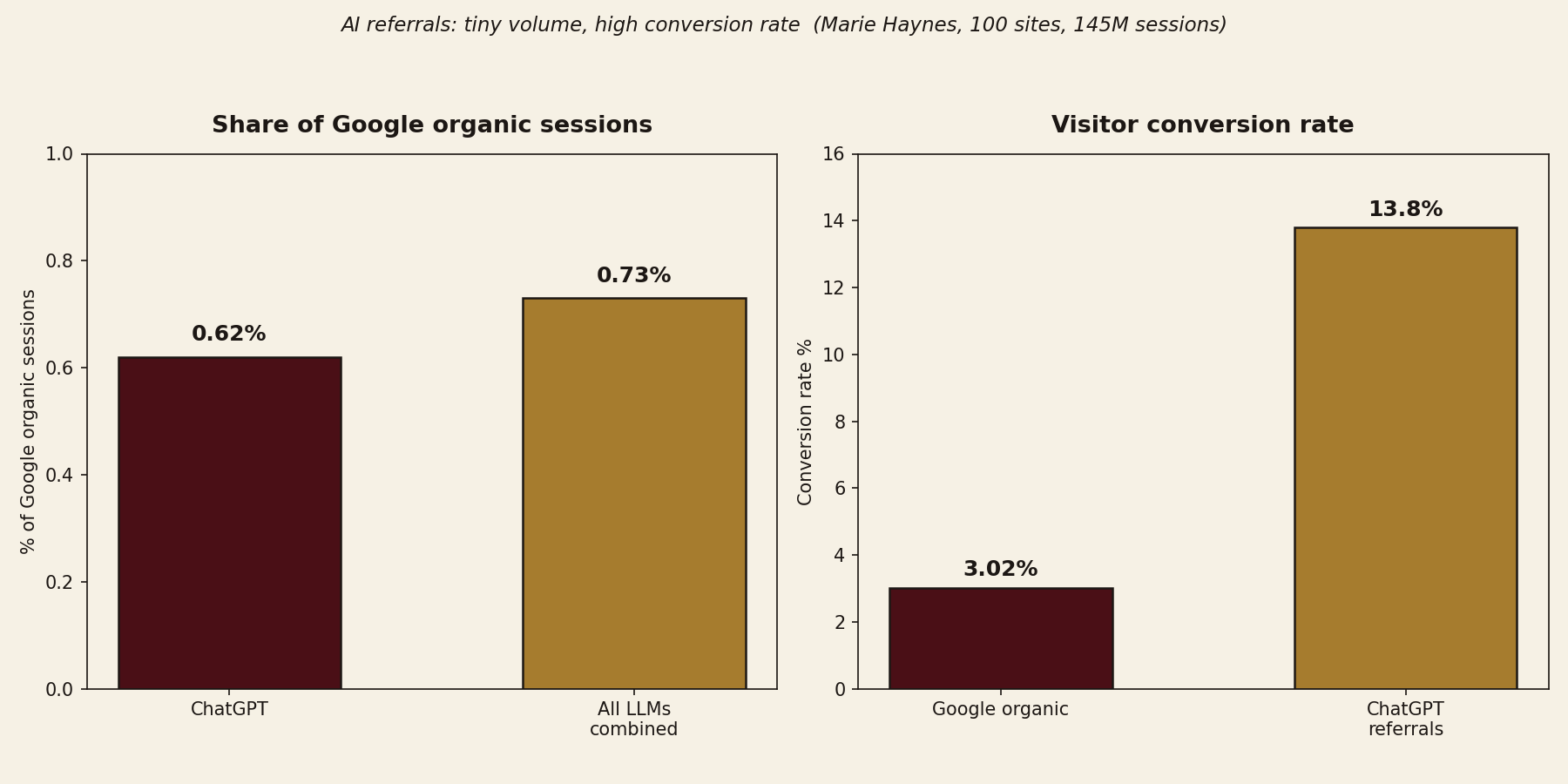
Marie Haynes just published the largest AI-referral dataset I have seen: 12 months of GA4 data, 100 websites, more than 145 million sessions. The headline number: ChatGPT sent 0.62% as many sessions as Google organic search. She called GEO "a distraction," and the 0.62% is being quoted as proof AI search sends no traffic.
The 0.62% is real. It is only half the study, and the half that tells you least about what to do.
Search Engine Land reported the findings this week, and the numbers deserve a slower read:
ChatGPT drove 0.62% of Google organic's sessions. All LLM referrals combined reached 0.73% of Google organic sessions, not of total site traffic.
The conversion picture, from the 55 sites that tracked conversions: ChatGPT visitors converted at 13.8%, Google organic at 3.02%. More than 4.5x the rate. Google organic drove roughly 27x as many conversions as all LLMs combined, and 96.5% of all conversions in the dataset.
Haynes' own summary line: "The AI search that is actually sending people to businesses today isn't ChatGPT. It's Google."
The 0.62% answers the volume question. It does not answer the value question.
Volume and conversion efficiency are different measurements. This study is the cleanest side-by-side comparison of both the industry has gotten, and the volume half gets all the quotes.
Do the per-session math. One hundred ChatGPT-referred sessions produced roughly the conversions of four hundred and fifty Google organic sessions. The volume still loses by roughly 27x, so nobody should read this as "abandon SEO for GEO." But if you are building an ROI case for citation coverage, the relevant unit is conversions per session. On that unit, ChatGPT referrals are the most efficient channel in Haynes' sample by a wide margin.
Two studies published the same week complicate the efficiency story. SEO Works measured 95 GA4 properties: organic search sent 39 times more traffic than AI assistants. On conversions, AI referrals ran at 7.18% against 6.08% for organic, about 1.2x, but converted worse than organic on 23 of 63 sites, and at 0.62x organic on B2B product sites. Against other channels, AI referrals converted 2.48x better than direct traffic and 0.67x worse than paid. One summary of all three studies puts the disagreement down to samples and definitions: Google organic converted at 3.02% in Haynes' dataset and 6.08% in SEO Works'. Kevin Indig, across 12 mostly-B2B sites, found no reliable link between AI visibility and later branded search or direct traffic, with his own caution: "An effect could still exist. I just couldn't isolate it." Three datasets agree on tiny volume. On efficiency, it depends on the sample.
What the referral count misses
First, referral counts undercount AI-driven visits. I wrote last week about how ChatGPT's UTM tags disappeared with GPT-6: the rollout stripped utm_source=chatgpt.com from outbound links, and Adobe's data showed Direct rising on two out of three pages as the ChatGPT numbers fell. That was a measurement break. Some unknown share of AI-driven visits now sits inside Direct in GA4. How much that touches Haynes' 0.62% depends on a detail she did not publish: the exact reporting window. Either way, the 0.62% counts referrals, and referrals are the leakiest unit in the dataset.
Second wrinkle: clicks from Google's AI Overviews count as ordinary organic visits in GA4, so the 3.02% Google organic conversion rate is itself partly AI-assisted.
The visits that do arrive behave differently. As bryn put it, the AI visitor arrives late, checking what an assistant already told them. The click lands on the shortlist, after the research is done, which explains the 13.8% and decides which pages you want cited: the ones that close.
Finally, the industry barely measures conversions at all. Forty-five of the 100 sites in Haynes' sample tracked no conversions. Most teams can tell you their AI referral session count. Very few can tell you their AI referral conversion rate. The channel looks like a traffic curiosity because nobody built the measurement to see it as a revenue channel.
Search Engine Land flagged the gaps: no exact reporting dates, no industry mix, no conversion definitions. It is the best dataset available, with real holes. Haynes also reported that ChatGPT referral growth stopped its exponential climb in August 2025 and declined afterward. Whatever AI search becomes, its traffic version has been shrinking for over a year.
What I am doing about it
At First Rank, the GEO campaign that grew LLM search traffic 98% in 30 days runs on a fixed prompt panel: the same money questions, four engines, logged in and out, on a schedule, scored on recurrence. A dashboard measuring citations alone would have shown the GPT-6 UTM break as a traffic drop. A panel logging cited pages plus a GA4 AI Assistant channel measuring conversions per session shows what happened.

Here is the protocol I would hand any team this week:
Track one key event first. Forty-five of Haynes' 100 sites tracked nothing. Pick one conversion that matters and segment it by the AI referral channel. Haynes' advice, as one writeup of the three studies summarizes it, was to track conversions and spend more effort on user satisfaction than on optimizing for machines.
Judge AI traffic in revenue per session, not sessions. The 4.5x rate is the unit that makes citation coverage defensible: 100 ChatGPT sessions a month are worth roughly 450 organic sessions in conversions, with the usual caveat that "conversion" meant different things across the 55 sites. That line belongs in the budget meeting.
Fix the plumbing you control. Gemini still sends UTM parameters, so the GA4 channel works there today. ChatGPT's broke with GPT-6, so your Direct channel carries AI-driven visits you cannot see. Separate what you can, and treat AI-referral counts as understated.
Keep the Google work. Nothing here argues for moving budget from SEO to GEO. Google drove 96.5% of conversions. Treat AI citation coverage as a layer on top: it raises the quality of the visits the answers send, while Google keeps sending the volume.
The traffic AI search sends converts at a rate nothing else in Haynes' dataset touches. Most teams cannot see it because they track sessions instead of revenue, and the referral count itself leaks into Direct. This is a measurement problem with a playbook attached. Build the measurement first. The citation work follows.
I publish these breakdowns on dalindegraff.com, where I write about search, AI, and marketing from the agency floor at First Rank.

About the author
Dalin de Graff is a digital marketing expert based in Winnipeg, Canada, with 9 years of experience across SEO, GEO, and AI search. At First Rank, he built the agency's GEO practice and leads its work on AI search and LLM visibility. His results include +311% organic clicks, +300% calls, and +98% AI search traffic in 30 days. He writes about search, AI, and marketing at dalindegraff.com.