
Google Wrapped Your Organic Clicks in Its Own Redirect
Google now routes organic clicks through its own /goto redirect. Rank trackers need 500-1,000 requests per query. Anchor your reporting on GSC.
Hover over a Google search result and check the URL your browser previews. It is not the publisher's address. It is google.com/goto?url=... plus an encoded token; clicking routes your browser through Google's servers first.
Google has been expanding this redirect layer across its results. Vendors say some tracking systems now need 500 to 1,000 requests to resolve the URLs behind a single results page (https://teckhustlers.com/google-goto-redirect-seo-tracking-impact/).
What the redirect is
In late July 2026, SEOs noticed destination URLs disappearing from result links, replaced by google.com/goto server-side redirects. By late August, Nozzle's Derek Perkins confirmed near-100% rollout across US residential IPs (https://susodigital.com/thoughts/googles-goto-redirect/). Early reports showed the wrapper on logged-out but not logged-in searches (https://blog.on-page.ai/googlecomgoto-live-black-box-serp-breaks/).
The token is protobuf-like and undecodable locally, so the only way a tool learns where a result points is to request the /goto URL and follow the 302 redirect (https://thatware.co/google-goto-redirect-wall-search-scraping/). The hop was confirmed as a 302 on paid and organic listings in early July (https://blog.on-page.ai/googlecomgoto-live-black-box-serp-breaks/).
Trackers used to read destination URLs straight from the SERP HTML. Now every keyword tracked requires following a redirect chain through Google's servers to retrieve a URL the tool used to get for free. Google does not allow HEAD requests through. Nozzle's figure: 500 to 1,000 HTTP requests to resolve the links on a five-page ranking check, compounding per keyword, per check, per tool (https://susodigital.com/thoughts/googles-goto-redirect/).
None of this reorders the index. It changes who can observe the click.
Last week I wrote about the three weeks your rank tracker went blind in September (https://dalindegraff.com/blog/rank-trackers-broke-september-2026). That was the collection break. This is the click break, the same wall on the other side.
What it breaks
Rank tracking economics. As of September 1, vendors were scrambling at different speeds. SE Ranking and Semrush said they were unaffected; SE Ranking says it resolves the destination URL without touching the redirect, generating no artificial clicks. Ahrefs acknowledged a temporary data inconsistency. SerpAPI confirmed impact across several products, including its AI Overview API. Nozzle raised the alarm earliest (https://susodigital.com/thoughts/googles-goto-redirect/).
GA4 attribution. The redirect inserts a hop between the SERP and the destination. When a redirect strips the HTTP referrer header, GA4 has no organic signal to read and reclassifies the session as (direct)/(none). Organic drops, direct ticks up, and nothing in the platform flags an error. It looks like a trend.
Meanwhile Search Console keeps reporting accurately, because it counts at Google's end when the result is clicked. So GSC shows steady clicks while GA4 organic falls. The hop stays on google.com, so browsers typically keep it as the referrer, and no referral loss has been confirmed yet (https://blog.on-page.ai/googlecomgoto-live-black-box-serp-breaks/). A referrer-policy change on the /goto page would flip that silently, which is exactly when you want the baseline built, not after (https://susodigital.com/thoughts/googles-goto-redirect/; https://www.batterseawebexpert.com/blog/google-goto-urls/).
AI citation tracking. In early September, Peec.ai's Metehan Yeşilyurt documented /goto URLs appearing as cited sources directly inside ChatGPT, Claude, Perplexity, and Copilot. When those engines use Google for retrieval, they now pull /goto links from results, sometimes passing them through as citations without resolving them first (https://susodigital.com/thoughts/googles-goto-redirect/).
If a brand is cited but the citation points to google.com/goto/... instead of its domain, every tracker matching on domain sees nothing. The brand has AI search visibility and the data does not reflect it. DataForSEO's August 27 numbers show the scale: it resolves /goto URLs on 99.99% of organic SERPs, but 52.26% of AI Overview SERPs and 25.1% of local-pack SERPs still carried at least one unresolved /goto URL (https://blog.on-page.ai/googlecomgoto-live-black-box-serp-breaks/). Whether AI engines pass those through as citations is not confirmed at scale, and no major AI visibility platform has commented publicly.
It pairs with this week's news: ChatGPT's UTM tags disappeared with the GPT-6 rollout, pushing ChatGPT traffic into the Direct bucket (https://dalindegraff.com/blog/chatgpt-utm-tags-disappeared-gpt6). Measurement is breaking at both ends: AI engines strip your tags on the way out, and Google wraps your clicks on the way in.
A pattern, not an incident
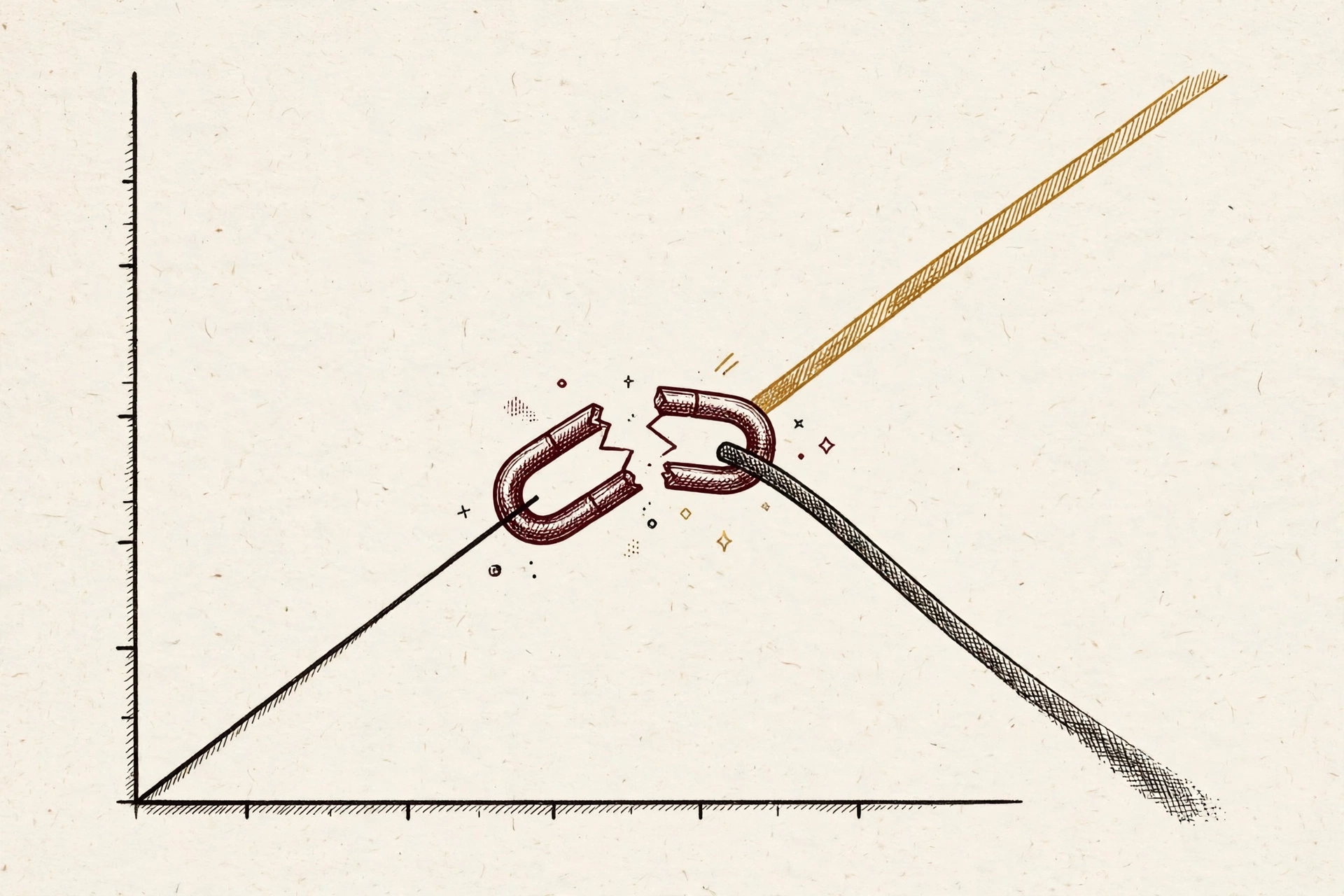
The /goto redirect is the third move in a sequence, and the sequence points one way.
In September 2025, Google removed the &num=100 parameter, forcing ten requests where one worked. In December 2025, Google sued SerpAPI under the DMCA over scraping; a federal judge dismissed the original complaint in July 2026, and Google amended its filing in August with licensing language restricting third-party extraction. Now the redirect sits at near-full rollout (https://susodigital.com/thoughts/googles-goto-redirect/).
The lawsuit is the legal prong, the redirect the technical prong. Each step makes SERP data more expensive to retrieve and harder to access without Google's cooperation. Google's statement on the change: "We have a long history of deploying technical measures against evolving forms of abuse." Abuse is Google's word; scraping is the practical reading it did not say (https://www.shahidali.co/blog/google-com-goto-in-search-results/).
Tools adapted after the num=100 removal and will adapt here too, inside infrastructure Google designs: Google controls the data layer, and every tool that reads it does so on Google's terms.

What I am doing about it
At First Rank (https://firstrank.ca), our rule: any ranking movement that does not move GSC clicks or impressions is instrumentation, not a result. That rule verified our +311% organic clicks e-commerce win: when the tracker said one thing and the clicks said another, the clicks were right every time.
Baseline the ratio before you need it. Pull GSC clicks against GA4 organic sessions for August, before full rollout, as your reference point. Flag drift in September and October. If organic falls in GA4 while GSC clicks hold, you are looking at a measurement problem, not a traffic problem.
Check your server logs. Look for google.com/goto in your referrer headers to see how your stack handles the hop.
Ask your vendor directly, in writing. SE Ranking and Semrush have said they are unaffected. Ahrefs has said it is working through a temporary inconsistency. If your provider has said nothing, that is not a clean bill of health. Ask your account contact what their /goto resolution looks like. A vendor transparent about temporary data issues is more trustworthy than a silent one.
Fix citation audits at the URL level. My fixed prompt-panel method already logs citations per engine, per question, logged in and out, with recurrence scoring. It needs one more step: resolve /goto URLs before counting. A citation pointing to google.com/goto/... is your brand getting cited while your tracker records nothing. Domain-level matching misses it. URL-level resolution catches it.
Frame the anomaly before the client does. If organic looks soft in August and September reports, the person who names the cause first controls the conversation. "Google wrapped its result links in a redirect that is degrading third-party measurement; your GSC clicks are steady" beats a client asking why the numbers stopped adding up.
Search Console counts a click at Google's end, when the result is clicked. The /goto hop makes Google the first stop on every organic click, giving it a cleaner click signal than ever. Plan your reporting stack around that asymmetry, because the legal and technical pressure is pointing the same way. Anchor on GSC, verify in server logs, and keep your vendors honest in writing.
I publish these breakdowns on dalindegraff.com, where I write about search, AI, and marketing from the agency floor at First Rank.

About the author
Dalin de Graff is a digital marketing expert based in Winnipeg, Canada, with 9 years of experience across SEO, GEO, and AI search. At First Rank, he built the agency's GEO practice and leads its work on AI search and LLM visibility. His results include +311% organic clicks, +300% calls, and +98% AI search traffic in 30 days. He writes about search, AI, and marketing at dalindegraff.com.