Half of Commercial Searches Now Open With an AI Answer
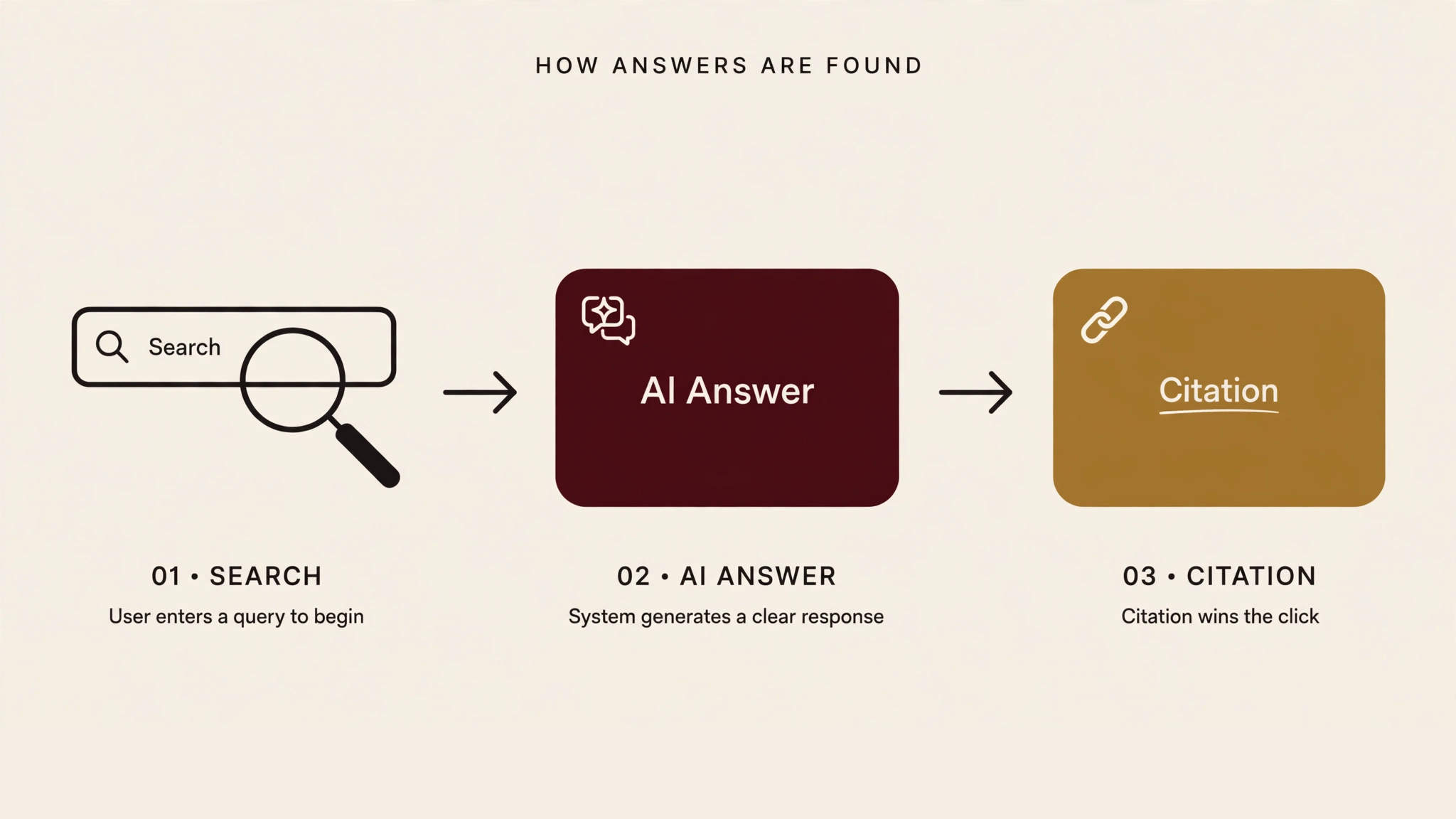
AI Overviews open 51% of commercial searches. Rank one is no longer the job. Winning the citation inside the answer is the job now.
A year ago, about one in four commercial Google searches opened with an AI Overview. Today it is one in two. That is the headline number in DataForSEO's Search Insider 2026 report, published October 29, 2026, on 190 million keywords and 165 million AI answers in US English. Commercial searches are where buyers compare options, and the comparison now happens inside Google's answer.
I read that as the end of rank one as the asset. The citation inside the answer is the asset now.
The click math
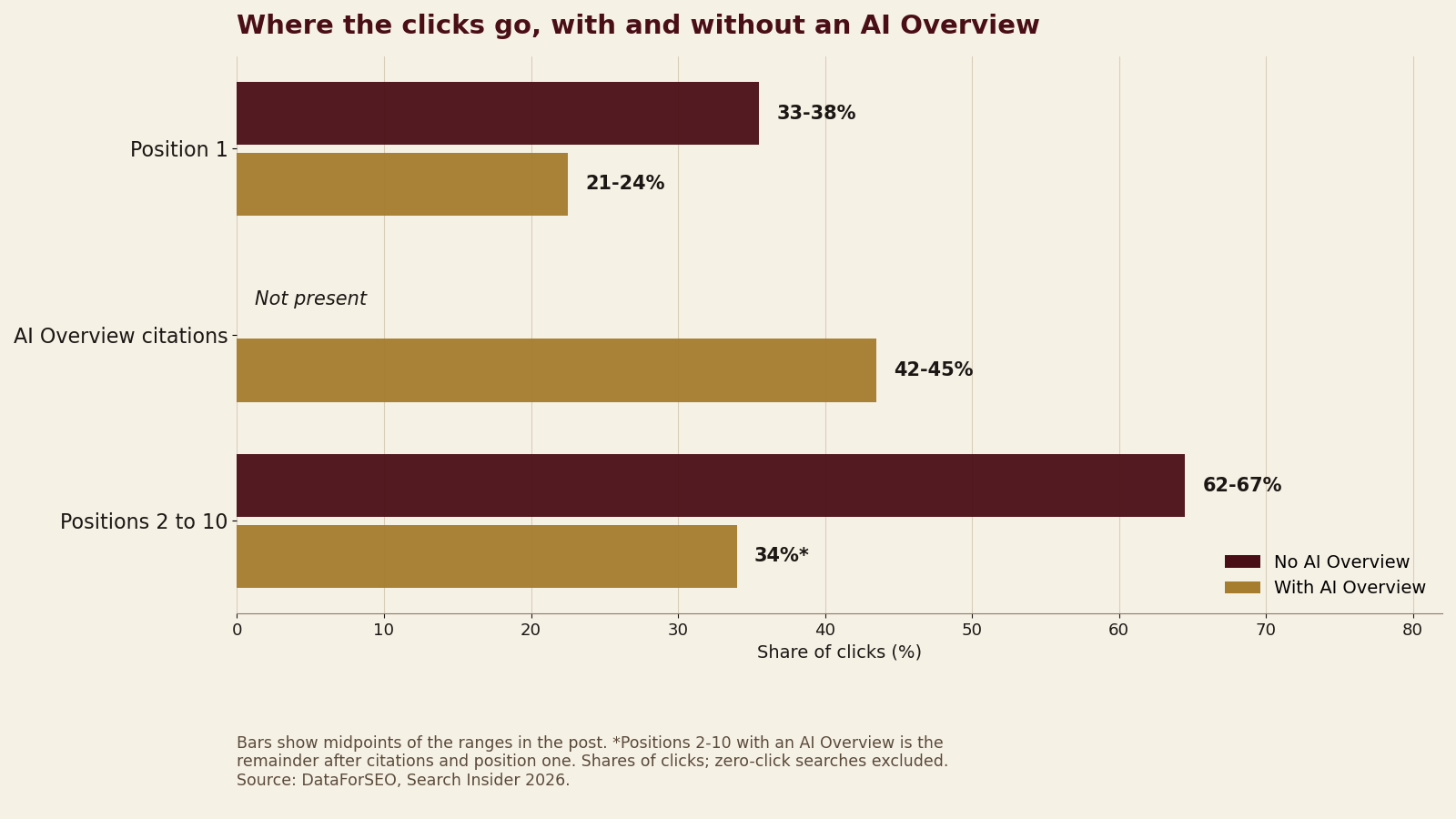
The report models where clicks go with and without an AI Overview, from clickstream data. The estimates are modeled, not observed clicks.
| No AI Overview | With an AI Overview | |
|---|---|---|
| Top organic result | 33 to 38% of clicks | 21 to 24% of clicks |
| AI Overview citations | Not present | 42 to 45% of clicks |
| Positions 2 to 10 | 62 to 67% of clicks | Lose 36 to 42% of it |
Shares are of clicks on pages where a click happens. Zero-click searches are excluded.
The raw click-through rates show it. Across more than 2,000 sites, desktop click-through for position one fell from 17.8% to 7.4% between September 2025 and August 2026, and position two fell from 15.3% to 3.1%. Mobile held up better, position one going from 25.2% to 20.8%. The report does not pin the whole drop on AI answers, and neither do I.
AI Overviews appeared on 5.9% of US Google results in September 2024, and 61.4% by August 2026. Informational searches trigger an answer 70% of the time, up from 48%; transactional searches went from 11% to 29%.
One caveat: the click and SERP figures are US English data, and only the backlink data is global, so use the direction.
There is no hiding place in the long tail
The first reaction I hear is to retreat to smaller, easier, cheaper keywords. Keywords with 201 to 300 searches a month trigger an AI Overview 59% of the time, against 49% for keywords with 601 or more. Mid-difficulty keywords trigger one about 65% of the time, against 54% for the hardest. Searches costing advertisers $5 or more a click trigger an answer 50% of the time, against 51% for searches costing a quarter or less. Low volume, low difficulty, and low cost do not mean low AI exposure.
Take a commercial query like "best payroll software for small business." Across pages like this, the modeled average is that the citation links inside the answer take 42 to 45% of the clicks, and position one keeps 21 to 24%. Positions two through ten split what is left.
The industry spread shows it. Health results carry an answer 70% of the time, finance 69%, retail 43%, real estate 22%. The average is 57%, and overall presence is still rising, so a low number now is a timetable.
The answer cites someone else
The report answers a question clients keep asking. Who gets cited instead of us? For AI Overviews, the most cited domains are YouTube, Reddit, Facebook, Wikipedia, Google itself, Instagram, and Quora. Six of the top ten are video, social, or community. Reddit alone appears in the top ten organic results for 32% of searches, nearly eight times Quora.
The citation a buyer reads often comes from a YouTube video, a Reddit thread, or a review site. Those channels are now part of search work. ChatGPT leans toward reference sites, and 27% of its answers cite no source at all, against under 1% of AI Overviews.
One old signal still holds. Sites ranking first have a median of 111 referring domains, against 85 for positions four through ten. Separately, the report finds only a moderate correlation between referring domains and AI citations, and stresses association, not cause.
The loss is inside Google, not in the chatbot
Two studies this week measure the other channel, and both point the same way. Leadfeeder, studying 1,200 B2B sites, found AI referrals are 1.8% of combined AI and organic visits, flat since mid-2025 while volume grew 3.1 times from January 2025 to July 2026. SEOcrawl AI, across 16,000 sites, found AI assistants send about 1.25 visits per 100 Google organic visits, while Google organic clicks fell 15% year over year. SEOcrawl also warns much of that traffic goes undetected, with ChatGPT app visits logged as direct and AI Overview clicks recorded as organic.
The chatbot is still a small referral channel. The click loss the DataForSEO data shows is happening inside Google's own results, and the chatbot channel is too small to explain it. That is why my budget moves toward the answer on the Google result page, where the clicks already went.
The four moves
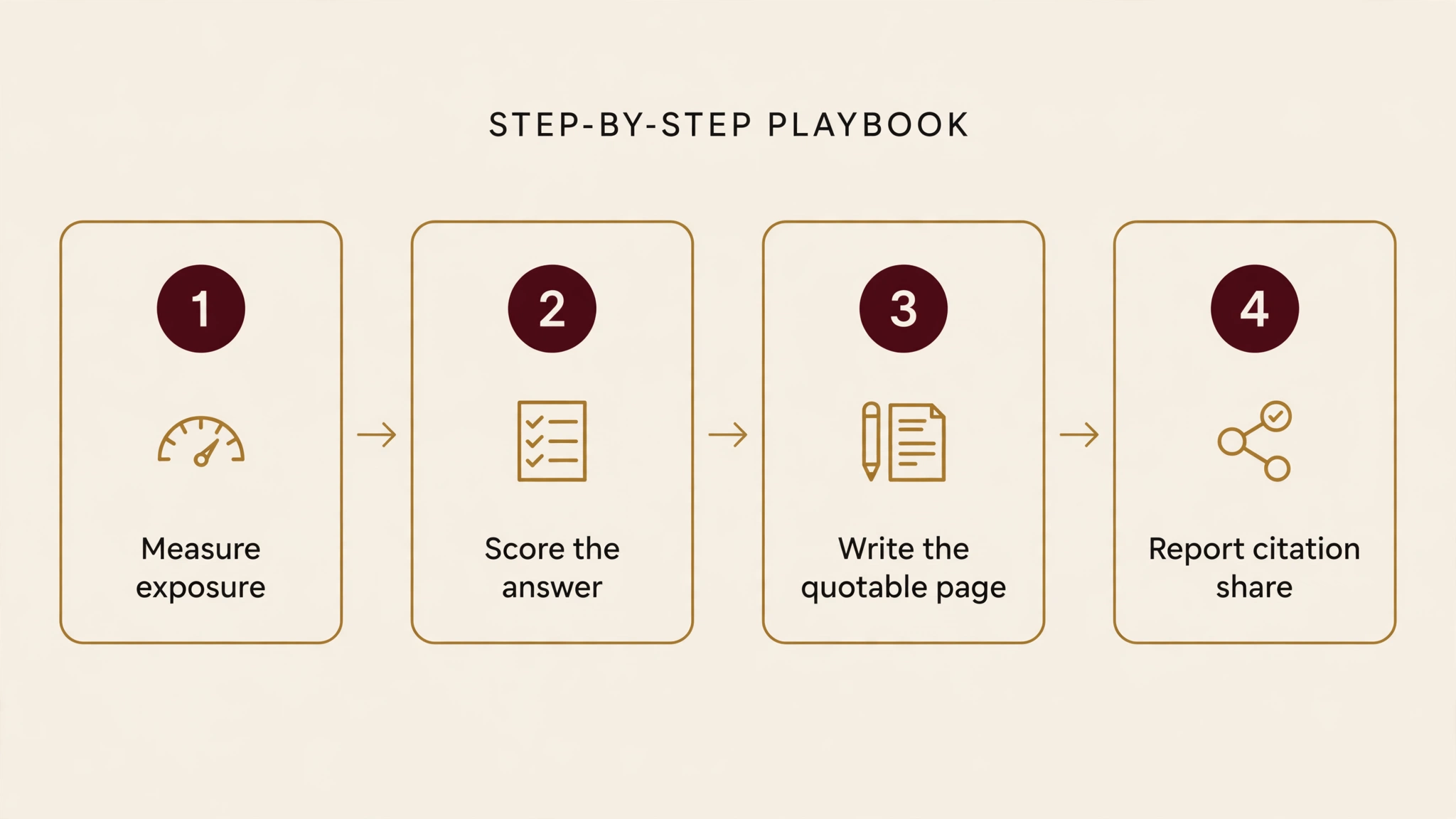
1. Measure your own exposure. Pull the top 20 commercial queries from Search Console, open each result page, and count: does an AI Overview appear, is the brand cited, and who holds the citations instead. I run the same check with the buyer questions for the brand across ChatGPT, Gemini, Perplexity, and Google AI Mode, three samples each, in a clean logged-out session. One afternoon gives a brand its citation rate, and that rate sets the priority.
2. Score the answer, not the page. For each buyer question I log one of three states: the brand is missing from the answer, described by someone else, or quoted in its own words. That three-state check is the one I have run on client sites since October, and it tells me where the work goes. Missing needs a page. Described by someone else needs a better page. Quoted in its own words needs nothing.
3. Write the page the answer can quote. An AI Overview cites a source for almost every answer. The pages that move a brand from described-by-others to quoted-in-its-own-words state a price, a limit, or a process as a plain fact on the page itself, in words the answer can lift verbatim. Generic comparison copy earns no citation.
4. Report citation share next to rank. Rank, citation, and mention are three different views of whether a customer can find a brand. I have written before that Google's AI still runs on rankings. Victorious's Q3 2026 tracking puts it at 37% of AI Overview citations ranking in the top ten. Rank one still helps, feeding the answer about a third of the time. Most citations come from outside the top ten, so rank alone cannot be the plan. But the client report now needs a second column, showing how often we are cited on the queries that open with an answer. Report citation share next to rank, and the gap between the two is the work.

About the author
Dalin de Graff is a digital marketing expert based in Winnipeg, Canada, with 9 years of experience across SEO, GEO, and AI search. At First Rank, he built the agency's GEO practice and leads its work on AI search and LLM visibility. His results include +311% organic clicks, +300% calls, and +98% AI search traffic in 30 days. He writes about search, AI, and marketing at dalindegraff.com.