OpenAI Says ChatGPT Is a Fifth of Google. Do Not Put That Number in Your Deck Yet.
OpenAI says ChatGPT runs a fifth of Google's searches. The published arithmetic does not close, so measure your own AI referrals instead.
OpenAI Says ChatGPT Is a Fifth of Google. Do Not Put That Number in Your Deck Yet.
On November 2, at a dinner OpenAI hosted in New York, ChatGPT consumer product lead Adam Fry told journalist Alex Kantrowitz that ChatGPT's volume of search-like queries is now roughly one-fifth of Google's. Kantrowitz published it November 3 in Big Technology, and it has since been repeated as if it were a market share. It is a vendor claim about a definition OpenAI has not published the arithmetic for, and the published numbers around it do not add up cleanly enough to plan on.
A ratio with no published denominator cannot support a budget line. I run a fixed panel of money questions every Monday across ChatGPT, Gemini, Perplexity, and Claude, logged in and logged out, for the GEO work I do at First Rank. I write up what the panel finds on dalindegraff.com. That panel is my measurement.
What Fry counted
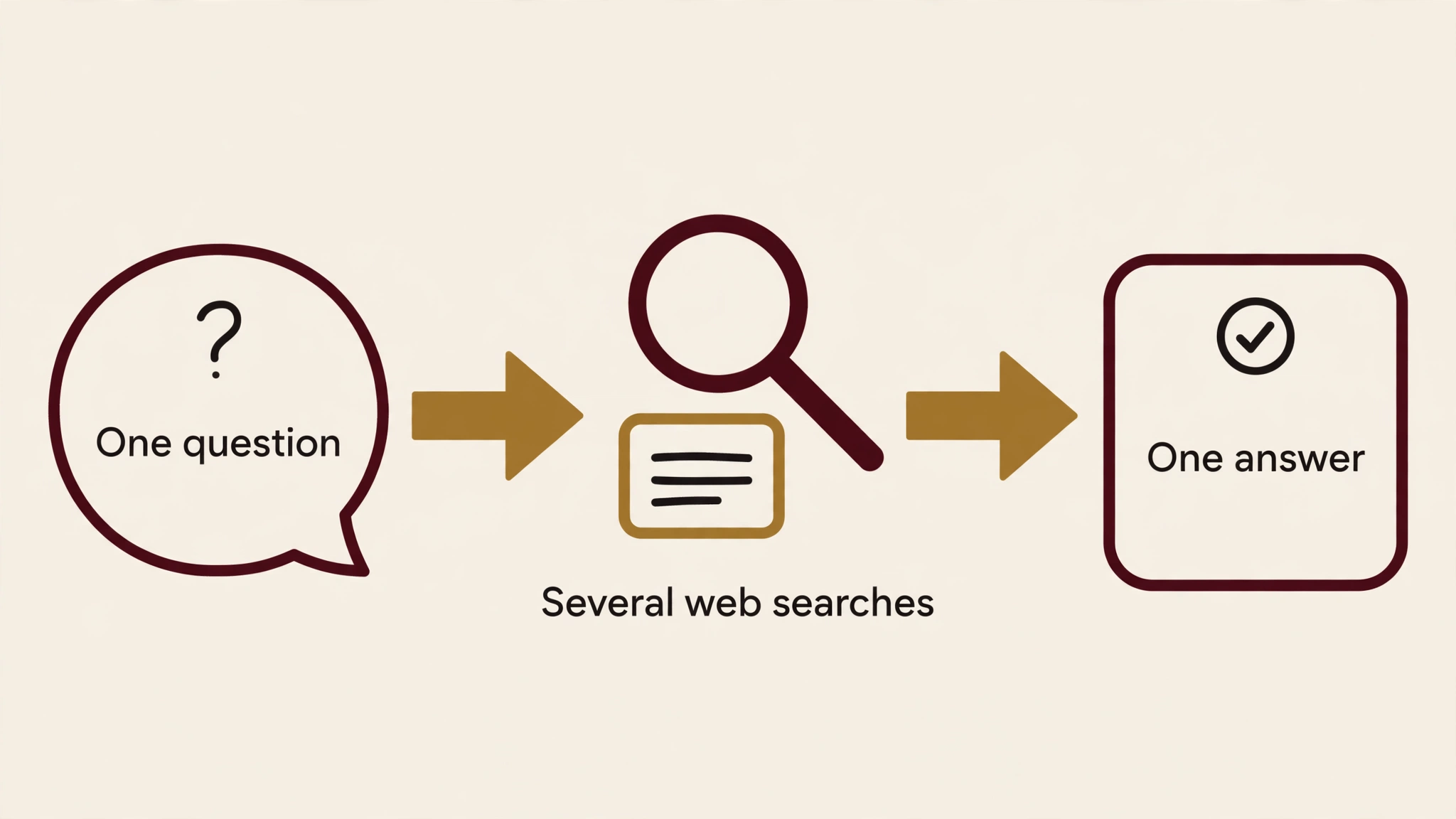
Fry defined a search as a question that sends ChatGPT to search the web: a question that needs up-to-date information. Every web search run in response to a question counts as one search, so a single conversation can add several.
The arithmetic does not close on published numbers
Google said in a March 2025 blog post that Search handles more than 5 trillion searches a year, based on internal data from January 2025. That converts to at least about 13.7 billion searches a day, so 20 percent implies at least about 2.74 billion search-like queries a day on that stale denominator. Alphabet said query growth was the fastest in five years in October 2026, without a count, so a current denominator would imply more.
A September 2025 NBER working paper put July 2025 ChatGPT at 700 million-plus weekly users and 18 billion messages a week, about 2.57 billion a day, consumer plans only. Against that July total alone, 2.74 billion would exceed it. But that total is 16 months old, and Fry put weekly users at 1.2 billion, about 1.7 times the July figure. Scaling July volume by users alone gives about 4.4 billion messages a day, so 2.74 billion would be about 62 percent of that scaled total, not above it. Without a November total, the July figure cannot refute the claim; it only proves the test total is unpublished.
The closest direct test is Semrush's US clickstream finding: ChatGPT ran a web search in 34.5 percent of queries in February 2026, down from 46 percent in late 2024. That rate is US-only and session-based, so it cannot be applied worldwide, but it is an execution rate, the measure Fry's definition requires. The NBER paper's 24 percent figure covers conversations, not messages, seeking information in July 2025, so it cannot be multiplied by a daily message total; information seeking is a purpose category, not a web-search count.
SparkToro and Datos (2024, March 2025) put search-like usage at up to 37.5 million a day, about 0.27 percent. Peec AI, July 2025 data, put information-seeking at about 4.3 percent. Ahrefs (July 2025, February 2026) estimated 65 percent of prompts as search-equivalent, 12 percent of Google's volume, 18 percent counting all prompts. OpenAI's November 2026 figure is about 20 percent.
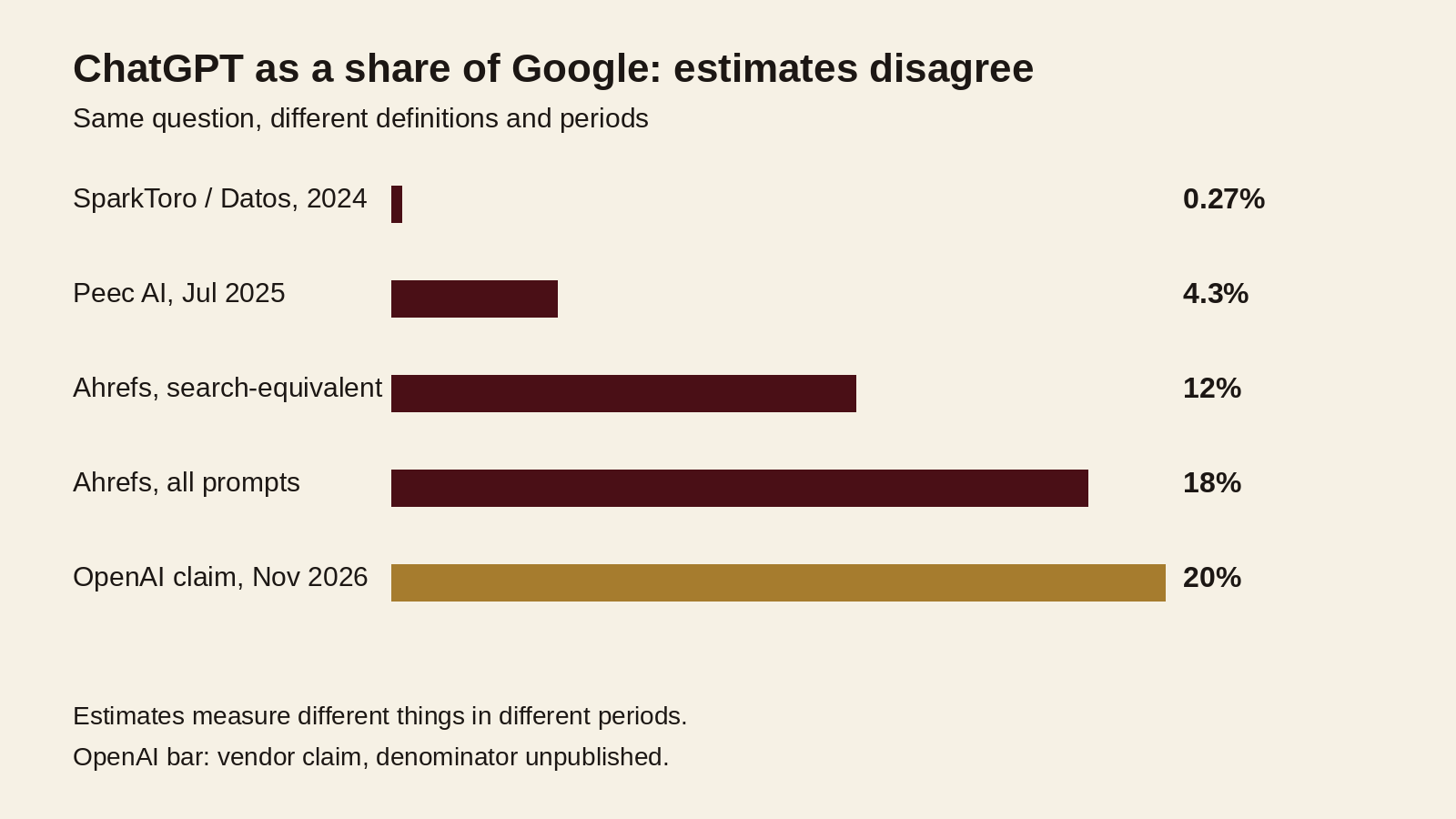
Across non-comparable studies and definitions, the estimates span a 0.27 percent upper-bound 2024 figure to OpenAI's roughly 20 percent for November 2026: a 74-fold spread between endpoints that never measured the same thing, not growth of 74 times, not a confidence interval. On July 2025 data, counting every prompt reached about 18 percent of Google's January 2025 volume. Fry's 20 percent is 16 months later on an undisclosed denominator, not a like-for-like paradox: scaling by reported 1.7-fold user growth alone gives about 31 percent of the January 2025 figure. Growth could explain the move; a published November numerator and denominator proving it did are missing.
What to do about the unproven number
Adobe's October 2026 survey of 1,011 US consumers who use AI tools to shop found 59 percent would abandon a preferred brand for an unfamiliar competitor if an AI tool recommended it, 59 percent lose trust in a brand when AI shows incorrect information about it even when the brand is not to blame, and 49 percent had abandoned a purchase after noticing a discrepancy between an AI tool's answer and the brand's website. Those are self-reported answers from AI shoppers, not measured sales across all consumers. Even with that limit, when an answer names the wrong price or competitor (hours and booking details fail the same way in my panel work), the customer may never reach your site to correct it.
In the GEO sprint at First Rank, we judged the work by whether engines named the client, quoted its own pages, and sent the booking to the right place, not by a vendor's share of Google.
Measure your own share instead
If a vendor ratio shows up in your next deck, ask for three things before it stays: the numerator, the denominator with its date, and the period both cover. Fry disclosed no dated window, no numerator, and no Google baseline source in the reported conversation; "now" and a 1.2 billion weekly-user figure substitute for none of the three.
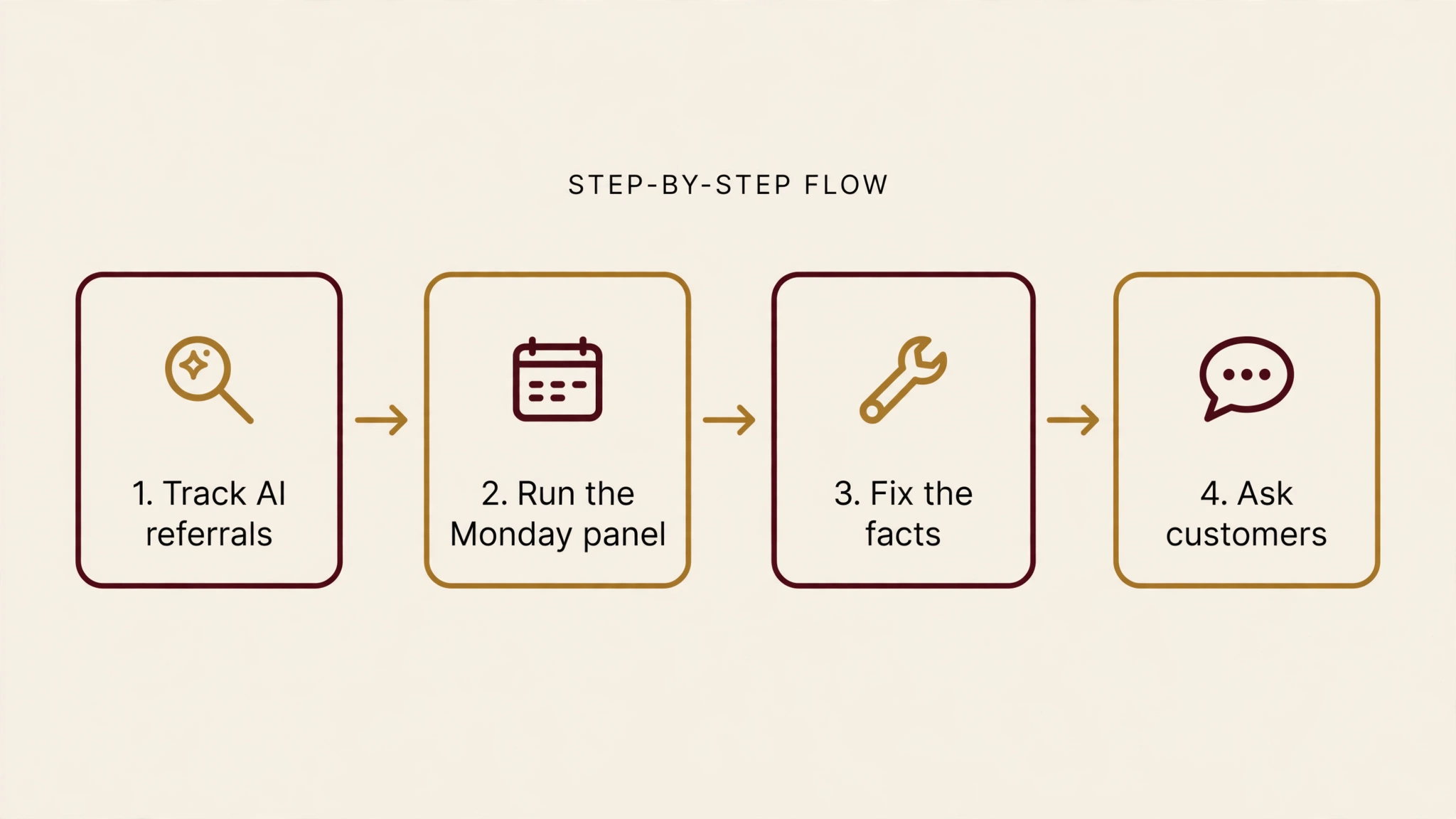
First, track your own AI referrals in GA4 through the AI Assistant channel (ChatGPT, Gemini, DeepSeek, Copilot, and Grok by default). Perplexity and Claude, both in the panel below, need a custom channel group above Referral, or they will be missed. Read the channel with the caveat I documented in October: during the GPT-6 rollout window, OpenAI dropped ChatGPT's utm_source tag, so GA4 undercounted ChatGPT referrals in that window and some traffic landed in Direct. I covered that break in ChatGPT's UTM Tags Disappeared With GPT-6. Check whether the tag has returned before treating the channel as complete.
Second, run a fixed prompt panel every Monday: the same money questions, the same four engines, logged in and logged out, three samples each, scored on recurrence. Per question, record separately whether the engine names the client, quotes its own pages, or sends the booking to a competitor; these outcomes overlap. I covered why blended scores mislead in ChatGPT Sends 0.6% of Google's Traffic. And Converts 4.5x Better.
Third, fix the facts that lose recommendations before you chase more citations. On my panel, a wrong price or hours entry flips a question from named to sent somewhere, so put hours, prices, service areas, and booking steps in plain text on the page that should win, and keep the Google Business Profile record identical. Two different prices on record give the engine a stale price to pick.
Fourth, add a self-reported attribution question to your forms: "Did an AI assistant help you find us, and which one?" People misremember, but answers can surface bookings GA4 misses. Treat them as a lead list to reconcile, not as measured attribution.
ChatGPT search needs its own measurement. Until OpenAI publishes those three, treat 20 percent as a hypothesis about scale. If your agency deck cites 20 percent this week, ask for the denominator. If they cannot give it, leave the number out of the deck. Press lines do not book appointments.

About the author
Dalin de Graff is a digital marketing expert based in Winnipeg, Canada, with 9 years of experience across SEO, GEO, and AI search. At First Rank, he built the agency's GEO practice and leads its work on AI search and LLM visibility. His results include +311% organic clicks, +300% calls, and +98% AI search traffic in 30 days. He writes about search, AI, and marketing at dalindegraff.com.