Google's AI Still Runs on Rankings. The Data Says So.
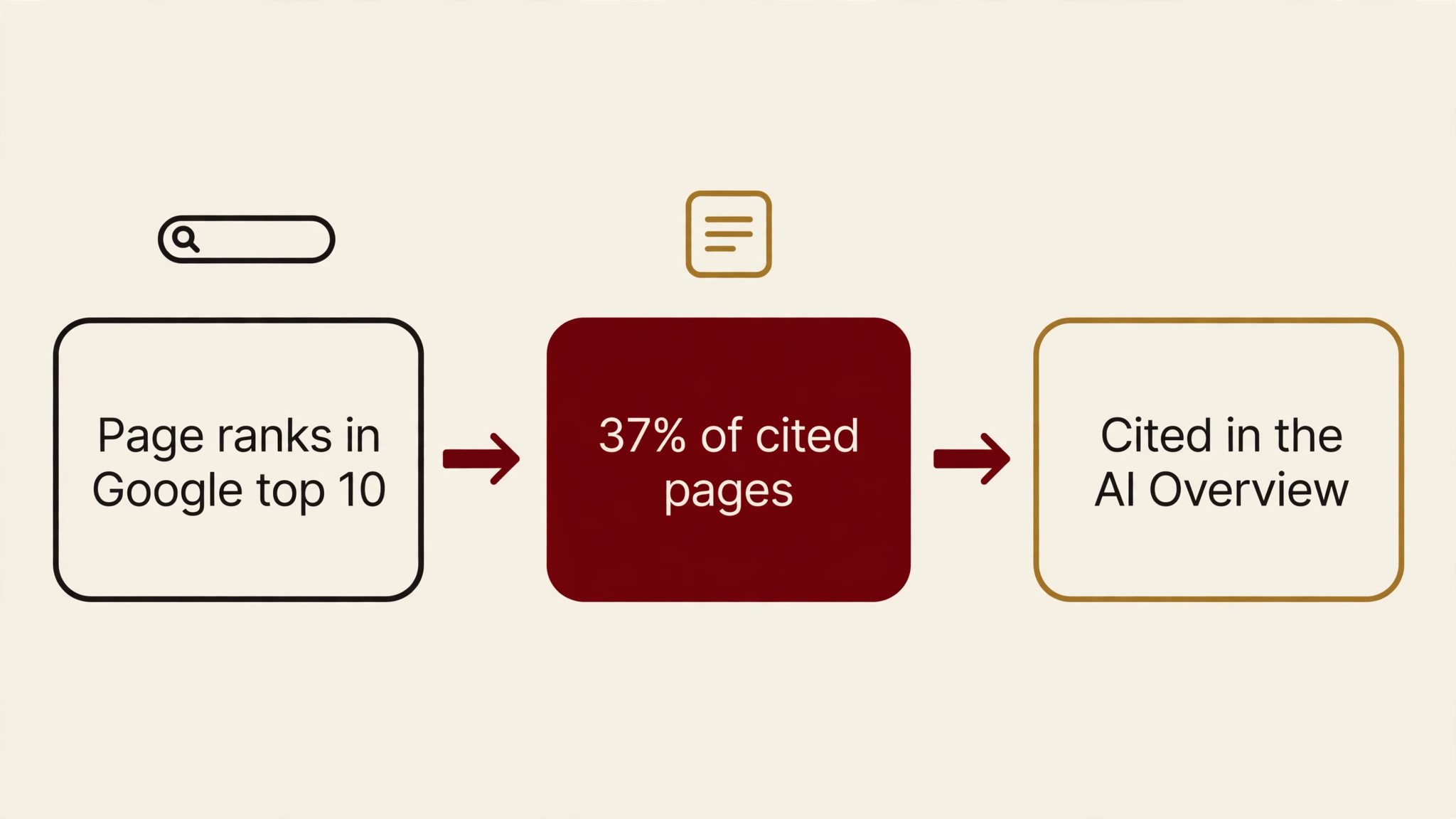
Victorious Q3 data: 37% of AI Overview citations rank top 10, vs 13-18% on ChatGPT. Rankings still decide who Google cites, but a citation is not a click.
Google's AI Still Runs on Rankings. The Data Says So.
I have heard "rankings are dead" at least once a month for two years. The claim usually goes like this: AI answers replaced the list, so where you rank no longer matters. A new study from Victorious says the opposite, at least for Google's own AI. Its Q3 2026 Search Report, published November 4, found that 37 percent of the pages AI Overviews cited also ranked in Google's organic top 10 for the same question. For ChatGPT, Perplexity, and Copilot, that overlap ran only 13 to 18 percent. Google's AI leans on its own ranking system far more than any rival does. Ranking in the top 10 is the strongest single signal the study found for earning an AI Overview citation.
What Victorious measured
Victorious asked 34 category questions, the kind buyers ask about a product or service, across five industries: ecommerce and retail, financial services and insurance, healthcare, legal services, and SaaS and technology. Each question ran roughly 30 times on nine AI platforms, once at the end of June and once at the end of September.
Three findings matter for anyone doing SEO:
First, AI Overviews appeared on 97.5 percent of those category searches in Q3, up from 72.8 percent in Q2. On buyer questions, the answer box is now the default.
Second, the ranking overlap. Of the sources AI Overviews cited, 37 percent ranked in the top 10 for the same question. ChatGPT, Perplexity, and Copilot sat between 13 and 18 percent. AI Overviews cited a ranking page at a higher rate than the other platforms on 29 to 33 of the 34 questions, depending on the comparison.
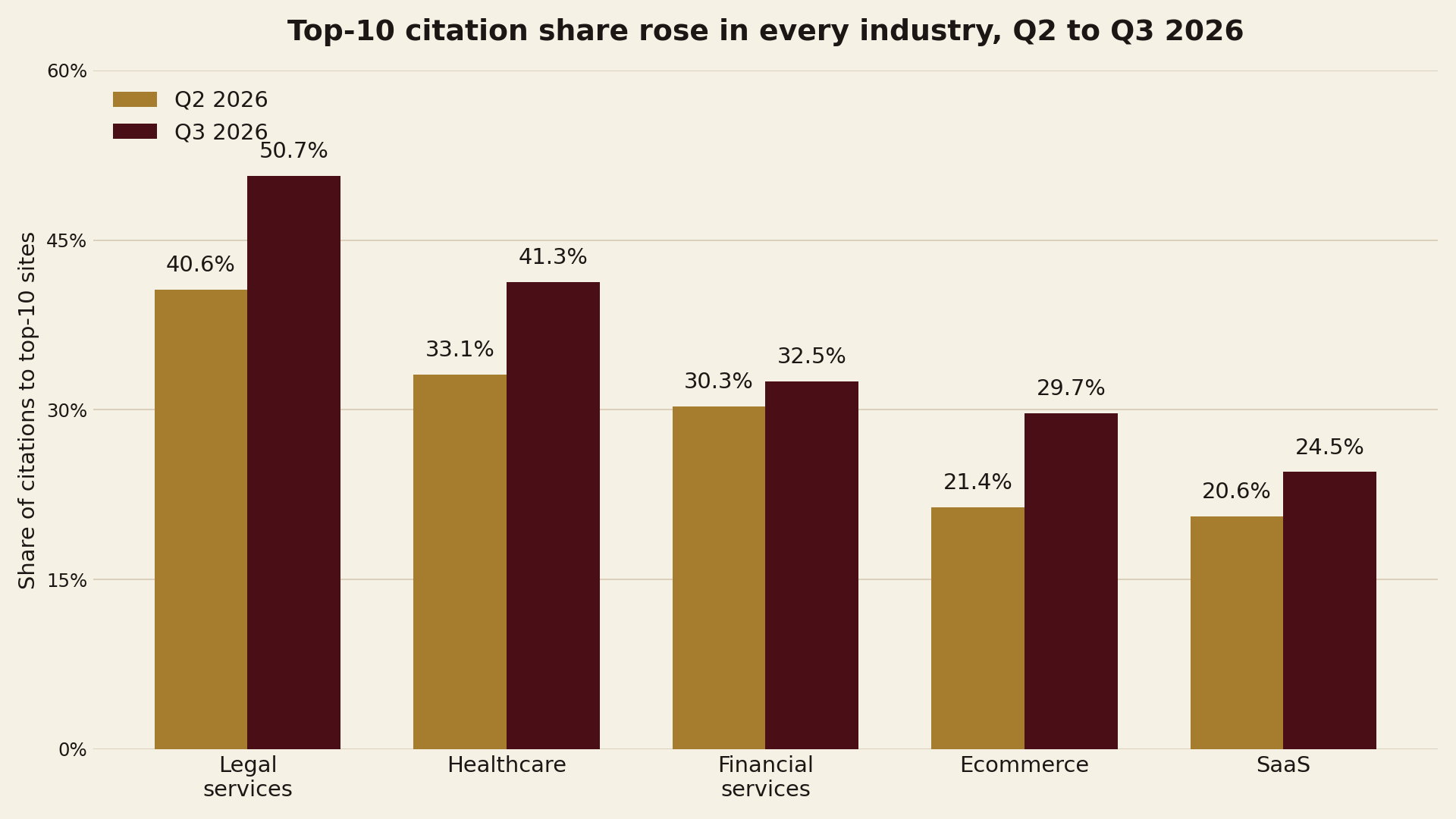
Third, the overlap is growing. The share of citations going to each industry's 10 most-cited websites rose in every industry from Q2 to Q3, most in legal services.
| Industry | Top-10 citation share, Q2 | Top-10 citation share, Q3 |
|---|---|---|
| Legal services | 40.6% | 50.7% |
| Healthcare | 33.1% | 41.3% |
| Financial services | 30.3% | 32.5% |
| Ecommerce | 21.4% | 29.7% |
| SaaS | 20.6% | 24.5% |
Victorious sells AI search work, so read its framing with that in mind. The report also warns that its overlap figures are directional comparisons, because Google's results shifted between searches run minutes apart.
37 percent is the biggest input, not the whole game
If 37 percent of cited pages ranked in the top 10, then 63 percent did not. That means most cited pages sit outside the top 10. Rankings are the single biggest input to AI Overviews, in the words of Victorious CEO Michael Transon, and they are not the only one.
That split changes the job. Ranking the page gets you into the pool Google draws from. It does not guarantee the citation. Third-party sources made up most of what AI Overviews cited, according to Victorious. YouTube and Reddit were the top two sources AI Overviews cited in both quarters. In legal services, that concentration is already visible. Three directories take about a third of citations on category questions. A firm that only optimizes its own pages and ignores where those directories get their listings is conceding a third of the citations before the fight starts.
The same report shows how little the platforms agree with each other. Asked the same question, two platforms shared only 4 to 10 percent of the websites they cited. A single platform asked the same question twice reused 25 to 74 percent of its sources. A citation on ChatGPT tells you almost nothing about whether Google will cite you, and a citation on Google tells you almost nothing about Perplexity. Each engine runs its own source list, and each list is narrowing. ChatGPT stopped citing Reddit entirely in Q3. In Q2, 223 of 1,017 ChatGPT answers cited it at least once. In Q3, none of 1,014 answers did. Wikipedia fell from 1.1 percent to 0.2 percent of ChatGPT citations over the same period.
Forty-two brands were named in Q2. Twenty-nine were named in Q3. The threshold for a 50 percent chance of being named rose from about 20,000 third-party web mentions to roughly 24,000 to 28,000. Getting named on at least three of six platforms took about 44,000 mentions. And 90.5 percent of brands were never named in answers to their own category's questions.
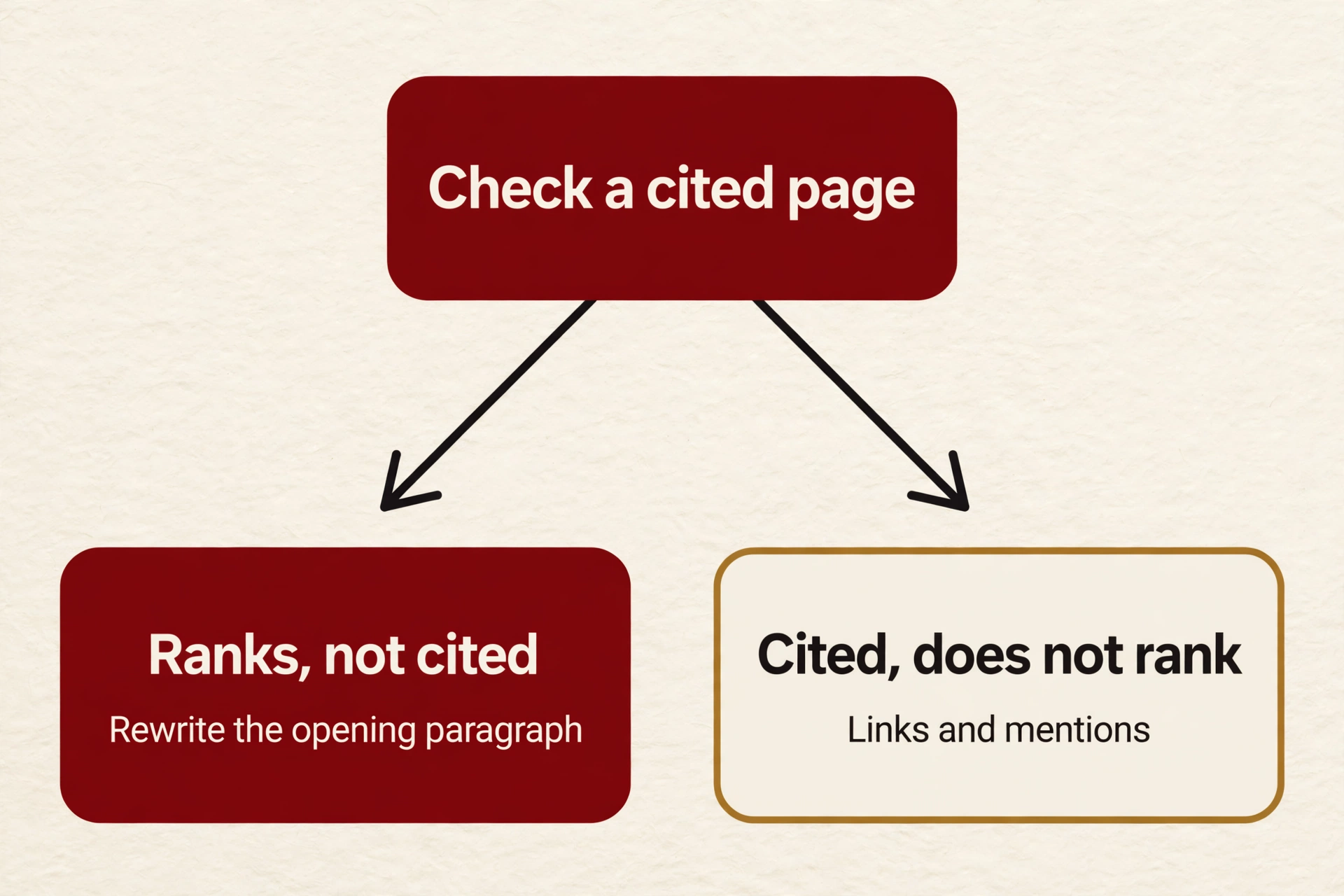
I use the split to sort client pages into two buckets. A page that ranks but is not cited usually fails at the answer level, because its opening paragraph buries the fact the overview needs. A page that is cited but does not rank is winning on usefulness and losing on authority. The report's naming data points toward links and mentions rather than more words on the page. I check it with five buyer questions run on four engines, logged in and in a clean session, three samples each, and I log whether the page was named, quoted, or lost the answer to a competitor.
The citation is not a click
On August 28, Google told Search Engine Roundtable that some AI Overviews now expand to full length automatically, pushing the organic list further down the page. And the Agarwal and Sen randomized field study found 39.8 percent fewer outbound organic clicks on queries where an overview appeared.
What would you check first on your own site: the pages that rank but never get cited, or the pages that get cited but never rank?

About the author
Dalin de Graff is a digital marketing expert based in Winnipeg, Canada, with 9 years of experience across SEO, GEO, and AI search. At First Rank, he built the agency's GEO practice and leads its work on AI search and LLM visibility. His results include +311% organic clicks, +300% calls, and +98% AI search traffic in 30 days. He writes about search, AI, and marketing at dalindegraff.com.