Your Search Traffic Didn't Vanish. It Moved.
Google Search sent publishers 40% less referral traffic in a year, but total pageviews barely moved. Where the audience went, and what to build instead.
Google Search sent publishers 40.2% less referral traffic in the year to July 2026. That number comes from Chartbeat's 2026 Publisher Playbook, built on two years of data across Chartbeat's network of media publishers, and it follows a 21.9% drop the year before.
Google Discover fell too, down 34.3% after a 6.6% decline the year before.
If search were the business, that would be the end of it. It is not. Average monthly pageviews across Chartbeat's network came in at 31.1 billion, barely below the 32 billion of the year before. The audience did not disappear. It changed how it arrives.
The mix moved toward channels publishers control
In July 2024, Google Search drove roughly 9% of pageviews across Chartbeat's network. By July 2026 it drove 5%, a nearly 46% relative drop over two years. Discover's share fell 28.4% over the same period.
Meanwhile, the channels a publisher influences all grew. Dark social, links passed around in private messages and texts, rose from 7.1% of pageviews to 11.3%. Direct traffic rose from 13.5% to 15.9%. Internal traffic, readers moving from one page on a site to another, rose from 37.9% to 40.4%.
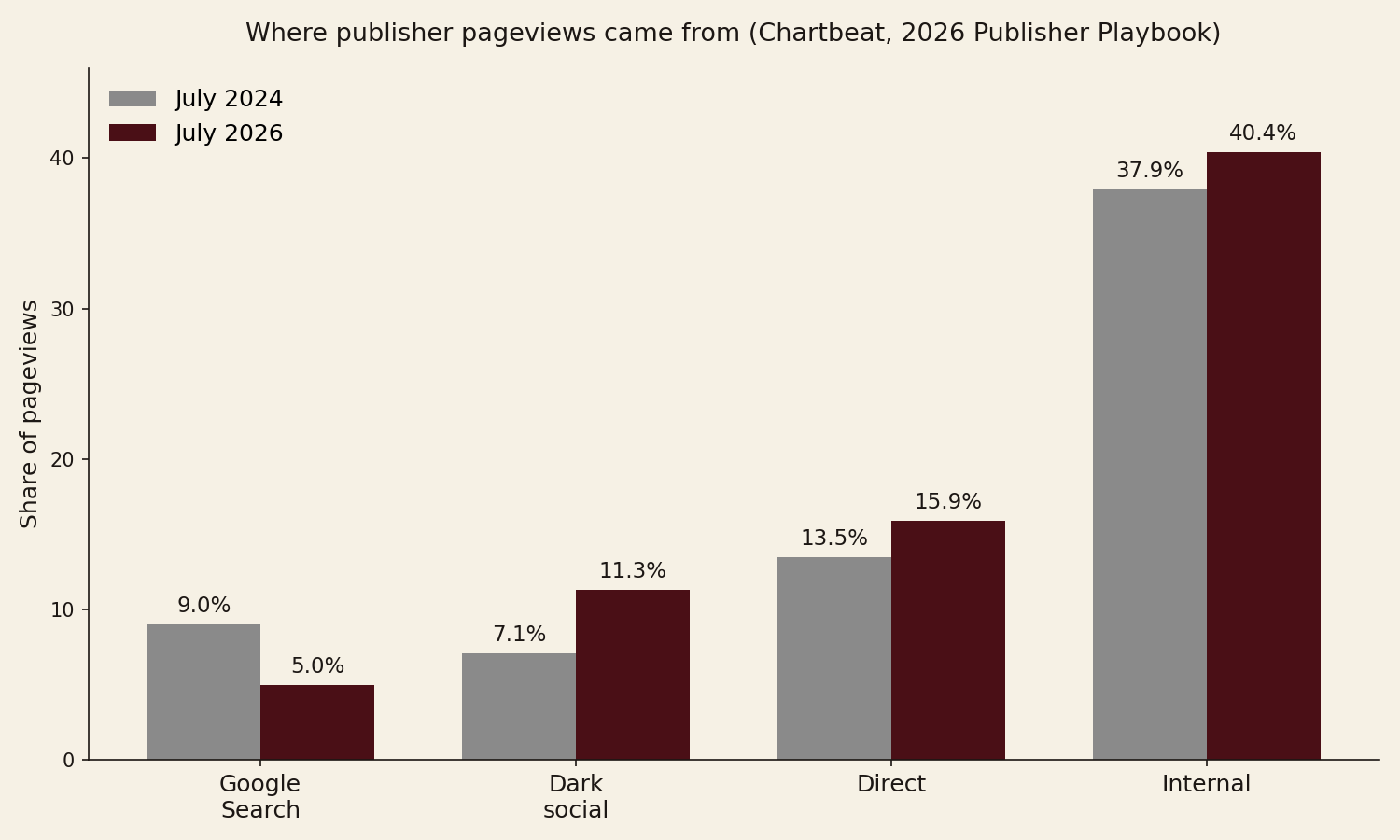
Internal traffic is now the single largest source of pageviews in the set. The audience that still shows up is not arriving cold from a results page. It is arriving because it already knows the site, or because something on the site sent it somewhere else on the site.
A publisher that spent the last two years trying to win back the search line was chasing the one channel shrinking fastest, while the channels growing were the ones it could build directly.
The pain was not evenly spread
Small publishers lost 60% of their search referral traffic over two years, according to Chartbeat data reported by Axios and covered by Search Engine Journal in March 2026. Mid-sized sites lost 47%. Large publishers lost 22%.
This explains why two SEOs can look at the same year and describe different realities. A large publisher with brand recognition and a direct audience absorbs a search decline. A small publisher with no direct audience and no internal traffic engine has nothing underneath when the search line drops. The same algorithm change lands as a bad quarter for one site and an existential event for another.
I see the same split in client work. The clients who survive a traffic shock are almost never the ones with the best rankings. They are the ones with a second way for customers to reach them. A Winnipeg therapy clinic I worked with is the clearest example. Local search and its Google Business Profile drove calls up 300%, and those calls did not depend on any single ranking holding. When one channel wobbles, the business still has a phone that rings.
The readers who stay leave faster
There is a second shift inside the same report, and it cuts against any plan that leans on longer articles to hold attention. Average engaged time fell to 24.3 seconds in the first half of 2026, down from 25.5 seconds in 2025 and 26.7 seconds in 2024. The point on a page where half of readers who scroll have left dropped from 700 pixels to 500 on desktop, and from 1,100 to 800 on mobile.
So the audience that remains is more loyal and less patient at the same time. Loyal readers, defined by Chartbeat as visitors who show up at least eight days out of sixteen, held steady at 15.02 billion monthly pageviews, up slightly from 14.98 billion. New-reader pageviews fell 14% and returning-reader pageviews fell 8%. The loyal core carried the network while acquisition shrank.
Related stories, newsletter signups, and the next step cannot live at the bottom of the page anymore, because so many readers never get there. Put related stories, signups, and the next step where readers still are, inside the first 500 pixels on desktop and 800 on mobile.
Do not count on chatbots to replace search
One more number from Android Headlines' coverage of the playbook is AI referrals at 0.01% of publisher traffic across Chartbeat's network, a figure that slipped through 2026 rather than growing. ChatGPT led the pack and still amounted to almost nothing at publisher scale.
I write a lot about AI search on this site, and I stand by the work of earning citations in AI answers. But the publisher data draws a line I will not cross. AI referrals are not a replacement channel for lost search traffic right now. They are a small, high-intent stream, which matches what I found when I measured ChatGPT referral conversion against Google organic traffic. ChatGPT sent 0.6% of Google's session volume and converted at 13.8% against 3.02% for Google organic. A channel can convert well and still be too small to carry a business.
What I would build instead
If your search line is falling, run this check before you rewrite anything.
First, audit your own mix. Open GA4 and compare sessions by channel over the last two years, not just Search Console clicks over the last three months. If search is down but direct, referral, and internal are flat or up, you have a distribution story, not a quality story, and rewriting articles will not fix it.
Second, make internal links a system. Every post on this site links to the homepage, to one or two related posts, and onward to the next thing a reader should read, because internal traffic is the channel I control outright. The network shift shows where the audience went; a linking system is how one site captures its share of that shift.
Third, build one owned route back: a newsletter, a community, a direct audience that does not need an algorithm to reach you. Chartbeat's loyal-reader line shows that a small core that returns on its own is worth more than a large audience that only arrives through a feed.
Fourth, measure conversions per session, not rankings per keyword. I made this argument when I wrote that rankings are not revenue, and the publisher data strengthens it. When the channel mix changes, the only number that still means the same thing is what a visit is worth.
What does your own channel mix look like over the last two years, and does it match the story you have been telling yourself about why traffic fell?

About the author
Dalin de Graff is a digital marketing expert based in Winnipeg, Canada, with 9 years of experience across SEO, GEO, and AI search. At First Rank, he built the agency's GEO practice and leads its work on AI search and LLM visibility. His results include +311% organic clicks, +300% calls, and +98% AI search traffic in 30 days. He writes about search, AI, and marketing at dalindegraff.com.