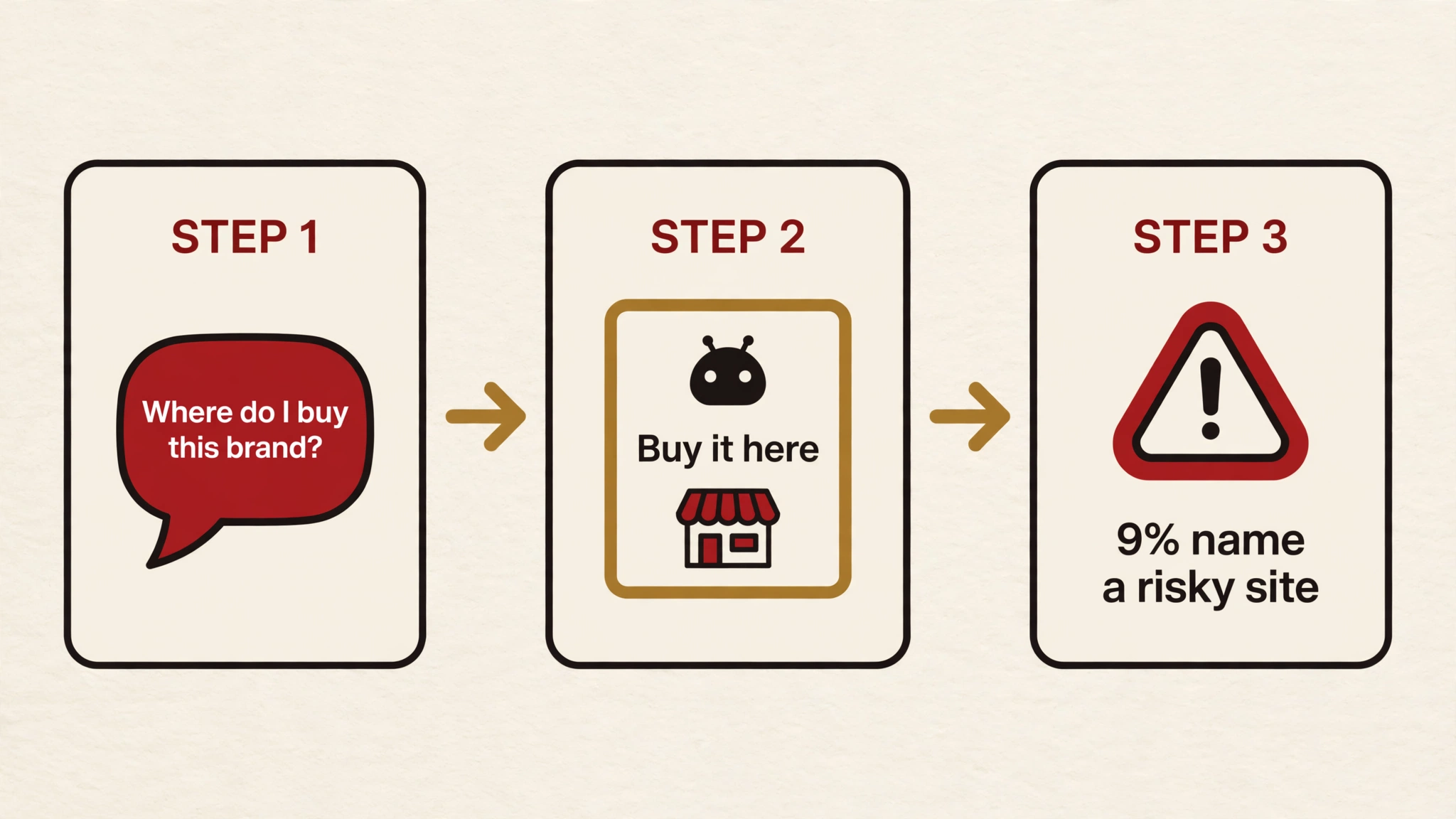
AI Chatbots Name Risky Stores in 9% of Shopping Answers
Podqi tested 6,795 shopping answers. 9% exposed shoppers to a risky site, and when one appeared it was recommended 57% of the time.
Black Friday is 12 days away. This year a growing share of shoppers will skip the search results page and ask a chatbot where to buy something instead. Research first reported by The Verge on November 12 found that about 9% of those answers exposed the shopper to a risky site, a fake store, a counterfeit seller, an impersonator, or a dead domain that could be repurposed for fraud.
That number comes from Podqi, a brand-protection firm. Podqi asked ChatGPT, Gemini and Perplexity the same five where-to-buy questions about 151 brands, from Lululemon and Birkenstock to Le Creuset, in two rounds during September. Podqi wrote the five questions itself. They were test prompts, not transcripts of real shopper conversations. The answers came from the logged-out, consumer-facing versions of each chatbot, collected with AI search company Gauge. Podqi reviewed every one of the 4,437 websites named in the answers and flagged 718 as risky: 351 fake and 367 dead.
The rates, by engine
| Engine | Answers naming a risky site |
|---|---|
| Perplexity | 15% |
| ChatGPT | 8% |
| Gemini | 4% |
| All three combined | 9% |
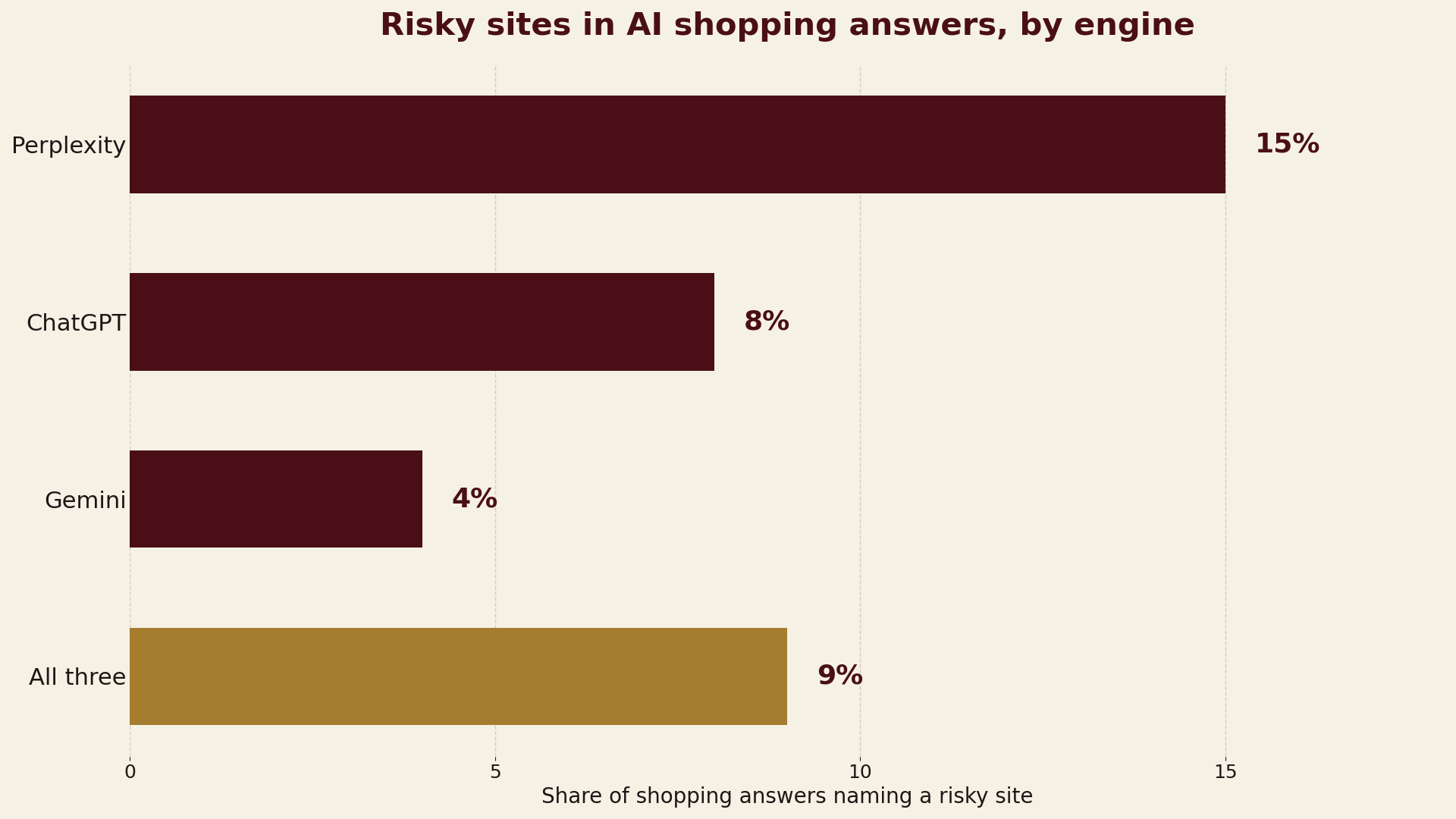
Each engine faced the same 151 brands and the same five questions, so the 11-point gap is a real difference between the engines. The study does not establish why the engines differ.
When a risky site appeared in an answer, the chatbot recommended it as a place to shop 57% of the time, said nothing about it 34% of the time, and warned against it 9% of the time. Risky sites were recommended 6.3 times as often as they were warned against. ChatGPT warned most often and still did so in only 24% of the cases where it surfaced a risky site.
Walk through one answer
The worst case Podqi documented was a Perplexity answer about Stüssy. The chatbot named an incorrect page as the brand's official site and called it the best starting point for guaranteed authentic items, even though the page was not the official store.
A chatbot answer presents its links with a confident recommendation attached. The study did not track whether shoppers clicked, so the number measures exposure, not sales.
Questions about larger companies surfaced risky sites about half as often as questions about smaller brands. The riskiest question category was regional storefronts, at 16% of answers.
Read the caveats before you quote the numbers
Podqi sells brand protection, so it benefits when impersonation looks like a serious threat. One of the 151 brands tested, Madhappy, is a Podqi client. Podqi wrote its own prompts instead of analyzing real shopper conversations, and the study measured exposure to risky links, not confirmed fraud. It did not track whether anyone clicked a risky link, bought anything, or lost money. The overall rate also improved between the two September rounds, falling from 12% to 7%.
None of that makes the finding go away. The caveats change how precisely you should quote the percentages. The companies answered with general statements. Google pointed to the source links shown beside answers and acknowledged that AI systems can make mistakes. OpenAI said it is working to make deceptive sites less likely to appear in shopping results. Perplexity said it never claims to be 100% accurate. All three responses were reported by The Verge and recapped by Gadget Review.
The 5-question storefront audit
I track citations with a fixed set of money questions across four engines, logged in and logged out, three samples each, logging exactly what each answer names, quotes, and links to. Here is my version of that check, adapted from Podqi's five-question test. Run it on your own brand before Black Friday:
- What are the best websites to buy [brand]?
- Where can I buy [brand] online?
- What is [brand]'s official website?
- What are [brand]'s regional websites for Canada?
- Where can I buy [brand] on sale?
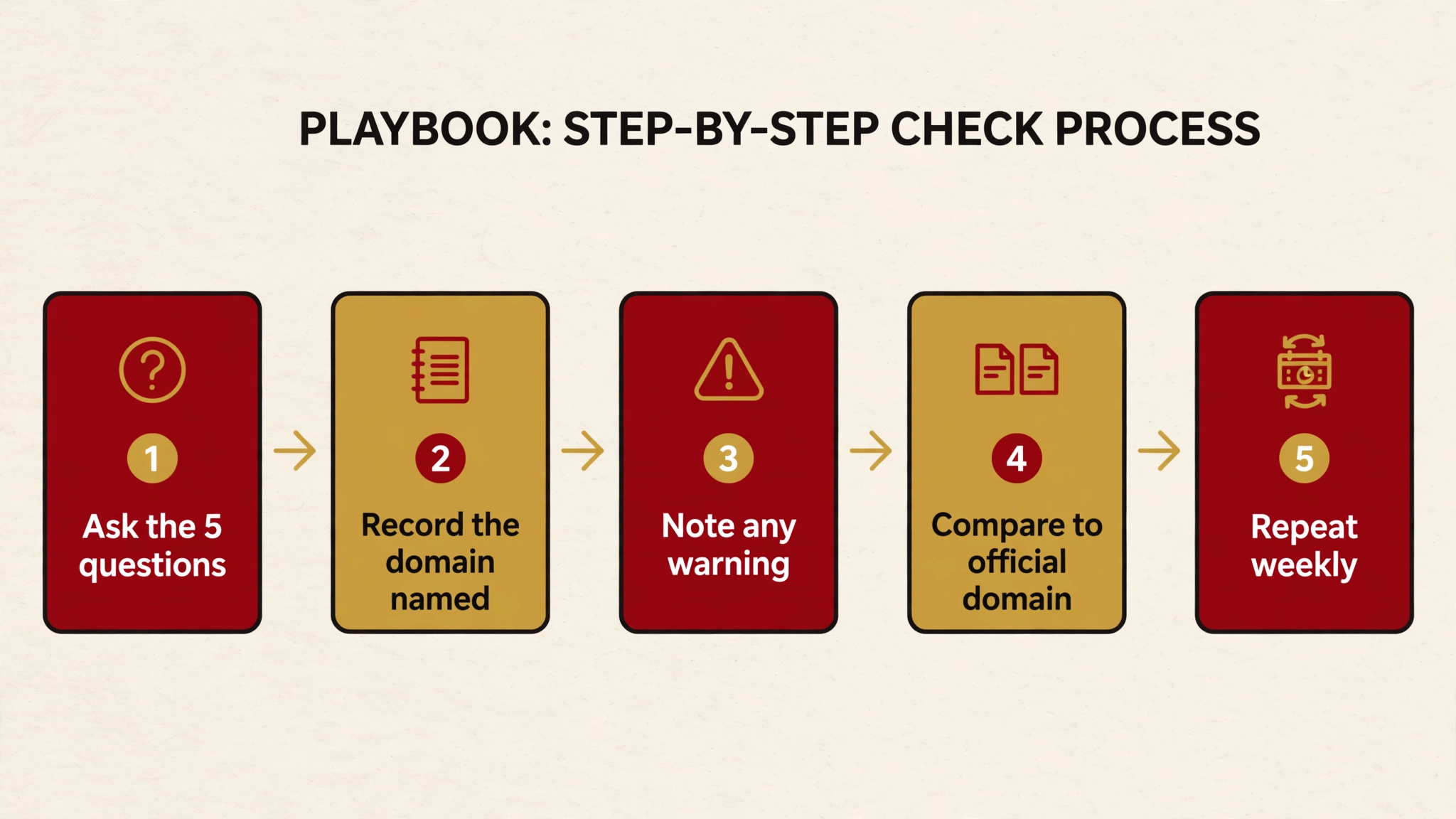
For each answer, record three things: the exact domain the engine names as the official store, whether it warns about any link it shows, and whether the domain it recommends matches the one your own site links to. Run my five questions on ChatGPT, Gemini, and Perplexity, the three engines Podqi tested, and add Claude, the fourth engine on my panel, as an extra check. Log the answers in a sheet with the date, the engine, and the question, and repeat the run weekly through the holiday season. A domain that appears once is a data point. A domain that appears in the same engine three weeks running is a leak you can fix.
Three fixes to make first. First, publish one canonical store page that states the official domain in plain text and links to every real regional store, and make sure no older page on your site still links to a domain you no longer own. Second, check the domains of any retired regional storefronts. An expired domain a chatbot keeps recommending can be bought by someone else and turned into a fake store, and Podqi counted 367 dead domains in its review. Third, ask your platform or marketplace partners to link to your official domain by name rather than to a search result, so the clearest official signal is the one partners reinforce.
Google launched Universal Cart in the US on October 15, and on November 4 it announced home-service booking links in AI Mode.
Run the five questions this week. If an engine names the wrong store for your brand, fix it before November 27.

About the author
Dalin de Graff is a digital marketing expert based in Winnipeg, Canada, with 9 years of experience across SEO, GEO, and AI search. At First Rank, he built the agency's GEO practice and leads its work on AI search and LLM visibility. His results include +311% organic clicks, +300% calls, and +98% AI search traffic in 30 days. He writes about search, AI, and marketing at dalindegraff.com.