AI Traffic Reached 79% of Websites. It Still Pays Almost Nobody.
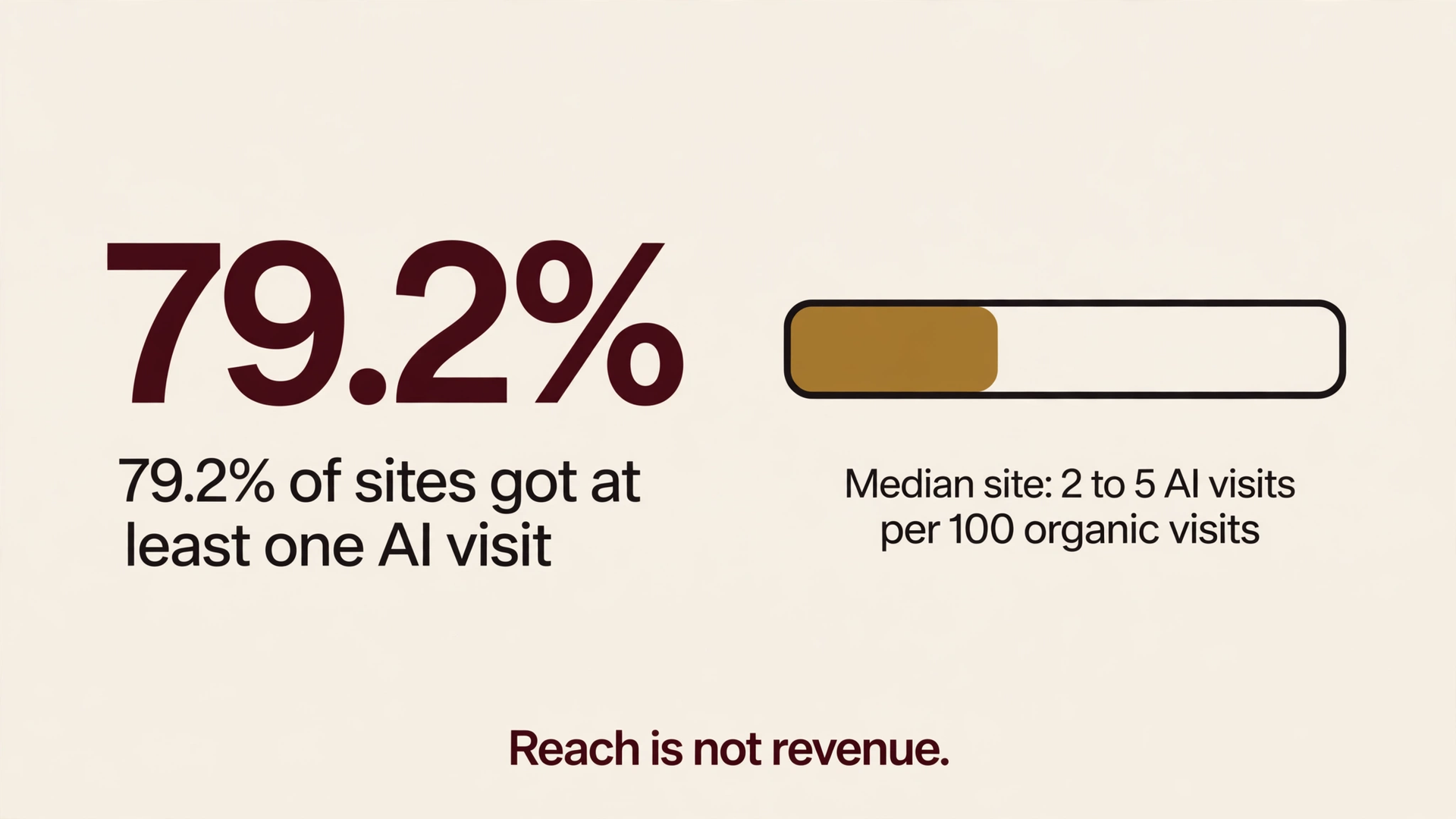
SE Ranking found 79.2% of sites now get AI referrals. The median site gets 2 to 5 AI visits per 100 organic visits. Judge it on conversions, not visits.
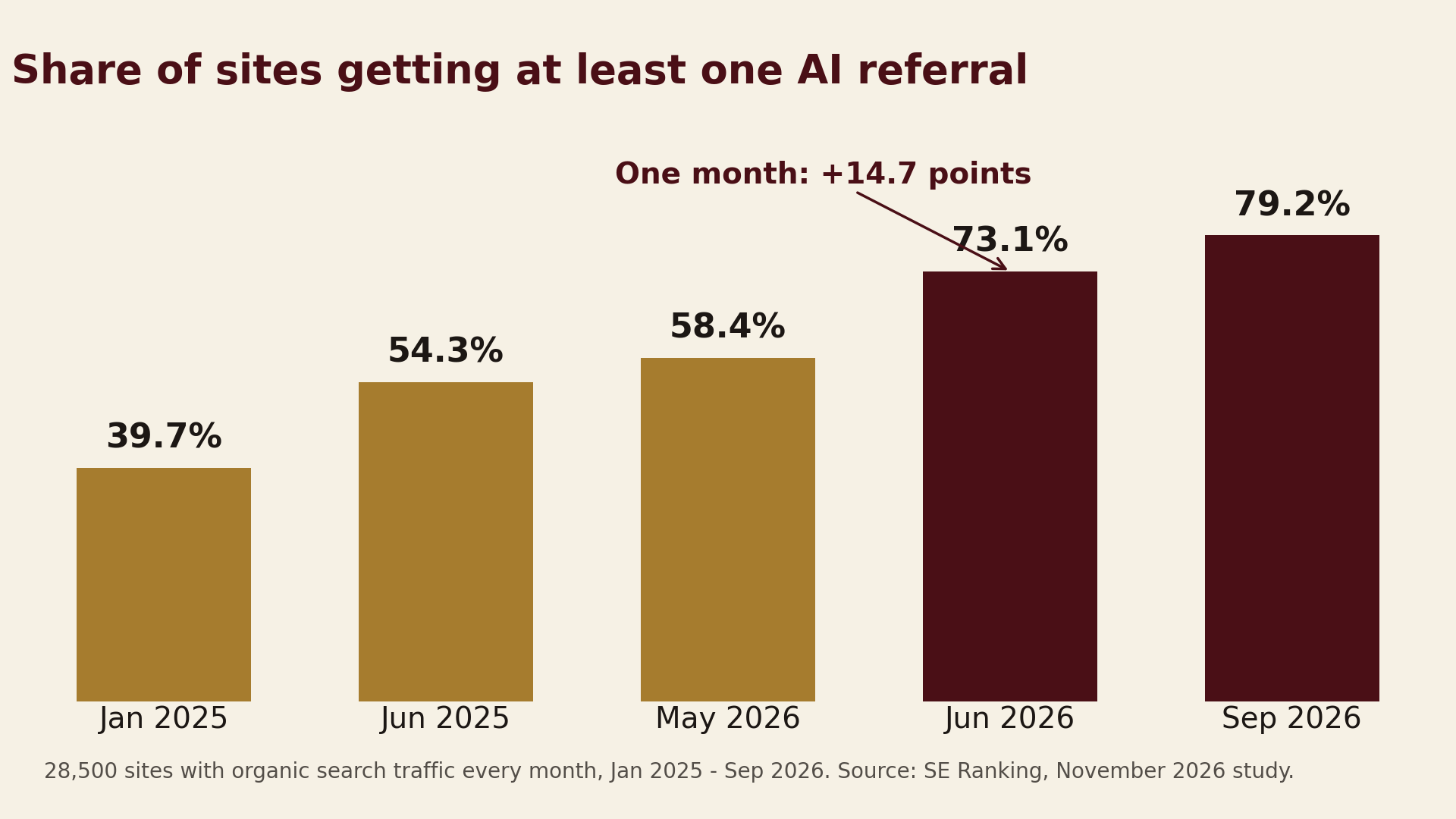
Nearly 8 in 10 websites in SE Ranking's sample now get traffic from AI platforms. SE Ranking tracked 28,500 sites from January 2025 to September 2026 and found 79.2% recorded at least one AI referral in September, up from 39.7% in January 2025. At least one visit is the bar. The median site with at least 1,000 monthly organic visits still gets 2 to 5 AI visits per 100 organic visits.
What the study actually measured
All 28,500 sites had organic search traffic every month from January 2025 through September 2026. That is a sample of sites with steady organic traffic. SE Ranking sells SEO and AI-visibility software, so treat the headline as a vendor's number. The headline counts reach, and SE Ranking says so itself: receiving AI traffic means recording at least one AI visit. That says nothing about a steady flow or conversions.
| Month | Sites with at least one AI referral |
|---|---|
| January 2025 | 39.7% |
| June 2025 | 54.3% |
| May 2026 | 58.4% |
| June 2026 | 73.1% |
| September 2026 | 79.2% |
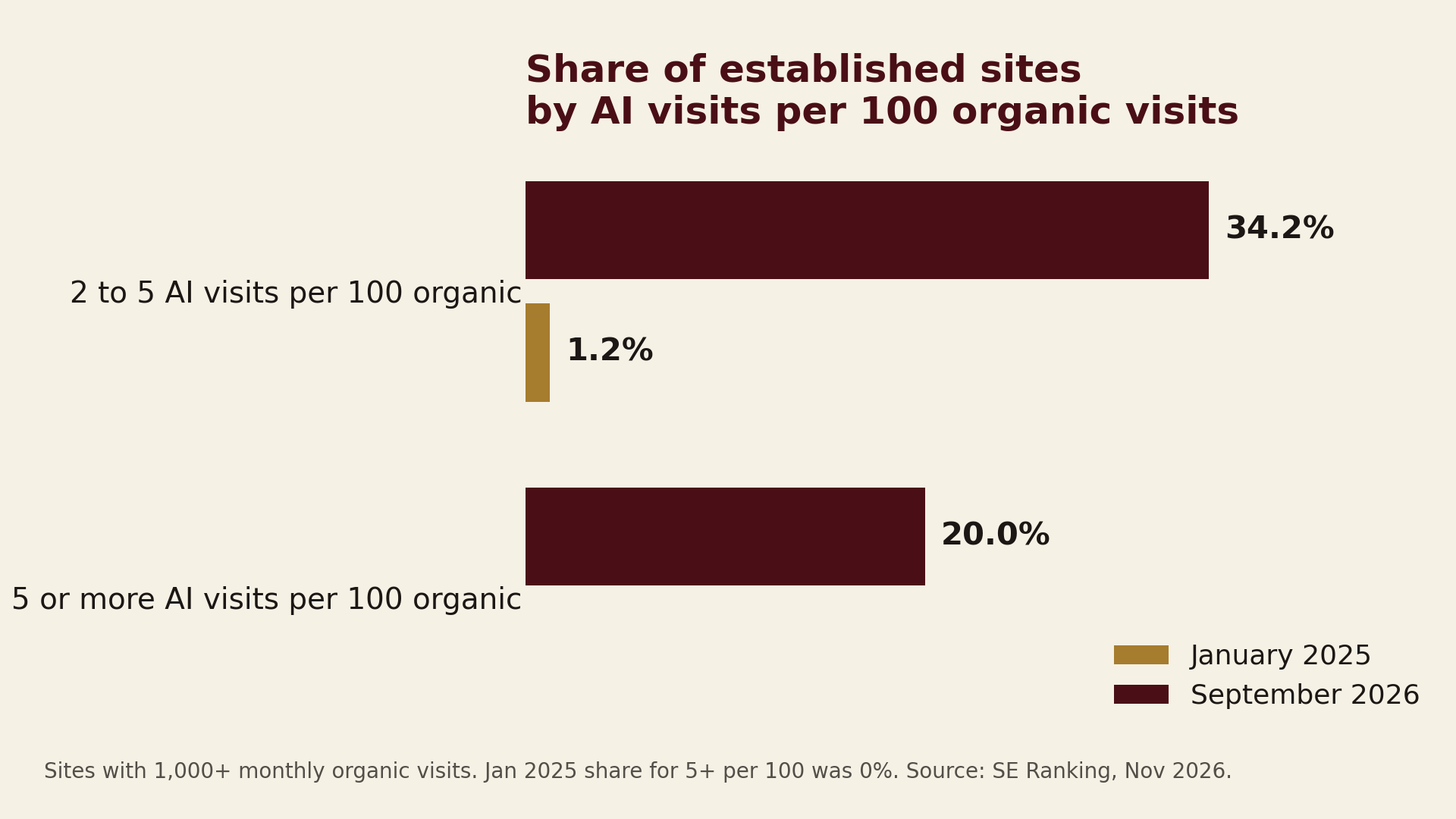
Among sites with at least 1,000 monthly organic visits, 99.7% got one in September 2026. By September, the most common range for those established sites was 2 to 5 AI visits per 100 organic visits, covering 34.2% of them. In January 2025, only 1.2% sat in that range, and the median site got fewer than 1 per 100. One in five reached 5 or more per 100, split between 13.5% at 5 to 10 and 6.5% at 10 or more. In January 2025, none reached 5 or more. A site with 20,000 monthly organic visits gets roughly 400 to 1,000 AI visits at that range. That is hundreds of extra visitors on top of 20,000 organic visits.
The June jump points to one product change
The share sat between 54.3% and 59.2% for nearly a year, then jumped from 58.4% in May to 73.1% in June 2026. SE Ranking names the likeliest cause but says it cannot prove it. ChatGPT sent roughly three of every four AI referrals in January to April 2026. SE Ranking points to a May change that made brand names inside ChatGPT answers more prominent and clickable. That month, ChatGPT's share of total website traffic rose 36.7% against April.
The likeliest explanation is one interface change inside one product. SE Ranking cannot prove the link, but the timing lines up. If your site started getting AI visits in June, the likeliest reason is that ChatGPT made its brand links easier to click. If my AI referrals dip next month, I check what the platforms changed before I rewrite a page. A reach number that moves on a vendor's release schedule is a poor way to judge your own work.
The assistants read far more than they send
Karbon Agency's own server logs, updated November 3, 2026 with data through November 2, make the gap concrete. AI-assistant crawlers fetched 23,678 pages from its domain between September 14 and November 2, against 5,073 for Google, Bing and Apple combined. That is 4.7 assistant fetches for every search fetch. OAI-SearchBot, the crawler that builds the index ChatGPT search answers from, re-read its 627 paths 21.75 times each in that window. It re-reads the same paths to keep a working set fresh. Those fetches refresh known pages.
Across 23,225 human sessions on 15 sites from June 1 to November 2, only 209 arrived from an AI assistant, 0.90%, and ChatGPT sent 191 of those. Perplexity sent 7, Gemini 6, Claude 3. The sessions were concentrated. Of the 140 AI-referred sessions from September 16 to November 2, 129 landed on Karbon's own site. Client sites received 11.
A crawler re-reading your pages 22 times each puts your content in the working set for answers. It says nothing about visitor volume.
The ratio can rise while the channel shrinks
Karbon found the trap in its own numbers and published the correction. Its AI share of human sessions rose from 0.53% to 0.90% without the assistants sending more visitors. A change to its bot-detection rule shrank the denominator, so the same numerator looked bigger. The same trap applies to the ratio itself. A higher AI-to-organic ratio can reflect falling organic traffic as well as rising AI traffic.
A line that says AI is now 4% of our traffic, up from 2%, can mean AI doubled. It can also mean organic fell by half while AI stood still. I report AI sessions per month first, then the ratio, never without the two numbers that built it.
Judge it in conversions per session
I track AI traffic two ways. In GA4 I keep an AI Assistant channel that splits out chatgpt.com, perplexity.ai and the other assistant referrers, separate from organic. Alongside it I run a fixed prompt panel every Monday: five money questions, three samples each, across ChatGPT, Gemini, Perplexity and Claude, logged in and clean, recording whether each answer names the brand, quotes its pages, or sends the reader to a competitor. The panel measures whether the answers recommend you; GA4 measures whether anyone arrives. In the GEO campaign that lifted LLM traffic 98% in 30 days, the traffic gains tracked the citations on the money questions.
Marie Haynes studied 100 sites over 145 million sessions. ChatGPT sent 0.62% of Google's organic sessions. Among the 55 sites tracking conversions, ChatGPT visitors converted at 13.8% against 3.02% for Google organic, 4.6 times better. I broke that study down in October and included the counter-data. SE Ranking's study carries a matching example. One marketer's AI traffic is around 2% of organic traffic but around 10% of organic qualified registrations. It is a small channel with high intent. The opt-out test I covered last week showed the other side. When one site left AI search, the answers kept appearing without it, and Zyppy estimated AI search accounted for about 23% of its clicks, 21% direct AI clicks plus a ~2% halo lift on organic clicks.
The three-number check
Run this three-number check once a month, and let it decide the budget:
| Number | Where to get it | What good looks like |
|---|---|---|
| AI sessions | GA4 AI Assistant channel, monthly | A rising numerator month over month |
| AI visits per 100 organic | Same channel divided by organic sessions | 2 to 5 is the median; above 5 puts you in the top fifth |
| Conversions per AI session vs organic | Same channel, conversion events compared | The only number that justifies spending more |
If citations on your money questions fall while sessions hold, the channel is sending people someone else recommended. If sessions rise and conversions per session stay flat, you have reach without revenue.
Run the three-number check next Monday. If conversions per AI session do not beat organic, stop spending on AI visibility and fix the citations on your money questions first.

About the author
Dalin de Graff is a digital marketing expert based in Winnipeg, Canada, with 9 years of experience across SEO, GEO, and AI search. At First Rank, he built the agency's GEO practice and leads its work on AI search and LLM visibility. His results include +311% organic clicks, +300% calls, and +98% AI search traffic in 30 days. He writes about search, AI, and marketing at dalindegraff.com.