One Site Opted Out of Google AI Search. It Lost 23% of Its Clicks.
Zyppy opted out of Google AI Overviews and AI Mode for 28 days. AI clicks were 21% of its search traffic, plus a 2.3% halo. Here is the math.
Last week I wrote that AI Overviews cut outbound organic clicks by 39.8% where they appear. That number came from a randomized field experiment. This week, one site ran the experiment in the other direction: Cyrus Shepard of Zyppy SEO turned Google's AI features off for his own site for 28 days, then turned them back on. The clicks he lost were the AI citations themselves, plus a lift on his ordinary listings.
Opting out removes your citations from answers that keep appearing anyway, with other sites' content in your place.
The test
On September 1, 2026, Shepard opened the Search generative AI control in Search Console and excluded zyppy.com from AI Overviews and AI Mode. On September 29, exactly 28 days later, he opted back in for another 28 days, comparing total clicks between the two windows and cross-checking query-level data to reduce confounding from ranking shifts. Zyppy's full writeup ran November 5.
Google's removal was fast. AI-feature impressions had run 500 to 1,000 a day, about 10% of the site's total search impressions. Within an hour of the switch, they fell by more than 99%, and returned almost as fast when he opted back in.
Google does not split AI clicks out in the main Search Console report, so Shepard inferred them by differencing total clicks between the two periods. Every number below is an estimate.
| What Zyppy measured | Number |
|---|---|
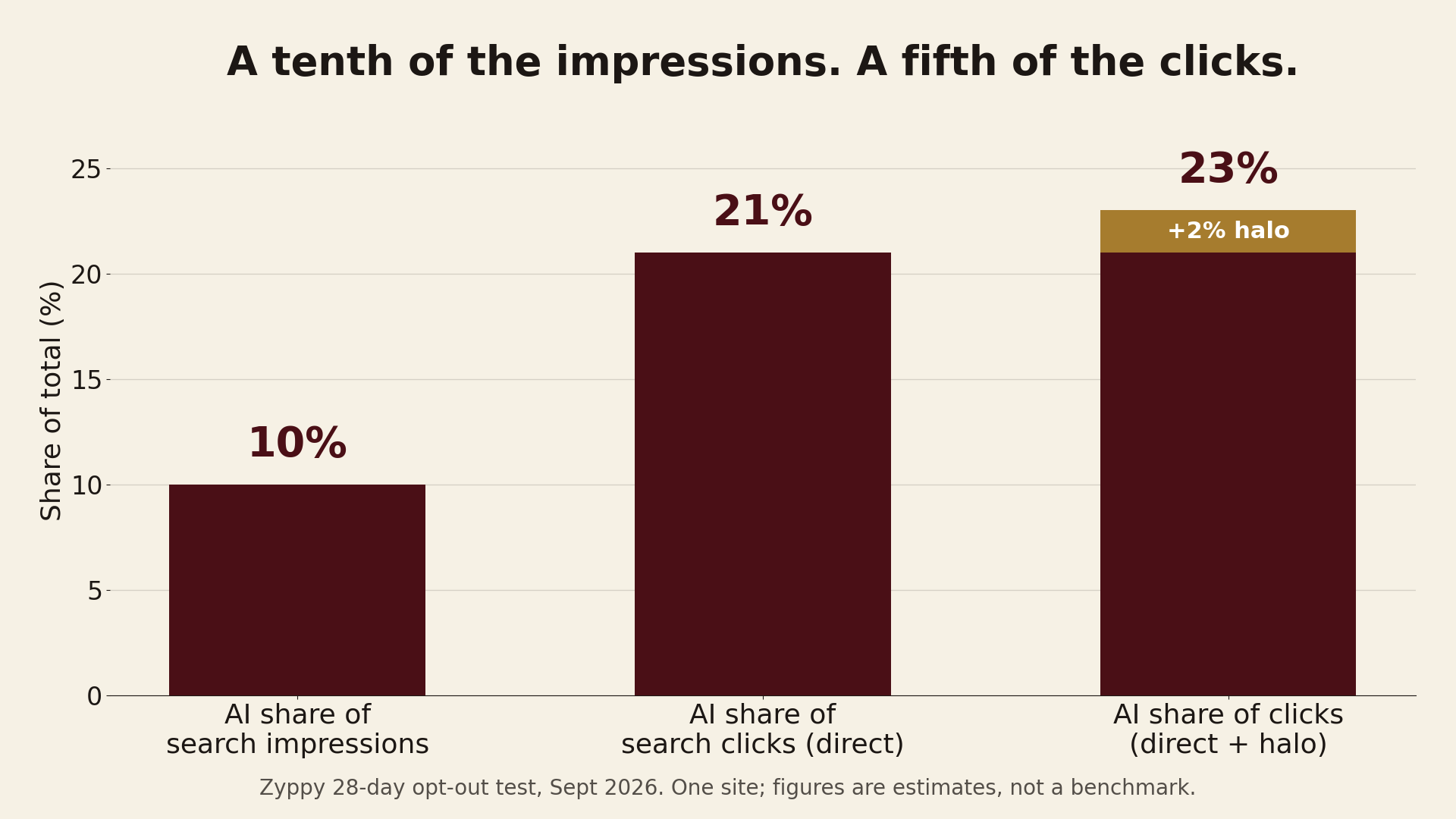
| AI-feature impressions, share of total search impressions | ~10% (500-1,000 per day) |
| AI impressions after opting out | Down more than 99% within an hour |
| Estimated CTR on AI Overview and AI Mode links | ~0.9% (range 0.7-1.1%) |
| Site-wide organic CTR for comparison | ~0.4% |
| Share of total search clicks from AI features directly | ~21% |
| Organic CTR lift on pages cited in AI answers (halo) | ~2.3% |
| Total search clicks tied to Google AI features | ~23% |
Three numbers change the decision
0.9% vs 0.4%. AI links clicked at about 0.9%. Put it next to the site's own organic rate of about 0.4% and the AI citation clicked at more than double the rate of the site's regular listings.
10% of impressions, 21% of clicks. AI impressions were only a tenth of the site's total search impressions, but they produced about a fifth of its total clicks.
The 2.3% halo. When Zyppy's pages appeared in AI answers, the click rate on its ordinary organic listings on the same results page rose about 2.3%, strongest on the URLs with the most AI visibility. Shepard calls the lift a halo effect. His likely explanation is brand reinforcement. A reader who sees a name twice on one page trusts the listing below more. Zyppy is explicit that nobody knows for sure why it happens. When he opted out, those ordinary clicks fell too, even after Zyppy checked the result against matched-query and position data. Add the halo to the direct clicks and Google's AI features account for about 23% of the site's total search clicks.
Walk through the actual result page
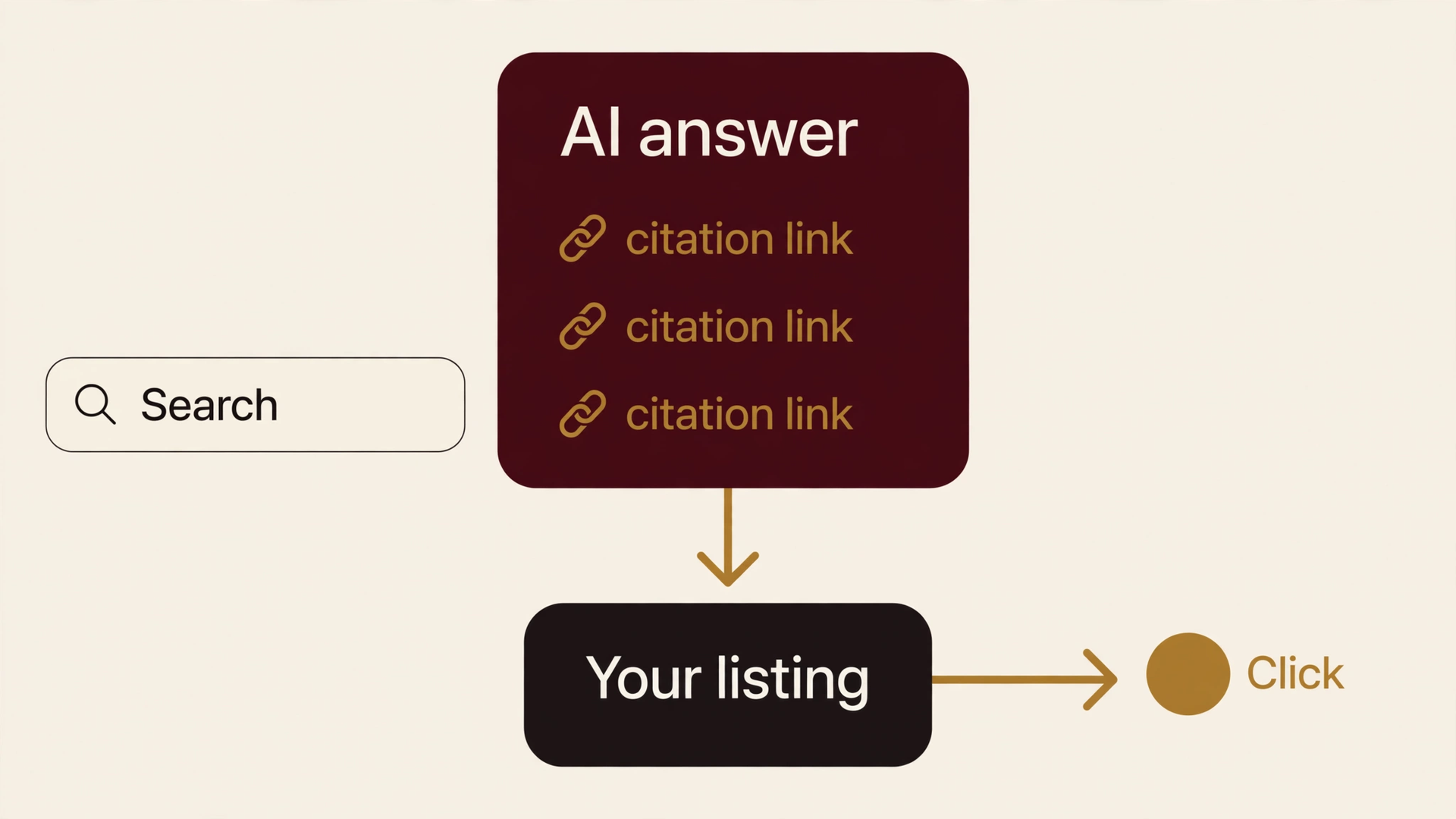
In Zyppy's example screenshots, the result shows three AI citation links plus its number one organic listing underneath, four appearances on one screen. After opting out, the listing stayed number one and every AI citation was gone.
| Before the opt-out | After the opt-out | |
|---|---|---|
| AI citation links to Zyppy | 3 | 0 |
| Organic listing | Number 1 | Number 1 |
| Times the reader saw the brand on the page | 4 | 1 |
The example listing still ranked number one. The traffic moved anyway. The opt-out control is not a ranking signal, per Google, and still cost Zyppy clicks, because it removed the extra appearances that were pulling clicks toward its listing.
Both studies are right
This looks like a contradiction of the experiment I covered last week. Agarwal and Sen, in a randomized field experiment run with a Chrome extension, found 39.8% fewer outbound organic clicks on queries where an AI Overview appeared, with zero-click searches up 34.5%. Agarwal and Sen measured the page; Shepard measured one site on it.
The AI answer takes clicks away from the page as a whole, and the cited sites keep a second route to the click that the rest do not. If your pages are not cited, you absorb the kind of click loss the experiment measured, 39.8% fewer outbound clicks on average on queries where an overview appears, and get nothing back. If they are cited, the answer becomes a second route to your site and lifts the listing below it. Whether your site gets cited decides whether you absorb the full loss or have a route back. It does not guarantee the answer sends you more than it costs you. I covered the click-loss study in detail last week: 40% Click Loss Where Overviews Appear. Measure It.
What the switch does
The control sits under Settings in Search Console and covers AI Overviews, AI Mode, and generative features in Discover. Google says exclusion is not a ranking signal and other sites' content can still appear in your place. The control does nothing about training; that is a separate lever, Google-Extended in robots.txt. I walked through the split in One Robots.txt Line Will Soon Tell Google, Microsoft, and OpenAI No to Training.
Google says a change generally takes 1 to 2 days. Zyppy saw his citations vanish within an hour, so treat the fast switch as one site's observation, not a promise.
Your content stays indexed, and the control does nothing about training; only the citations leave. What it did, on Zyppy's numbers, is remove about a fifth of that site's search clicks and a small lift on the rest.
Run your own 28-day test before you decide
Zyppy flags this itself. The site had already spent real effort optimizing for AI citations, so its share is likely at the high end.
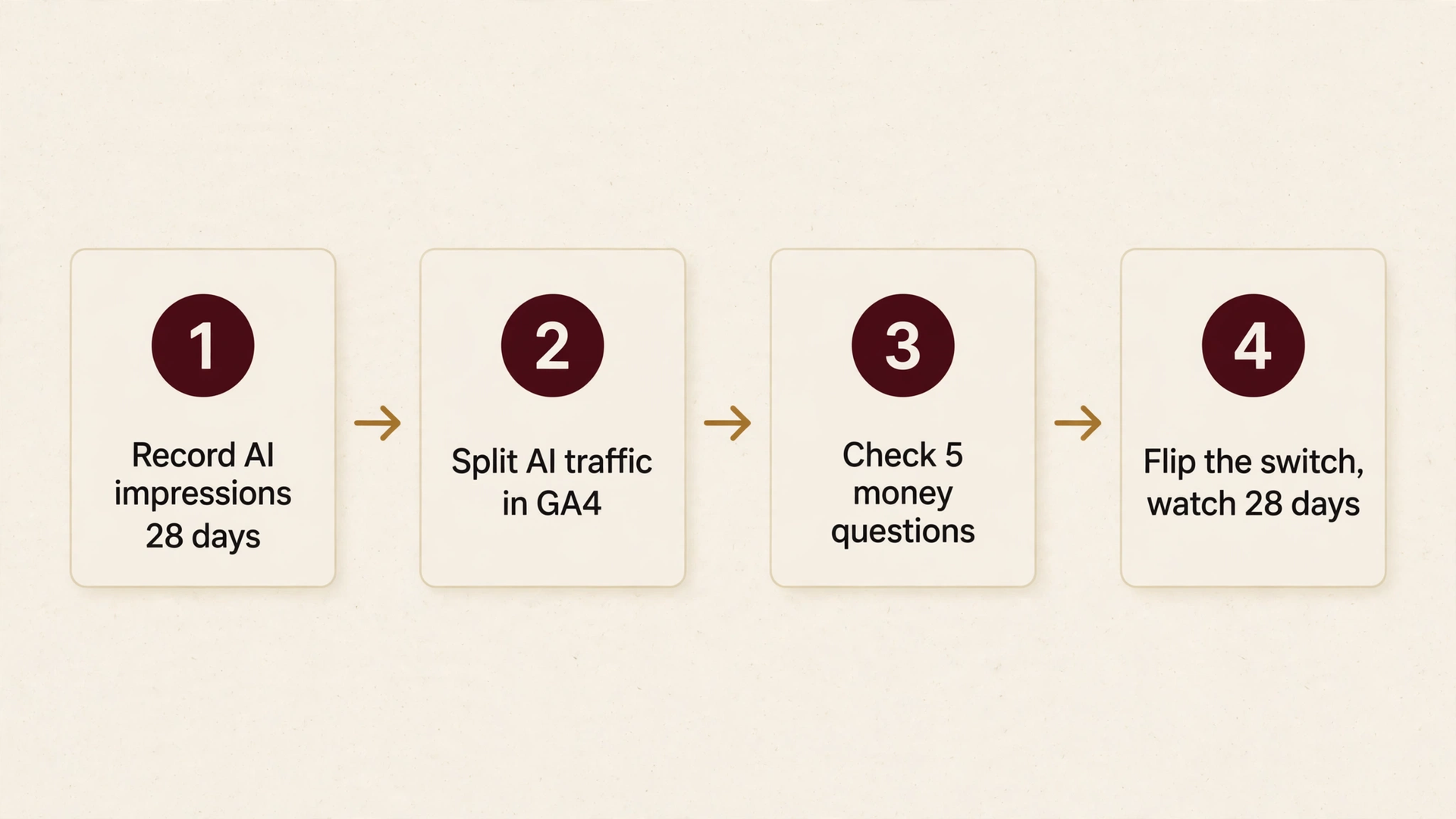
Start with the baseline. In Search Console, open the Generative AI performance report and record AI impressions for 28 days, next to total clicks and impressions. In GA4, split out the AI Assistant channel so ChatGPT, Gemini, and Perplexity show up separately from Google organic, and measure the AI surfaces as their own channel.
Then pick five money questions your buyers ask and check them three times each across ChatGPT, Gemini, Perplexity, and Claude, logged in and logged out, and log whether your site is cited, linked, or named. That check tells you which of your pages the answers use. A page that never gets cited has the least to lose from opting out today, though opting out also gives up any future citations it might have earned. A page cited on every check has the most to lose.
If you do flip the switch, hold everything else steady for 28 days, compare branded and non-branded query buckets separately, and watch the click rate on your most-cited pages. If total clicks fall 5% or more across the 28 days and the drop sits in your most-cited pages, opt back in.

About the author
Dalin de Graff is a digital marketing expert based in Winnipeg, Canada, with 9 years of experience across SEO, GEO, and AI search. At First Rank, he built the agency's GEO practice and leads its work on AI search and LLM visibility. His results include +311% organic clicks, +300% calls, and +98% AI search traffic in 30 days. He writes about search, AI, and marketing at dalindegraff.com.