Yahoo Will Pay Publishers for AI Answers. The Check Will Be Small.
Yahoo Scout became the ILC's first paying licensee on Nov 12. One buyer, no rates, and only 2 of 92 big sites show the sign-up line.
On November 12, Yahoo Scout became the first commercial licensee of the Internet Licensing Collective, a new nonprofit and the industry's first blanket license paying publishers for content inside AI answers. It has one paying customer, no published rates, and a sign-up gap you can check yourself in thirty seconds.
I have tracked publisher payment since Google confirmed its pilot in September. That pilot invited about 100 publishers, paying from under $1,000 across several months to over $1 million in a year, with a formula nobody outside Google has seen. The direction mattered more than the dollars. Publishers were getting paid for answers instead of suing over them. The ILC deal works differently, and the differences decide whether it pays you.
What Yahoo signed
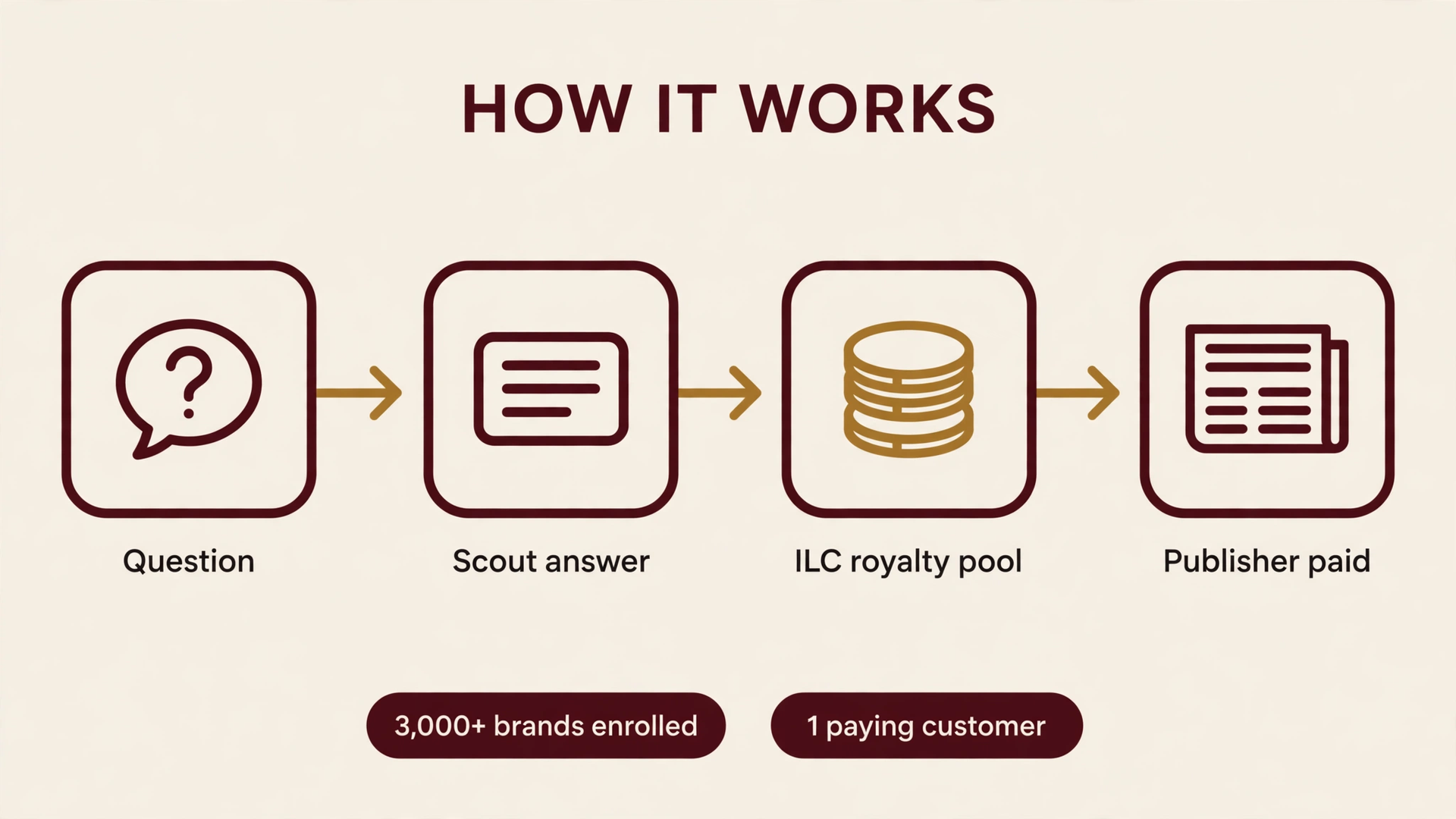
The ILC is the group formerly called the RSL Collective. It co-wrote Really Simple Licensing, an open standard from 2025 that lets a site state machine-readable terms for AI use. On November 12 it launched as a nonprofit with more than 3,000 media brands, content owners and publishing platforms enrolled, and Yahoo Scout as its first paying customer.
Yahoo pays one blanket fee that scales with Scout's revenue. The amount is undisclosed: co-founder Doug Leeds told Digiday the fee is tied to demand-side revenue and declined to give the number, and Yahoo declined to be interviewed. That is the whole public price: a fee exists, it grows with the product, and nobody outside the deal knows its size.
The money goes into a Yahoo-only royalty pool, so a publisher shares only in the revenue of the AI products that used its content. Allocation weighs how the content was used, grounding, retrieval or display in an answer, and whether the publisher was credited. Leeds gave one example: displaying election results with credit to the Associated Press earns more than using a page to check a fact. The exact formula and weights are not disclosed. The ILC projects operating costs at or below 10 percent, with the rest going to rights holders.
Mather Economics released a report called The Price of Intelligence the same day, estimating collective licensing could pay publishers 15 to 35 percent of AI company revenue, a market worth tens of billions that could pass the 2025 US display advertising market within three years. Treat that as a projection. Mather says its study was independent and not funded by the ILC. The ILC says it is in talks with unnamed AI companies.
The gap between 3,000 members and 2 sign-up lines
The Search Post checked the robots.txt files of 92 sites on November 20, eight days after launch and six days after its first check, looking for the License line that points AI companies to a site's licensing terms. Only two sites had one: Medium and The Guardian. Eighty-three had no line, seven blocked the check, and Yahoo itself does not carry one.
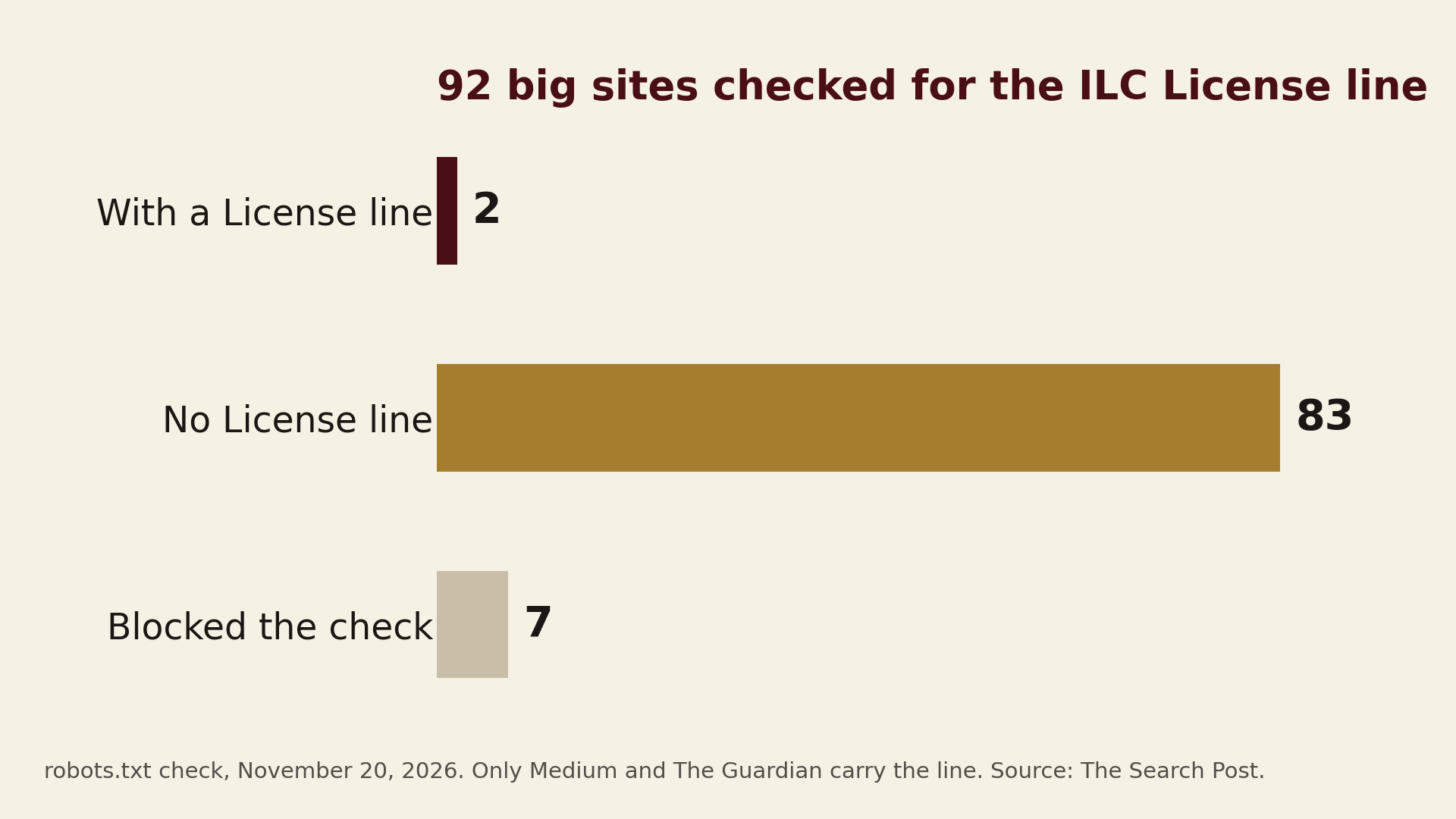
The check does not disprove the 3,000 number: members may be smaller sites, or not finished the robots.txt step yet. The ILC lists hundreds of brands on its homepage. But the License line is the public declaration of terms, and the biggest names in publishing have not put it up yet. Enrolling happens through the ILC portal; the line alone enrolls nobody. A collective with 3,000 members and two visible sign-up lines has launched. It has not become a market yet.
The ILC announced no rates, no minimum payout, no payout frequency and no countries. The only paying customer is Yahoo Scout, which launched in beta on January 27, 2026 for US users only and exited beta on November 10 after delivering more than 3 billion answers, according to Yahoo. Yahoo holds about 2.5 percent of US search, per StatCounter's October 2026 figures, and Scout rides inside that share. Scout answers now ship inside the rebuilt Yahoo Search in the US, UK, Europe, and Switzerland; only the standalone Scout app is US-only.
How this differs from Google's pilot
The two payment models now in the open are not the same thing. The difference is who can join, how the price is set, and what the payout rewards.
| Model | Who can join | How the price is set | What the payout rewards |
|---|---|---|---|
| ILC collective license (Yahoo Scout) | Anyone, free, non-exclusive | Share of Scout revenue, undisclosed | Use and credit: display and citation earn more than background use |
| Google AI contribution pilot | About 100 invited publishers | Set by Google, formula undisclosed | Contribution to Gemini, AI Overview, and AI Mode answers |
| Bilateral deal (one lab, one publisher) | One publisher, negotiated | Negotiated, typically undisclosed | Negotiated per deal |
Google's pilot is invitation-only and black-box. The ILC is open to join, free, non-exclusive, and describes its allocation principles in public, even if the fee and the weights stay private. The openness is new. One paying customer paying an undisclosed fee into one pool is not money anyone can budget around.
The payee is whoever enrolls the website, not necessarily the people who wrote the content. The ILC's brand list includes Wiktionary, Wikidata, Ask Ubuntu and wikiHow, sites written by volunteers and users, and its pages say nothing about passing any share to those writers. If you write on someone else's platform, ask whether it enrolled.
Who should join, and what to do instead of waiting
The join decision starts with a citation check. The license pays on use and credit, so a page Scout never cites earns nothing from it. Run your money questions through Scout first. If the answers quote your pages, join: it costs nothing, the license is not exclusive, and you can still negotiate directly. If Scout never names you, the citation is the work to do first.
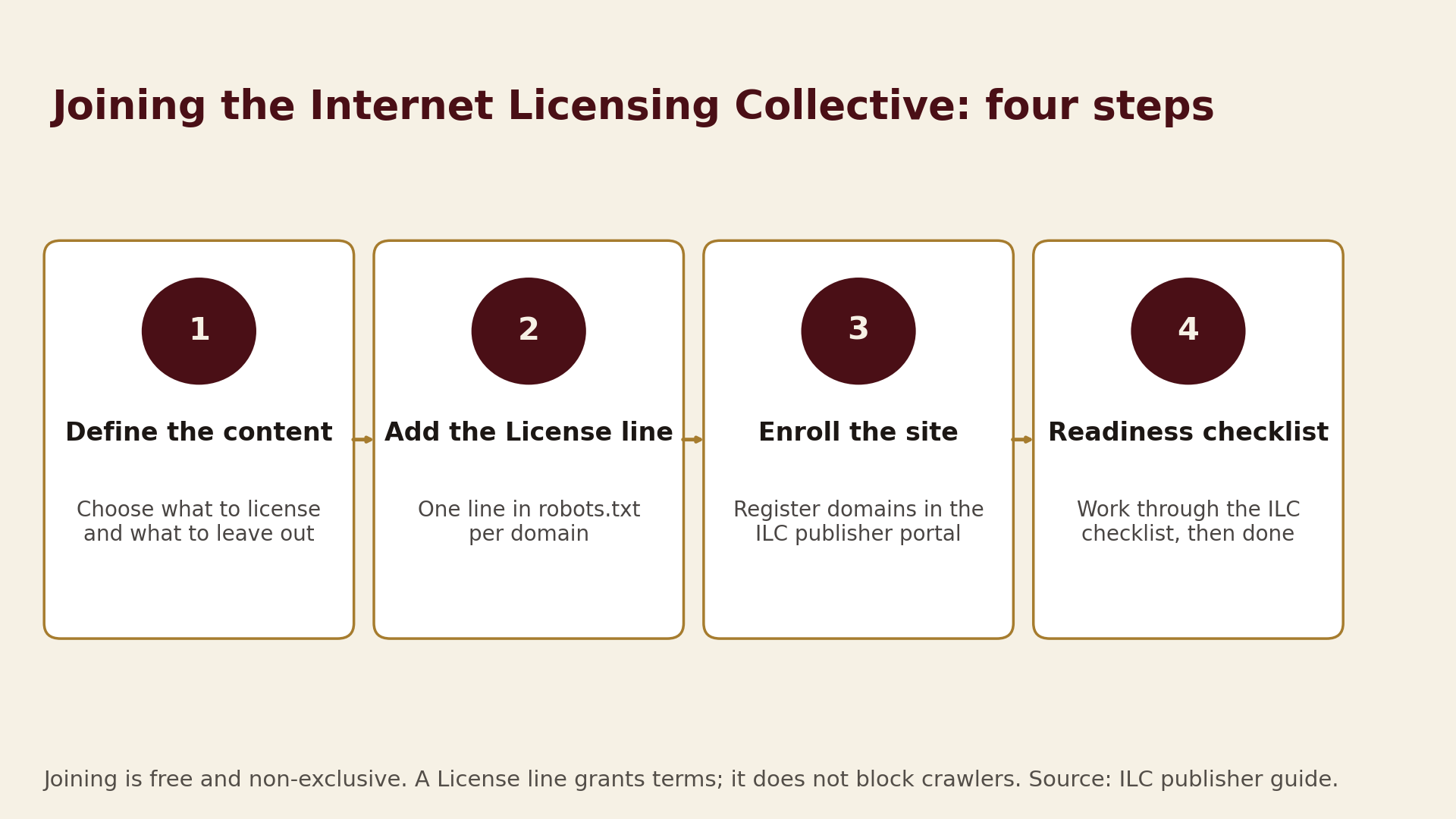
The ILC publisher guide lays out four steps: define the content you want to license, add a License line to robots.txt, enroll the site and its subdomains, then work through the readiness checklist. A License line grants terms; it does not block anything. Your Disallow rules still do that. The line looks like this:
License: https://example.com/license.xml
If your site's job is to win customers, the citation is the work and the license is a side effect. Nothing I have seen says a license makes Scout cite you more often.
When Scout exited beta I added it as a fifth engine to the fixed prompt panel I run: the same five money questions across ChatGPT, Gemini, Perplexity and Claude, three samples each, logged in and clean. Scout gets the same five questions, and I log whether it names my pages, quotes them, or sends the answer to a competitor. The ILC pays on use and credit, so that citation log is the payment log. If Scout never cites a page, no license line will make it pay. I have not published a Scout result yet; the first logged run is the next panel. Run the panel before you join, and again a month later.
Take the option if you publish original work. Do not put the revenue in any plan.

About the author
Dalin de Graff is a digital marketing expert based in Winnipeg, Canada, with 9 years of experience across SEO, GEO, and AI search. At First Rank, he built the agency's GEO practice and leads its work on AI search and LLM visibility. His results include +311% organic clicks, +300% calls, and +98% AI search traffic in 30 days. He writes about search, AI, and marketing at dalindegraff.com.