Ask AI Mode for a Flight. It Only Links to Google Flights.
Barry Schwartz tested AI Mode flight searches: every link went to Google Flights. What it means for travel SEO, and how to test your own vertical.
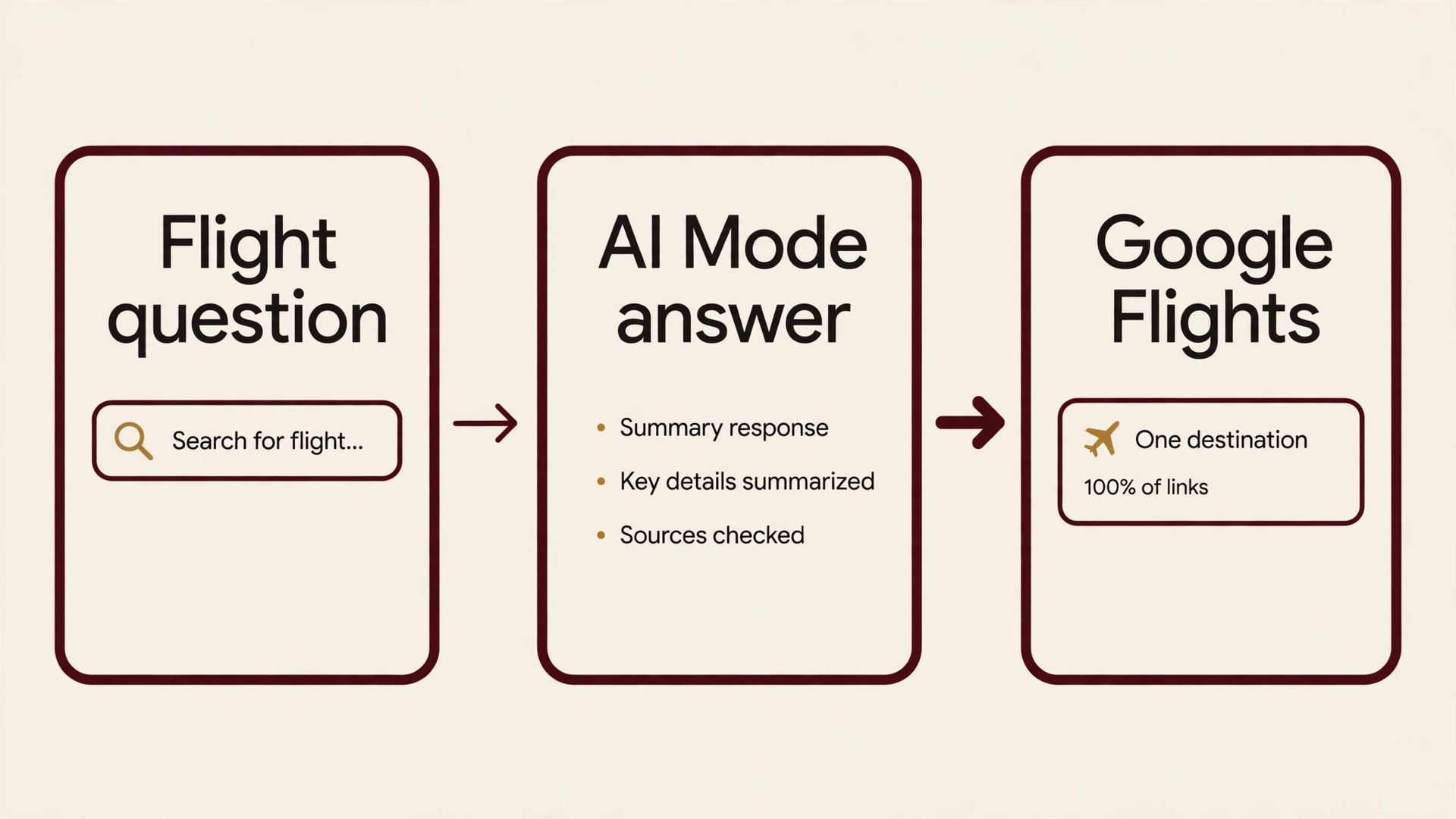
Barry Schwartz spent a weekend asking Google AI Mode for flight information. Every answer linked to one place: Google Flights. He tried several destinations, domestic and international, and the result repeated. He published the test on November 3, 2026.
Four days earlier, Natzir posted the same pattern on X, with a screenshot showing every link in an AI Mode flight answer pointing to Google Flights. His line sums it up: ask AI Mode for flights, get Google Flights. Two independent sightings in the same week produced the same result. Google has not commented on either test.
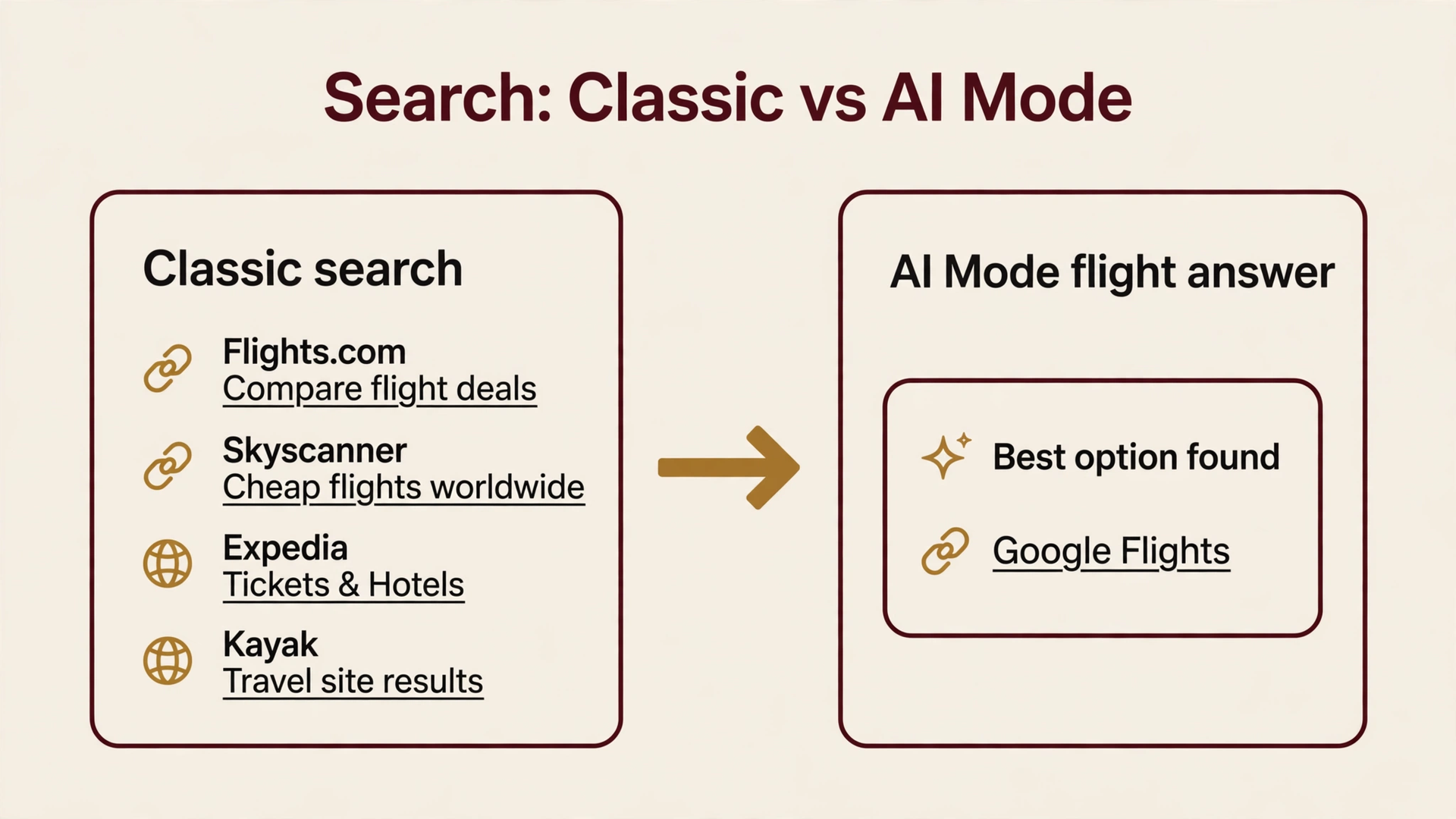
In AI Mode flight answers, the link goes to Google itself. Ranking used to earn the click. Now the answer keeps it.
What the test proves, and what it does not
The sample is small. Schwartz ran the test over one weekend and published one screenshot, saying he had dozens. Neither he nor Natzir published a count of queries run. Nobody has published a measured rate, and nobody has tested hotels, cars, or destination questions the same way. Treat this as a sighting with two independent witnesses. I treat a sighting like that as a prompt to test, not a fact to cite.
In late August, Prince of Travel asked AI Mode what a Toronto to Miami flight on October 16 cost in AAdvantage miles. AI Mode priced the 6 a.m. nonstop at 23,500 miles plus $88 CAD, and the booking link went to aa.com. So the pattern holds for cash flight searches in the tests so far. The one award test published, a single AAdvantage query, handed off to aa.com. But the same article's Aeroplan query did not hand off at all. It answered in cash. Treat the cash/award split as untested.
The pattern across four launches
This is the fourth time since late August a transaction, or the link to it, has ended up inside Google's own surface. Three arrived by announcement. One was observed in testing.
| Date / event | What happened | Where the click lands |
|---|---|---|
| Aug 27, 2026: AI Mode travel features | Flight price tracking in 180+ countries, points and miles rates, hotel booking in the US | Prices come from 300+ partner airlines and travel sites; hotel booking runs through Google Pay |
| Oct 15, 2026: Universal Cart | Checkout inside Search and Gemini, with Google as merchant of record | The purchase completes without leaving Google |
| Nov 3, 2026: AI Mode flight links | No announcement; observed in testing by Schwartz and Natzir | Every link in the tested flight answers went to Google Flights |
| Nov 4, 2026: AI Mode home-service booking | Booking links inside the answer for home services | The booking starts in the answer, not on the business site |
I covered Universal Cart and the home-service booking links in earlier posts. The direction in all four rows is the same. Google keeps adding steps of the journey inside its own answer, and the outside link gets thinner each time. With flights, the outside link is gone in the tests published so far.
Hotels got ten named booking partners and a Google Pay checkout, and the hotel or booking site stays the merchant of record. Flights got price tracking and, in the tested answers, a link only to Google Flights, with no partner booking link in the answer. Where a partner still owns the transaction, the partner's name stays in the answer. Where no partner owns it, Google's own surface takes the click.
Google's own announcement says AI Mode shows flight prices from more than 300 partner airlines and travel sites. Those partners supply the prices that make the answer useful, and the answer links only to Google Flights. The data flows in from the web. The click does not flow back out.
The money layer sits underneath
The same week the flights pattern surfaced, AI Mode's ad load grew. Search Engine Watch reported four text ads stacked under a single answer on November 2, up from the usual two, with three spotted weeks earlier; Search Engine Roundtable reported the four-ad layout on November 4. Google had already announced on October 28 that ads would appear on follow-up questions in AI Mode in the US and expand to ten more countries. Search Engine Roundtable reported that Google said on its earnings call it would show more ads, more often, in AI Mode.
In the published screenshots, the ads sit below the answer. In the tested flight answers, the only outbound link went to Google Flights. The organic citation still exists, but the exit that used to carry the click now points inward.
The regulator question is already written
Schwartz opened his post with a prediction: "I am sure the Digital Markets Act (DMA) folks in Europe are going to like this." Schwartz's point is that a regulator concerned with self-preferencing would notice this. Whether the DMA reaches it is a legal question I am not answering here.
Google's announcement says flight price tracking is available in more than 180 countries and territories; Prince of Travel notes that footprint covers every market where AI Mode is offered except the European Economic Area. Price tracking, the feature whose answers link only to Google Flights in the published tests, is not available in the EEA, per Prince of Travel's reading of the footprint. Whether the link pattern itself differs there is untested.
The check: a three-query AI Mode link audit
I run a fixed prompt panel every Monday across four AI engines, logged in and logged out, three samples per question, logging which pages get cited and which get the click. The flights finding adds one column to that log, where every link in the answer goes. Run the same check in ten minutes, because your vertical may already look like flights.
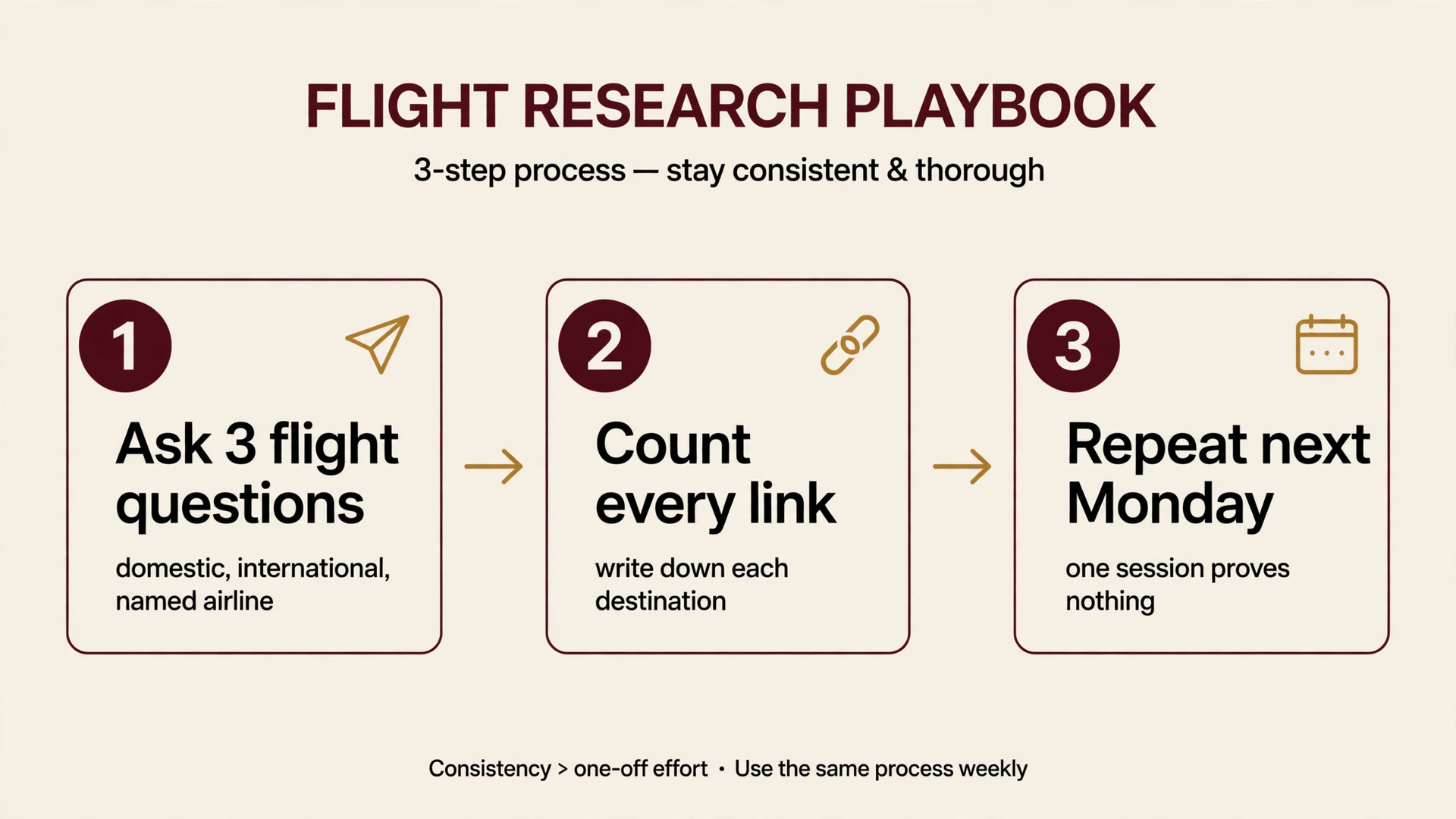
Ask AI Mode three flight questions: one domestic route, one international route, and one that names a specific airline. In each answer, count every link and write down its destination. Then ask three questions in your own vertical: one hotel, one car rental, one destination question. Log the same thing. Run it logged in and logged out, and again next Monday: one session proves nothing, a pattern across weeks proves a lot.
Then read the result as a decision. If every link in your vertical points to a Google surface, stop spending that effort chasing the AI Mode citation and start feeding the surface that gets the link. For flights, that means feeding the data Google Flights ingests from airlines and travel sites. For hotels, it means feeding the booking partners AI Mode already lists. The citation is still worth having. It is no longer the thing that delivers the customer.
Run the three queries in your vertical before you plan another quarter around AI Mode citations. If your links point the same way, be present on the surface the answer points to.

About the author
Dalin de Graff is a digital marketing expert based in Winnipeg, Canada, with 9 years of experience across SEO, GEO, and AI search. At First Rank, he built the agency's GEO practice and leads its work on AI search and LLM visibility. His results include +311% organic clicks, +300% calls, and +98% AI search traffic in 30 days. He writes about search, AI, and marketing at dalindegraff.com.