Your AI Overview Link Moved to the Bottom of the Answer
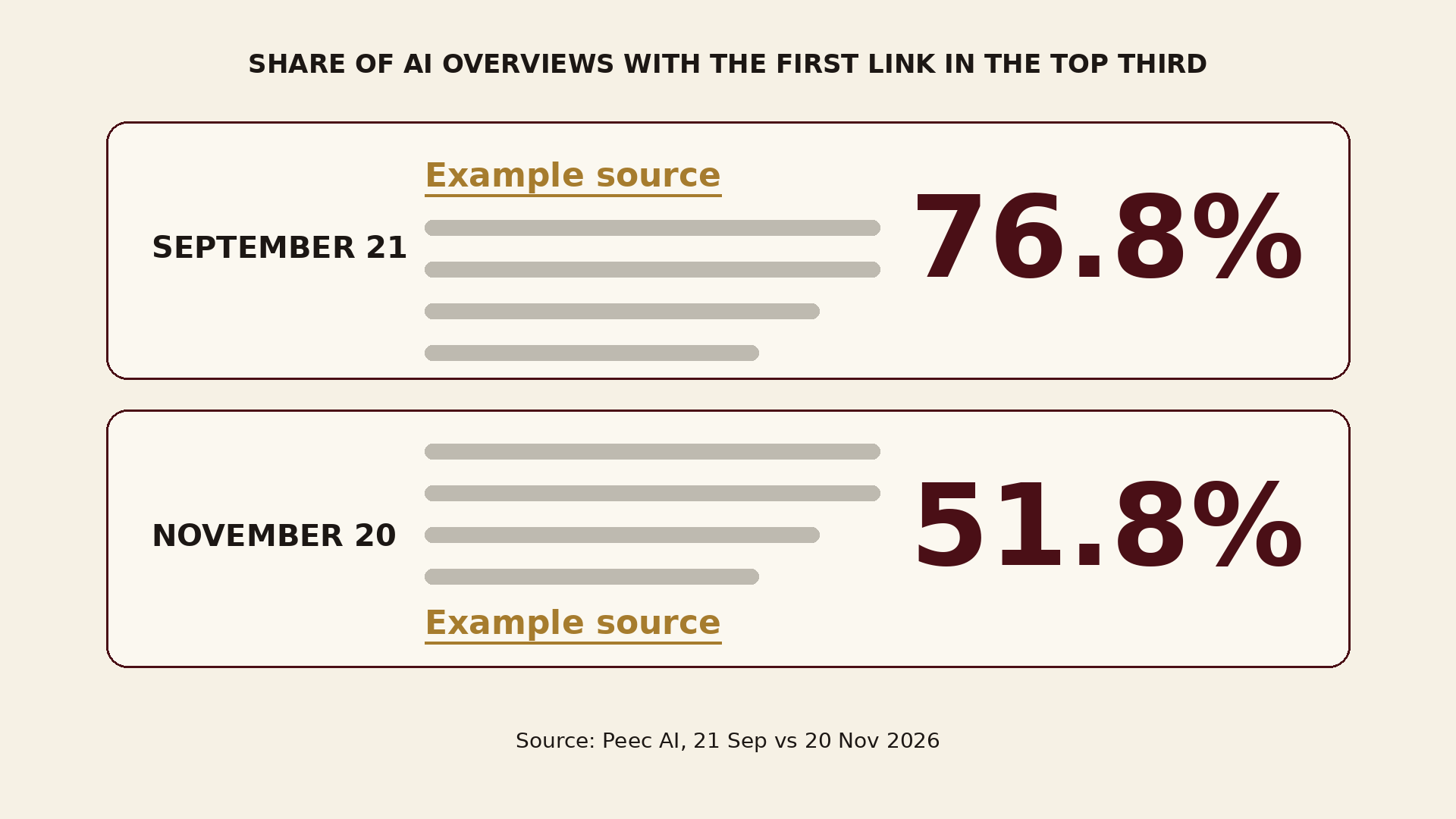
Peec AI tracked the first inline link in AI Overviews falling from 76.8% in the top third of the answer to 51.8% in two months. A citation is not a click.
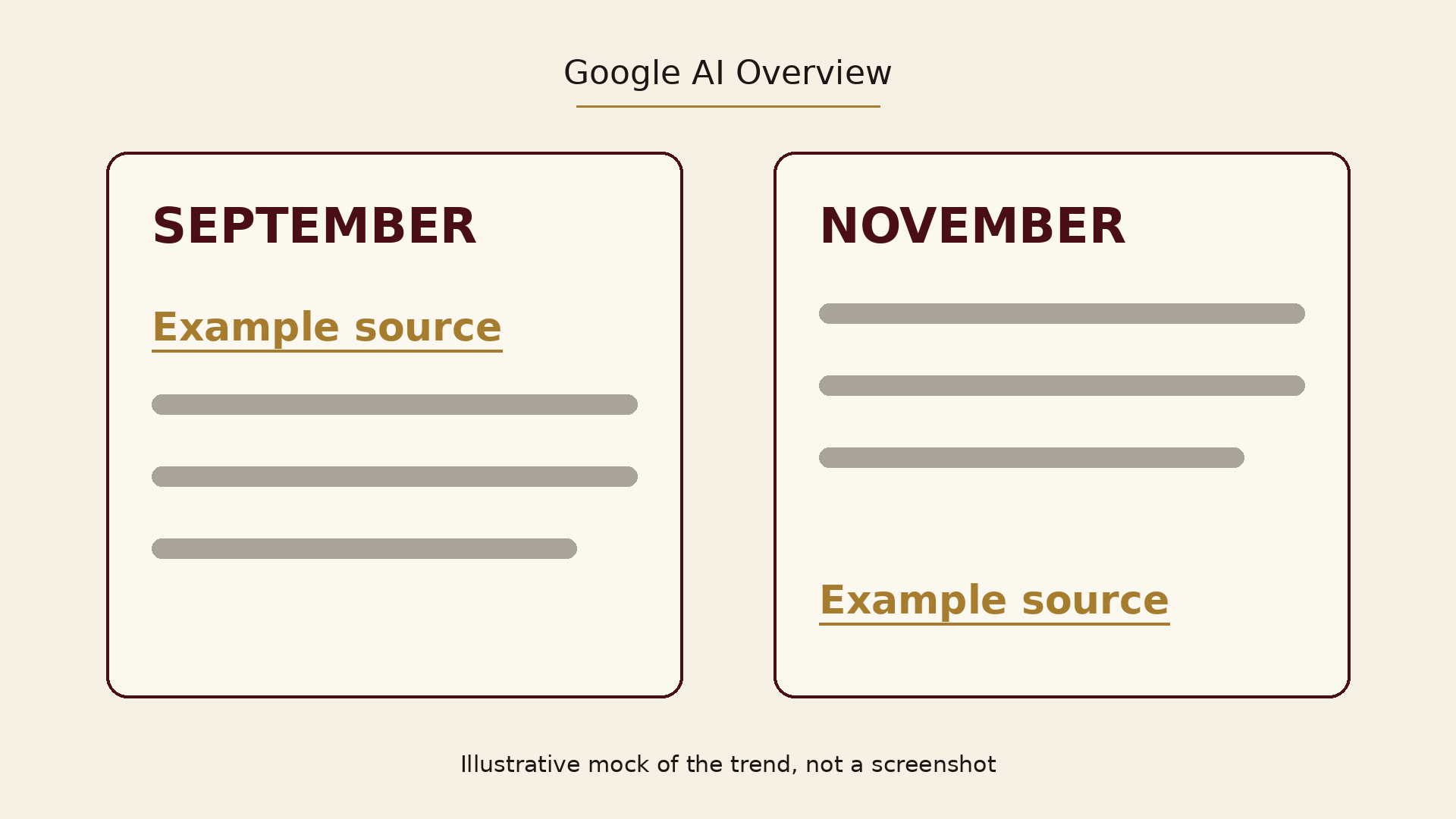
On September 21, 76.8% of Google AI Overviews put their first inline link in the first third of the answer. By November 20, that share was 51.8%. That is a 25-point drop in two months.
On October 15, Google said it was launching updates to show inline links higher up in responses more frequently. The second of the two noticeable drops came on October 30, two weeks after that announcement. But Google published no baseline, so there is no promised number to measure against, and the first drop, around October 9, predates the announcement. A citation count never told you whether anyone could reach your site. Now it does not tell you where your link sits.
What the numbers count
David Konitzny, a researcher at Peec AI, shared the figures on LinkedIn and X on November 23, and Search Engine Roundtable reported them the next morning. Konitzny reports examining more than 88 million AI interactions, with two noticeable drops, around October 9 and around October 30.
Konitzny counted inline links, the hyperlinked words inside the answer text, and left out the source cards beside an answer. A second dataset published November 24 confirms the distinction. The chips sit early and the text links sit late. But by its own statement it cannot show a trend, and it is not comparable with the Peec series.
Peec AI is an AI search analytics company, and the published summary includes no query set, country breakdown, or count of qualifying overviews. No Google response to the figures appeared in the coverage reviewed. Treat the series as a signal worth logging against your own data, not as settled fact.
Two links, two positions
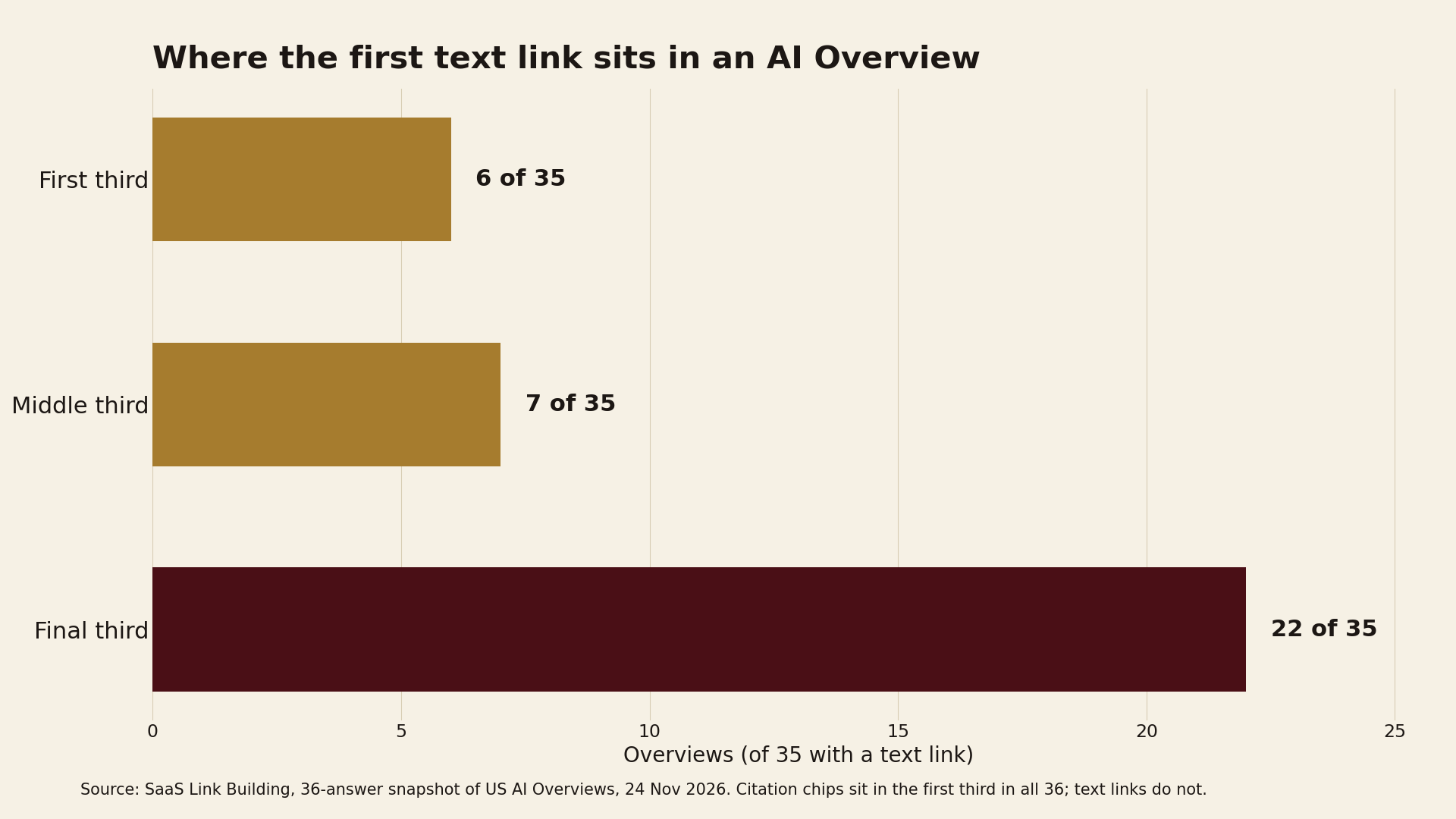
SaaS Link Building searched 41 US queries on November 24 and analysed the 36 overviews that loaded. The citation chips sit near the top. The text links sit near the bottom.
| Link type | Where the first one sits |
|---|---|
| Citation chip (source icon at the end of a passage) | First third in all 36 answers, median 16% of the way through |
| Inline text link (hyperlinked words in the answer) | Final third in 22 of 35 answers, median 85% of the way through |
The chip shows where a claim came from. The text link is the only thing a reader can click without opening a panel, and it arrives after the answer is over.
Three in four of the 89 text links sat in the final third, and 54% sat in the very last sentence or list item. Reddit took 17 of the 89 text links, one in each of 17 different overviews, more than any other domain. Government sites took 15, led by the CDC with four. The closing line of an answer is where Google sends readers elsewhere, and those two took the most text links overall (17 and 15 of 89).
The same answer, two link positions
Ask how to get TSA PreCheck and the opening sentence links to the TSA site. For jet lag, the CDC appears in the first paragraph. For vitamin D, vaccines, or a check engine light, the first text link came after at least 96% of the answer.
The exceptions were mostly searches with an obvious official or institutional source. TSA PreCheck and the CDC on jet lag got linked near the top. That matches Google's October announcement and the test I covered, in which Google is testing a dedicated section at the top of some answers. Explanatory questions get the opposite treatment. The answer runs its full length, and the link shows up in a closing pointer such as "You can review full IRS rules on Fidelity or compare account features on Vanguard."
My read is that business questions will usually behave like the explanatory ones in this pull. The study does not break results out by topic, so this is an inference to test against my own money questions, not a finding. That would put your service page, your guide, and your comparison post in the final line. The exception is a task page with one canonical URL for one job, and that is a page worth building on purpose.
A citation is not a click
A draft paper on SSRN found 39.8% fewer outbound organic clicks on queries where an AI Overview appeared. I broke that study down in a separate post. The answer keeps the reader, and the link has to earn the click that remains.
Search Console cannot tell you whether it does. Its generative AI performance report shows impressions by page, country, device, and date, but no clicks. A link at the bottom of an answer and a link at the top register as the same impression, and a dashboard counting citations treats both the same way.
Elizabeth Reid, VP of Search, said in a FOMO Sapiens interview circulated November 23 and reported November 24 that people do not want purely AI, they want AI and the web. She drew the line at commodity content. A page that tells you the time zone in Japan is replaceable, while perspectives, unique experiences, and in-depth research still draw demand.
CXL analyzed 100 AI Overview citations and found 55% of the cited passages came from the first 30% of the source page. Kevin Indig found the same shape across 18,012 verified ChatGPT citations, where 44.2% came from the first 30% of the document. Put the answer early on your page or the model is less likely to reach it. Your link still sits at the bottom of theirs.
Log the position, not the citation
I run a fixed set of money questions through ChatGPT, Gemini, Perplexity, and Claude, logged in and logged out, scored weekly. The log already records whether the answer names the brand, cites a page, links to it, or sends the task to a booking page. From this week it records one more column: where the link sits. Recast in my log's format, the SaaS Link Building pull gives two rows. The position values are theirs, the columns are mine:
| Question | Link present? | Link position |
|---|---|---|
| How to get TSA PreCheck | Yes | Opening sentence |
| What is vitamin D good for | Yes | After 96% of the answer |
A citation count can rise while the link sinks. The dashboard reports the first and hides the second.
The fix for a late link is a reason to leave the answer. SaaS Link Building put it plainly: pages that win the closing slot offer something the summary cannot, a calculator, a full rule set, a tool, or a thread of first-hand experience.
Start with the page that already gets cited. Add the one thing on it a summary cannot reproduce: your own numbers, a working tool, or a decision the reader makes with your data in front of them. Then run the money questions again and watch the position column.

About the author
Dalin de Graff is a digital marketing expert based in Winnipeg, Canada, with 9 years of experience across SEO, GEO, and AI search. At First Rank, he built the agency's GEO practice and leads its work on AI search and LLM visibility. His results include +311% organic clicks, +300% calls, and +98% AI search traffic in 30 days. He writes about search, AI, and marketing at dalindegraff.com.