Google Preannounced the December Core Update. Measure Before It Lands.
Google preannounced its December core update for complex questions and personalized results. Here is the five-check pre-flight to run before it lands.
Google preannounced a core update. I am freezing a baseline first.
On November 24, the Google Search Status Dashboard listed a December 2026 core update before it ships. It "focuses on multiple improvements to how our systems understand and rank relevant content (including for longer and more complex questions), as well as improving personalized results for people who have personalization turned on." No start date was given. A Google spokesperson told Search Engine Roundtable: "We don't have a date yet." Google will announce it as usual the day it starts rolling out, and the spokesperson confirmed three times that it is not imminent.
That same day, three other things landed, and a fourth had landed the day before. The November 2026 core update finished after a 14-day rollout, November 10 to 24, with a model swap two days in, when Gemini 4 Hydrogen became the default behind AI Mode. Google opened a new Search ranking hub. And it published a document that explains, in plain steps, how AI Overviews and AI Mode pick the pages they link to. The day before, Google announced that AI Mode can now draw on Wallet, with Drive and the Gemini app to follow, and that AI Overviews and AI Mode will show more personally relevant responses based on recent search context.
There is no longer one ranking to watch. The December update ranks for the complexity of the question and for the person asking it. The likely reason for the advance notice, per Google's new notice document, is the UK Competition and Markets Authority's fair-ranking-conduct requirement for UK users facing a significant ranking shift. Google has said for years that it does not pre-announce core updates. This time it did, and the notice names the two things to measure: complex questions and personalization.
What Google published on November 24
The new document is called Attribution and factuality in Search generative AI features, and it lays out source selection in four steps. First, the model starts from ranked results in the Google Search index, and snippets from those pages form the basis of the overview. Second, it may run related searches, which Google calls query fan-out, to retrieve pages that address different parts of the question. Third, it writes the response from those results and cites the pages that support specific claims in it, a step Google calls grounding and corroboration. Fourth, it picks which links to show by balancing relevance and quality signals with layout and a diverse set of sources.
The model starts from snippets of ranked pages, so an answer buried late in the page is less likely to be cited than one stated plainly near the top. And a page earns a link by backing up a claim the answer makes: a price, a step, a definition, a date. Google says the same practices that help a site in Search help it get linked: clear sourcing, author and site background, and facts kept current.
The display step has moved against publishers this autumn. Peec AI's David Konitzny tracked the first inline link in the first third of AI Overview answers falling from 76.8% on September 21 to 51.8% on November 20, across 88M+ chats. That is one vendor's sample, reported by Search Engine Roundtable on November 24. The link you earn can still sit where few readers reach it.
The complex question is the unit that matters now
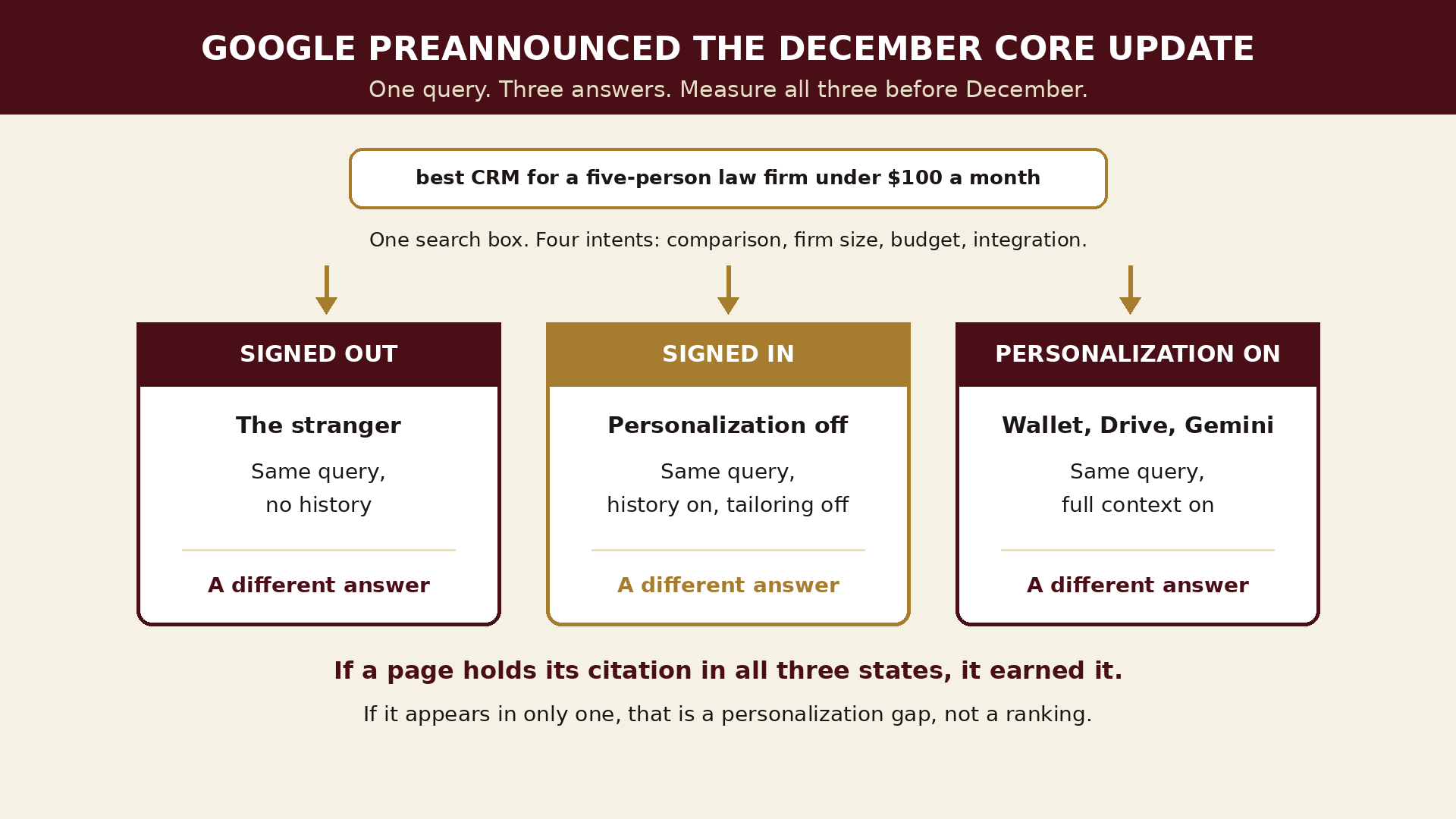
Take one query a buyer would type: "best CRM for a five-person law firm under $100 a month that integrates with Outlook." That is one search box and four intents at once: a comparison, a firm size, a budget, and an integration. Fan-out splits it into separate searches, one per sub-question, and each one can surface a different page. A page that answers only "best CRM" competes in the first search and vanishes from the other three. When I audit a money page now, I list the sub-questions first and check each one against the page. A missing sub-question is a missing citation.
| Sub-question fan-out asks | What the page must show |
|---|---|
| Which CRMs fit a five-person law firm? | A named fit for small firms, not a generic list |
| Which cost under $100 a month? | A current price, with the plan named |
| Which integrate with Outlook? | The integration named, with what it syncs |
| Which do other small firms pick? | A named small-firm case or review count, with the source linked |
Personalization is now a ranking variable
The November 23 announcement extends Personal Intelligence in AI Mode to Wallet, rolling out now, and to Drive and the Gemini app in the coming weeks. Four apps feed context now: Gmail, Calendar, Photos, and Wallet. Drive and the Gemini app make six once they land. Google also said users will start seeing more personally relevant responses in AI Overviews and AI Mode, tailored to recent search context. Google's personalization help page explains that personalization does not change every result, but it may change the order of individual results or entire result groups.
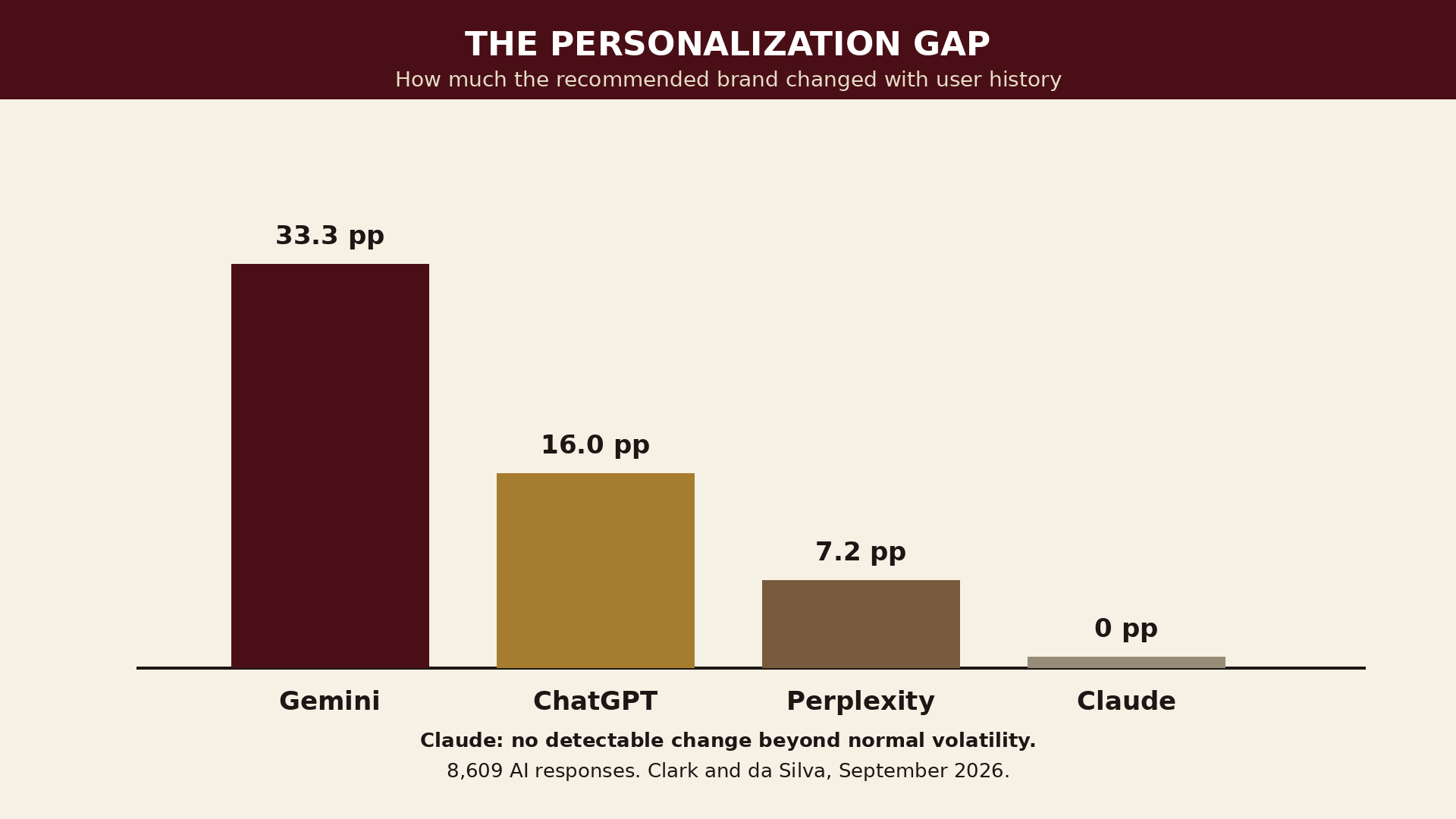
Cassie Wilson Clark and Joao da Silva measured how large that effect can be in AI assistants, before Google made it a Search feature. They ran 8,609 responses through ChatGPT, Gemini, Claude, and Perplexity, comparing history-free API calls, temporary logged-in sessions, and accounts primed with user history. Above the study's volatility floor, brand-set divergence was 33.3 percentage points on Gemini and 16.0 on ChatGPT. Perplexity moved a borderline 7.2 points. Claude showed no detectable change. The numbers do not transfer to Google Search. The pattern suggests what happens when the system knows the asker.
A single rank check no longer tells you where you rank. I run a fixed set of money questions through ChatGPT, Gemini, Perplexity, and Claude, logged in and logged out, scored weekly. The log records whether the answer names the brand, cites a page, links to it, or sends the task to a booking page. That panel stays as it is. December needs a second measurement on Google itself. Run the same money questions in AI Mode and AI Overviews in three states: signed out, signed in with personalization off, and signed in with personalization on. I will run the same questions in all three states in the same week. If a page holds its citation in all three, it held across states. If it appears only signed out, it ranks for a stranger and loses the customer.
The five-check pre-flight
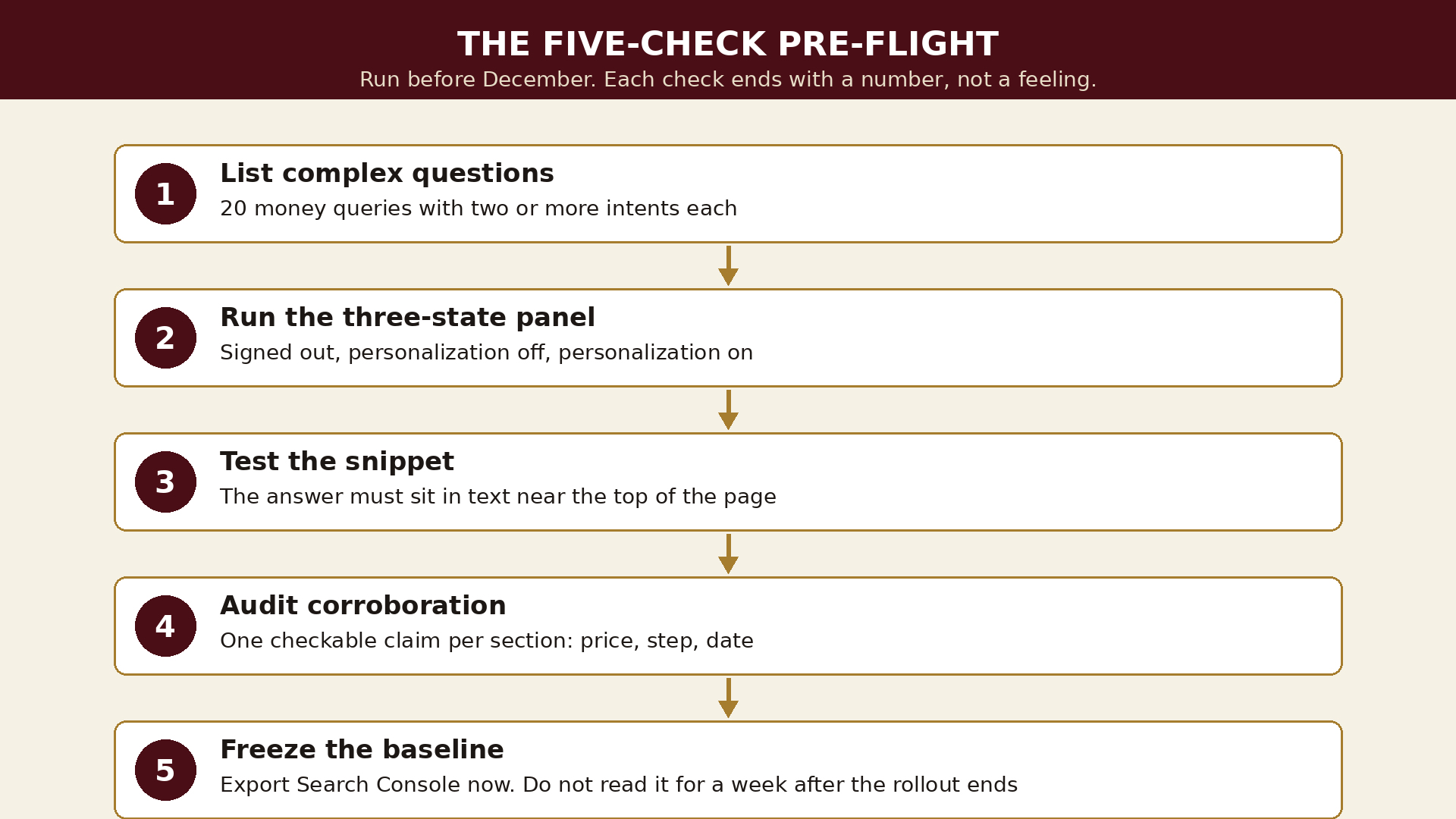
Run these before December, while the update is still a date on a dashboard. The checks flag pre-existing gaps: a sub-question with no answer, a claim with no source, a page that only ranks for strangers. Only flagged gaps get fixed before December.
| Check | Record before December | Decision rule |
|---|---|---|
| 1. Complex-question list | 20 money queries with two or more intents each | Any query with no page answering every sub-question goes on the fix list |
| 2. Three-state Google check | Same questions, signed out, personalization off, personalization on | A citation in one state only, across repeat runs, points to a personalization gap, not a ranking |
| 3. Snippet test | The answer to each sub-question, in text in the first 30% of the page | CXL found 55% of cited passages came from the first 30% of the source page; Kevin Indig found 44.2% of 18,012 verified ChatGPT citations in the first 30% |
| 4. Corroboration audit | One checkable claim per section: price, step, date, definition | A claim with no source or no current date gets fixed or cut |
| 5. Baseline export | Search Console clicks, impressions, and average position for the 20 queries | Freeze the export. Do not read it again until a full week after the rollout ends |
Google's standing advice is to wait until the rollout finishes, then wait at least one more full week before reading Search Console data. That puts honest answers about December somewhere in January. Without the baseline export, every change looks like the update, including Black Friday traffic still in the numbers and the November update that finished on November 24.
What not to do
Do not rewrite pages on the strength of the preannouncement. Google gave a scope, and nothing in it names a ranking factor to optimize for. Fix only what the five checks flag, and leave the rest alone until the rollout ends.
Do not read your Search Console numbers during the rollout either. The November update ran 14 days, and December will run its own course. A dip in week one is noise until the rollout completes and the extra week passes.
Freeze the export this week and do not open it again until a full week after the rollout ends.

About the author
Dalin de Graff is a digital marketing expert based in Winnipeg, Canada, with 9 years of experience across SEO, GEO, and AI search. At First Rank, he built the agency's GEO practice and leads its work on AI search and LLM visibility. His results include +311% organic clicks, +300% calls, and +98% AI search traffic in 30 days. He writes about search, AI, and marketing at dalindegraff.com.