Your ChatGPT Ad Just Fired on a Query Nobody Typed
OpenAI's ad agent writes its own queries to match ads in ChatGPT. You cannot see the trigger, bid on it, or report on it. Here is what still works.
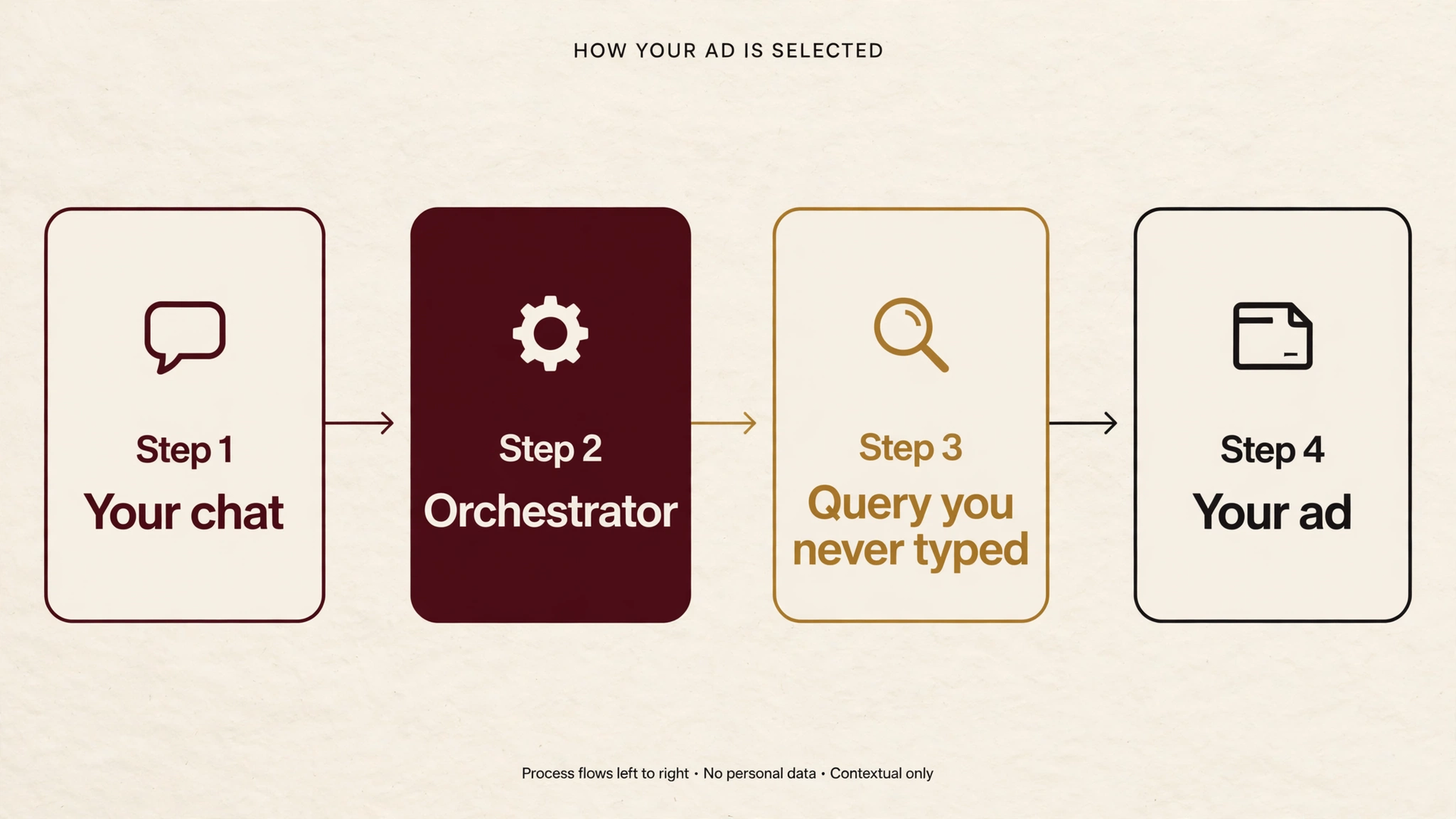
On November 23, Adweek reported that ChatGPT ads run through an internal agent OpenAI calls the orchestrator. The orchestrator reads a conversation, works out what the person might want to buy, and writes its own queries to match ads against. An ad can fire on a query the user never typed. OpenAI engineer Ritendra Datta put it plainly: "It's like a completely made-up query that is not in the user's search at all."
Inside ChatGPT, the keyword is not an input you control. In Google Ads you bid on a term, see it in your search terms report, and add the bad ones as negatives. In ChatGPT you can enter keywords only as hints. OpenAI's CTO of applications told Adweek advertisers can enter keywords and location as targeting parameters, and one agency buyer put it plainly: keywords act as hints rather than hard targeting. The trigger is invented by the platform, inside a conversation you cannot see. There is no search-terms report, and Raji said not to expect prompt- or intent-level reporting.
How the orchestrator picks an ad
The sequence, as Adweek's three OpenAI executives described it: the orchestrator reads the current conversation and infers commercial intent, writes search-like queries from that context, ranks the ads in OpenAI's inventory, and sends the strongest candidates to an auction. The auction weighs your bid against how useful OpenAI expects the ad to be. OpenAI's own help center lists what the system considers: the context and intent of the current conversation, the ad's landing page, title and copy, advertiser-provided context hints and targeting selections, and, when personalization is on, select signals from the user's broader ChatGPT experience.
Keywords enter the system only as hints. The inputs you control are the page the ad points to, the copy on the ad, the context hints you hand OpenAI in Ads Manager, and the targeting selections you set there. Everything else is the model reading a conversation.
What you get to see: totals
Advertisers get aggregate reporting only: views, clicks, spend, and attributed conversions, with no prompt or query attached. OpenAI's help center confirms advertisers never receive chats, chat history, memories, names, email addresses, or precise location. You cannot see the prompt that triggered your ad, the query the orchestrator invented, or the conversation it came from. Several advertisers Adweek spoke with treat ChatGPT ads as test spending rather than a measurable performance channel. You are buying outcomes from a system that will not show you its inputs.
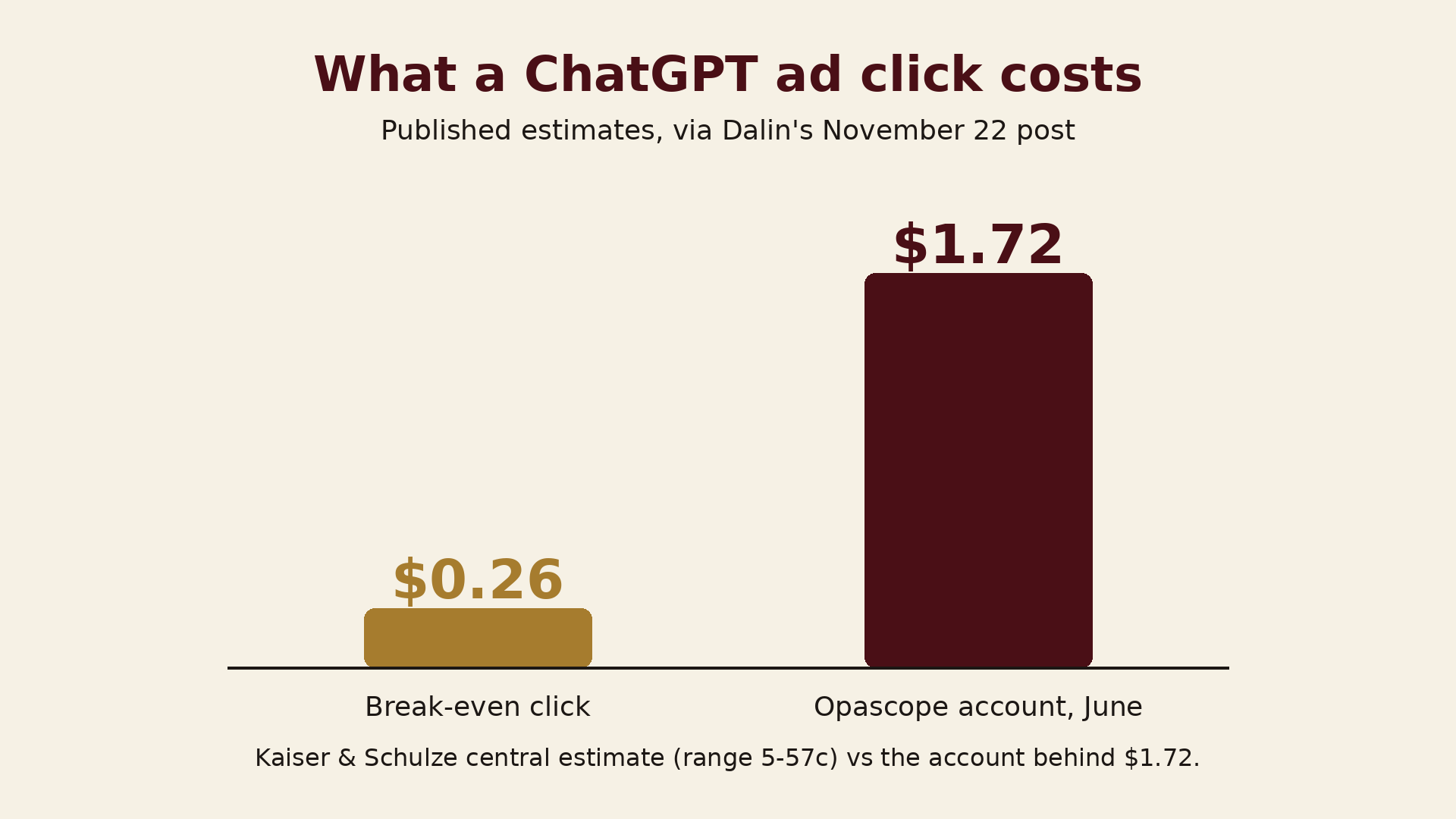
The best published estimate puts the break-even ChatGPT click at 26 cents. Two marketing professors, Maximilian Kaiser and Christian Schulze, priced it from a panel of 102 advertiser sites: resampling puts the parity price anywhere from 5 to 57 cents, around a central estimate of 26 cents. The account behind the $1.72 figure, Opascope, paid $1.72 a click in June on about $60,000 of spend over 15 days. Treat the 26 cents as fragile: one advertiser drove 76% of US paid ChatGPT revenue in the panel, and the parity math assumes equal margins on a single tracked visit. A 26-cent click with no query attached leaves nothing to prune and nothing to repeat.
OpenAI lets users open an About this ad panel that explains why an ad appeared. That panel is the one place OpenAI shows its reasoning for a specific ad.
Amazon already plays both sides of this
On November 24, Digiday reported that Amazon is running Black Friday ads inside ChatGPT in the US. Open Amazon's robots.txt and you will find three OpenAI crawlers blocked outright: GPTBot, ChatGPT-User, and OAI-SearchBot each get Disallow: /. Amazon will not let OpenAI's crawlers read its catalogue, but it will pay OpenAI to put its deals in front of ChatGPT users anyway.
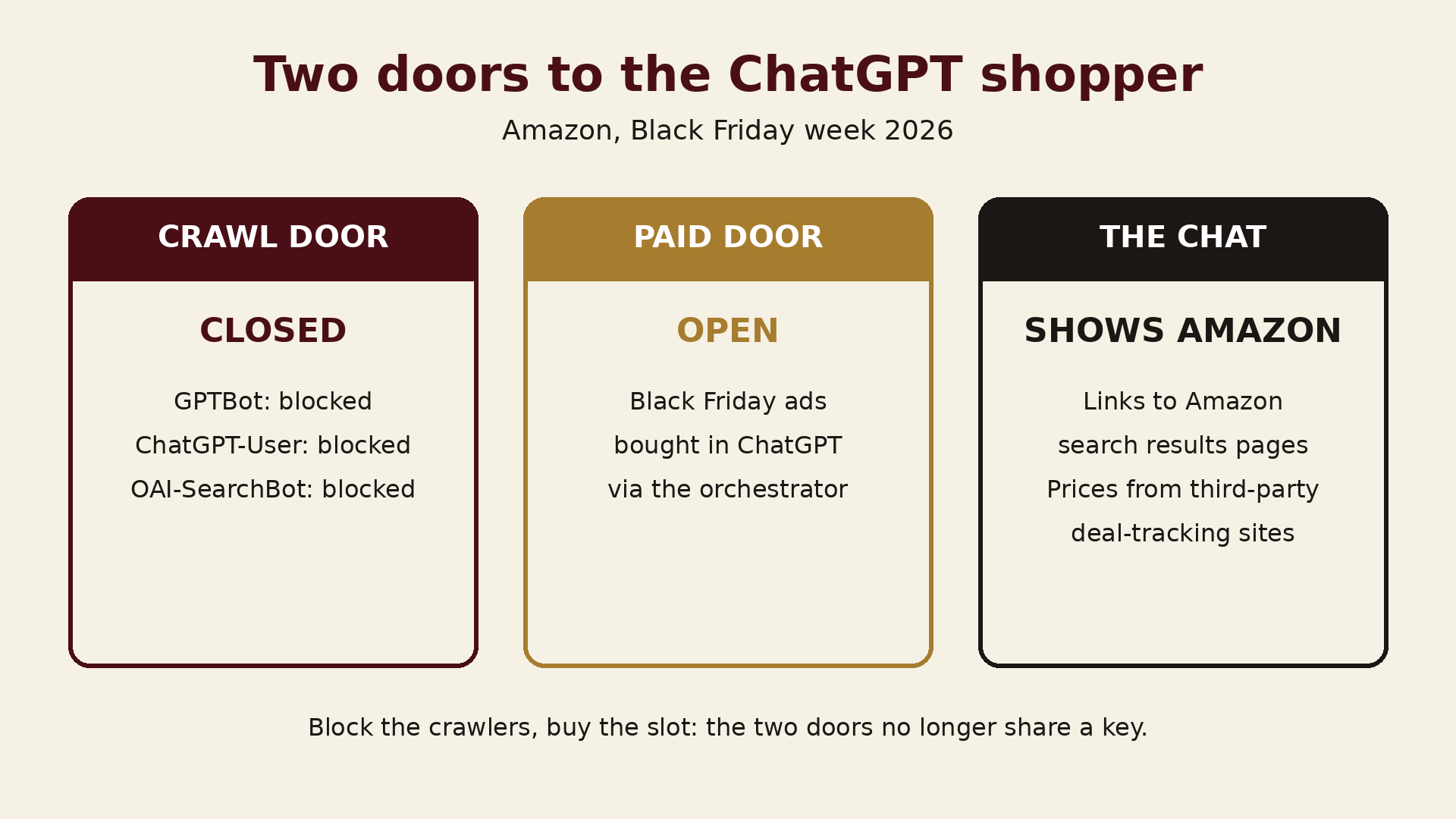
Digiday found ChatGPT still shows Amazon deals, but instead of product pages it links to Amazon search results pages and pulls prices and discounts from third-party deal-tracking sites. Amazon gets the visibility without handing over the catalogue.
The paid slot sits below the answer, separate and labeled. Ads do not influence ChatGPT's answers, per OpenAI's own help center. A site can block every AI crawler and still buy a labeled slot beside the answer. A site can open every crawler and still watch a bidder take the slot under it. Amazon blocks the crawlers outright. What is new this week is the resumption of its Black Friday ads after months quiet since Prime Day.
The paid slot does not fix the price problem. My November 17 post showed the other side of it: if the ad carries a comparison value or an old price, you pay to show a second wrong one. ChatGPT already gets a third of Black Friday prices wrong in its answers, 13 of 38 quoted prices in the Core dna test I covered on November 17.
| Google search ads | ChatGPT ads | |
|---|---|---|
| Trigger | The query the user typed | A query the orchestrator invented |
| What you see | Search terms report | Aggregate views, clicks, spend, conversions |
| What you control | Keywords, match types, negatives | Landing page, ad copy, context hints, targeting selections |
| Who sees the ad | Anyone searching | Free and Go only; no ads on Plus, Pro, Business, Enterprise, Edu |
What to do with a channel that will not show you its triggers
First, write the landing page for the conversation the buyer is already having. The landing page title and copy are now targeting signals, per OpenAI's own list. A page that answers one buying question in plain language gives the orchestrator something clear to match. A page stuffed with keyword variants gives it noise. This is the same page quality work as GEO. It now counts twice, in the answer and in the ad match.
Second, fill in the context hints. That field is the closest thing to a keyword this channel has. Treat it as the targeting. Write the three or four buying situations your product fits, in the words a customer would use in a chat.
Third, run the panel log. In your own Free-plan chats, open About this ad on every ad you see, copy the reason it gives, and write down what you typed. After twenty panels you hold a map of what the orchestrator infers that OpenAI does not publish. Treat that log as the reporting. Twenty panels is my starting sample.
Fourth, budget it as a test with a hard cap. Work your own break-even from your conversion rate and order value, and stop when the clicks stop paying for themselves. In the study's panel, 73 of 87 US advertisers recorded no sale at all from their ChatGPT ads across 18,726 visits. Judge the spend on downstream conversions only until OpenAI ships real reporting. If the conversions do not clear your bar at a test budget, kill the spend. There is no query report to fix it with.
Run the test small, log the panels, and keep the spend where the conversions justify it.

About the author
Dalin de Graff is a digital marketing expert based in Winnipeg, Canada, with 9 years of experience across SEO, GEO, and AI search. At First Rank, he built the agency's GEO practice and leads its work on AI search and LLM visibility. His results include +311% organic clicks, +300% calls, and +98% AI search traffic in 30 days. He writes about search, AI, and marketing at dalindegraff.com.