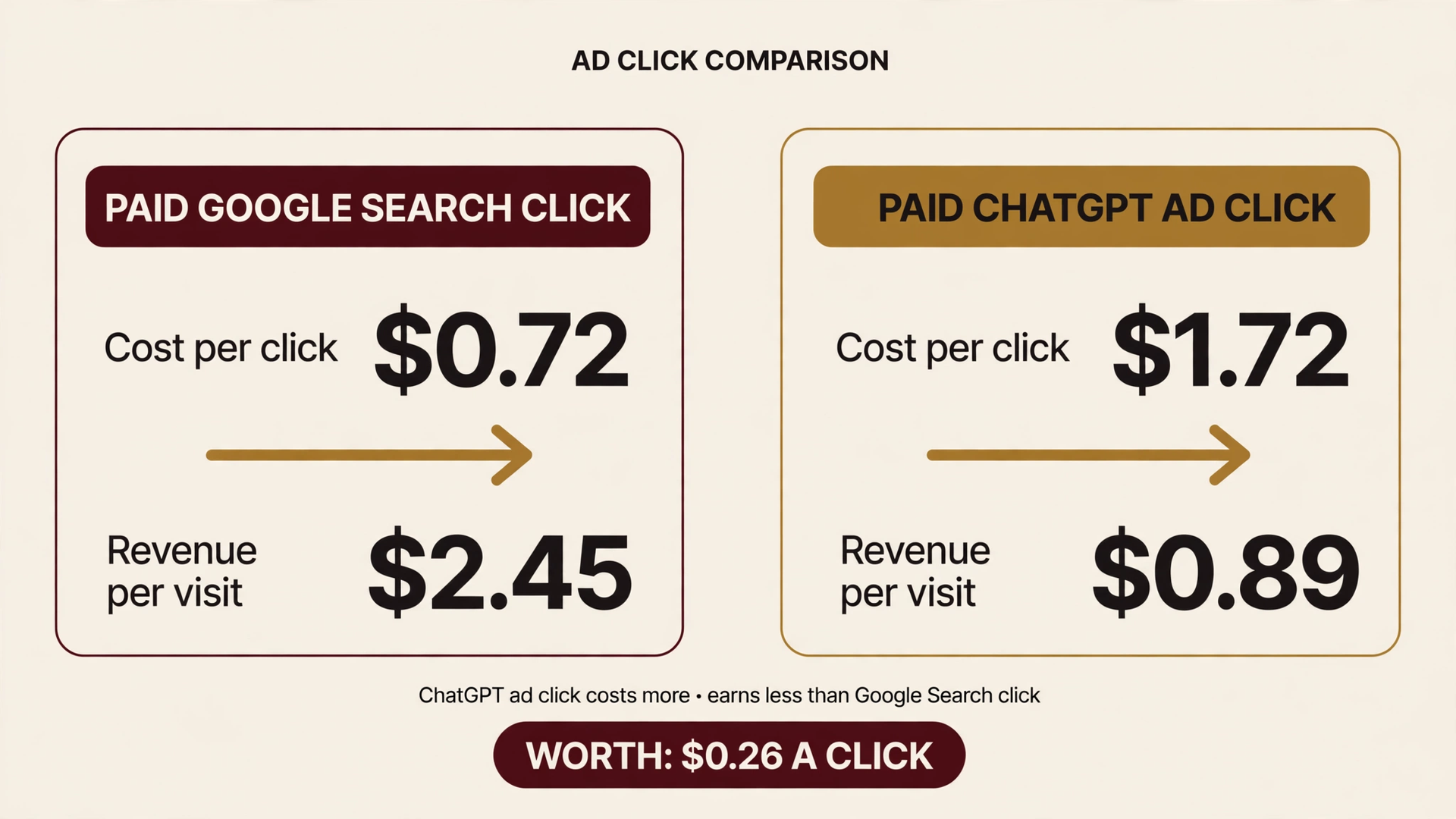
A ChatGPT Ad Click Is Worth 26 Cents. One Account Paid $1.72.
A paid ChatGPT visit earned $0.89 against $2.45 for paid search, and 73 of 87 advertisers made zero sales. The break-even click price is $0.26.
Two marketing professors priced a ChatGPT ad click at 26 cents. The largest publicly known account paid $1.72 a click, and OpenAI's own help pages suggest a starting maximum bid of $3 to $5. The price paid per click sits below that cap. That spread is the first real measurement of ChatGPT Ads. The clicks carry search-level prices and social-level intent.
At 26 cents a click, the test is worth running. At $1.72, it is a donation to OpenAI's inference bill.
What the study measured
Maximilian Kaiser and Christian Schulze published the working paper Can Advertising Fund Free AI? Evidence from ChatGPT's International Advertising Rollout in October 2026. It is version 1, under review.
Grips Intelligence supplied the data: Google Analytics ecommerce tracking from 1,898 online shops over 60 weeks to August 22, 2026, covering nearly 10 billion sessions. The paid panel is 102 advertiser sites with complete sales tracking. The panel is not pure ecommerce: about a fifth of the 102 sites are services, software, education, or finance businesses reporting leads and bookings as transactions, so the revenue figures are category-mixed, not a retail verdict.
OpenAI rolled ads out from February 9, 2026, while the European Union stayed untreated until August 24. Same shops, same weeks, with and without ads.
Three limits apply to these numbers. The comparison is descriptive, not causal: advertisers chose to buy the ads. Kaiser advises Grips Intelligence; the authors disclose that and state the firm had no role.
The paid click earns a third of a search click
In United States traffic, a paid ChatGPT ad visit generated $0.89 in revenue per session, against $2.45 for a paid Google search ad. ChatGPT ad visitors converted at 0.37 percent against 1.17 percent for paid search, so a ChatGPT click has to cost roughly a third of a search click to return the same money. The pooled appendix table:
| Channel (US traffic) | Revenue per visit |
|---|---|
| Unpaid ChatGPT answer | $3.27 |
| Paid Google search | $2.45 |
| Direct | $1.70 |
| Organic search | $1.25 |
| Paid ChatGPT ad | $0.89 |
Source: Kaiser & Schulze Table J.1 Panel B, pooled unadjusted US figures, via SearchPanel.
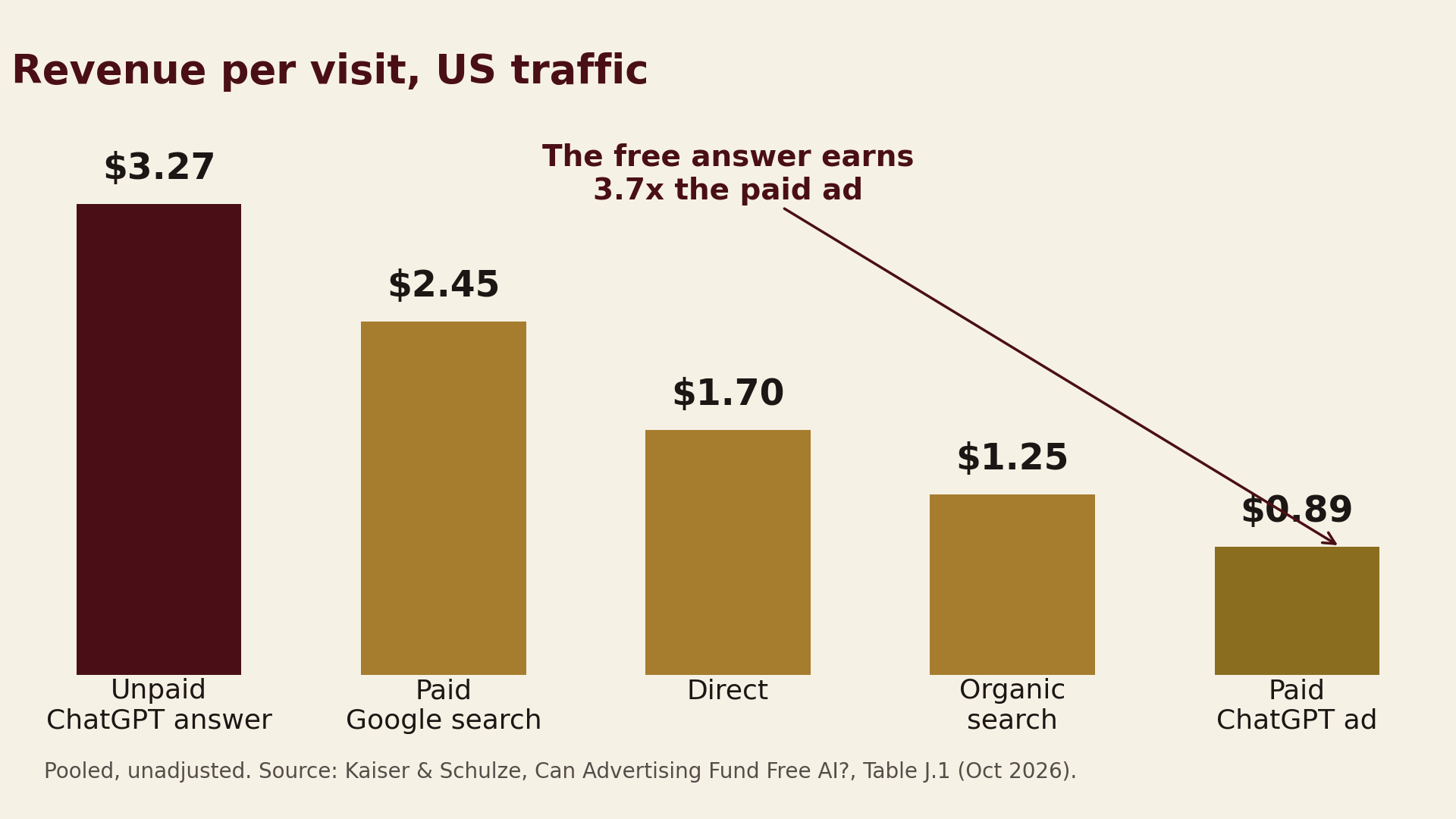
An unpaid answer earns 3.7 times what the paid placement earns. The recommendation inside the answer is the valuable inventory; the sponsored card below it is the cheap seat priced like the front row. My Black Friday test found the same gap: ChatGPT got 13 of 38 prices wrong when recommending a top-100 retailer.
Most advertisers made zero sales
Of the 87 United States advertisers who bought both ChatGPT ads and paid search, 84 earned less revenue per ChatGPT visit, and 85 converted worse. Seventy-three of the 87 recorded no sale at all from their ChatGPT ads, across 18,726 visits. The remaining 14 generated all 570 ChatGPT ad purchases. Only 18 of the 102 sites recorded any ChatGPT ad transaction at all (all countries).
A single account made 66 percent of all paid ChatGPT purchases across the 102 sites and 76 percent of all United States paid ChatGPT revenue. Resampling the advertisers puts the parity price, the click price matching search's return per dollar, anywhere from $0.05 to $0.57, around a central estimate of $0.26.
The price is wrong for the performance on record
$0.52 back for every dollar spent on ChatGPT Ads, against $3.40 for Google search. That is the Frankfurt School's press release arithmetic, computed from the measured revenue per session and the click prices, not reported inside the paper body. On the paper's figures, Google search delivers 6.6 times better value for money.
One account sets the $1.72 price: Opascope published it in June, about $60,000 over 15 days, reporting a 1.49x return. The authors call $1.72 conservative, toward the low end of practitioner reports and below OpenAI's suggested $3 to $5 starting maximum bids, a cap rather than the price paid per click.
OpenAI told Search Engine Journal the study "captures an earlier period of ChatGPT Ads' development and extrapolates platform performance from a small sample."
The small agency cases point the same way. StubGroup got cheaper leads on ChatGPT at a worse conversion rate, Workshop Digital got zero qualified leads from $2,319 of clicks, and Brafton got one form submission from 263 clicks. Cheap leads that do not convert are still a loss at $1.72 a click. OpenAI's own published case runs the other way: Jotform reports a cost per signup about 30 percent lower than paid search on July internal data, with no costs shown and no attribution detail, and sign-ups are not sales.
Ads also shrank the free channel
After ads launched, unpaid ChatGPT referrals fell by an estimated 6 to 8 percent over the first 13 weeks, against organic search referrals and the European Union control. That range comes from adjusting for faster North American adoption, not from a confidence interval. Visitors who still arrived converted at the same rate, so the traffic loss is a volume loss, not a quality loss.
Unadjusted, the estimate is a 5.9 percent drop with a 95 percent interval from minus 12.6 percent to plus 1.2 percent, which includes no change at all. The joint pre-trend test did not reject (p = .109 for volume), though four of five groups failed individually and the pooled test flagged 49 of 100 placebos.
OpenAI will keep pushing: about $1 of advertising per free user per year against roughly $5 in inference cost to serve that user. The fact sheet puts it bluntly: "ChatGPT's ads don't pay. Fixing them could cost ChatGPT its users."
The test to run before moving budget
I laid out a test design for this format in October, built on suppression first and a geographic holdout. The test:
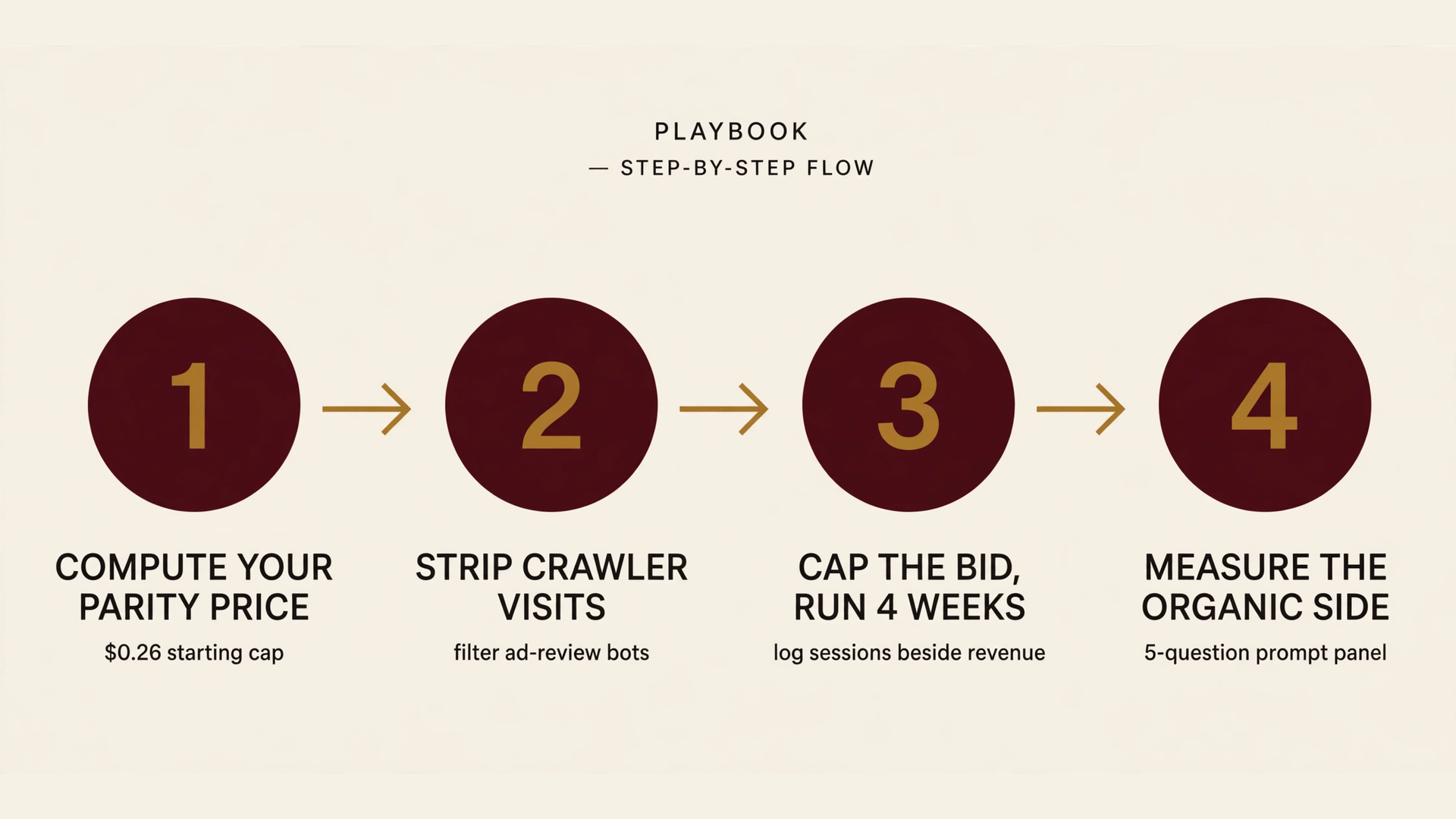
- Compute your own parity price: your revenue per visit from ChatGPT ads divided by your revenue per visit from paid search, times your search cost per click. With no ChatGPT ad data yet, use $0.26 as your starting cap. The study's $0.26 uses a $0.72 median search CPC from 16 accounts, assumes equal margins, and counts only the tracked visit.
- Strip the crawler visits first. OpenAI's own help pages say ad-review crawlers can visit landing pages carrying tracking parameters, and analytics may count those visits as paid traffic.
- Cap the bid at your parity price and run four weeks on a fixed budget. Log sessions beside revenue: a zero on 30 sessions means nothing, a zero on 1,000 means the channel did not sell. Use Target CPC. Max Bid and Max CPC retire January 1, 2027.
- Measure the organic side too. Run the five-question fixed prompt panel I use every Monday: five money questions, four engines, logged in and clean, three samples each. Log whether ChatGPT names you, quotes you, or sends the click elsewhere. The $3.27 number says the citation is the asset, and the GA4 ai-assistant medium counts what it sends.
Target CPA and Target CPC bidding arrived November 9, after this study's data ends. Better bidding does not fix a click priced more than six times above its value. What did your first ChatGPT ad test return per visit?

About the author
Dalin de Graff is a digital marketing expert based in Winnipeg, Canada, with 9 years of experience across SEO, GEO, and AI search. At First Rank, he built the agency's GEO practice and leads its work on AI search and LLM visibility. His results include +311% organic clicks, +300% calls, and +98% AI search traffic in 30 days. He writes about search, AI, and marketing at dalindegraff.com.