Google Swapped the Model Behind AI Mode. Your Citation Data Split in Two.
Gemini 4 Hydrogen became AI Mode's default on November 12. Split your citation log at that date and re-run it, or the average hides the model change.
On Thursday, November 12, Google changed the model that answers AI Mode, two days into a core update, the day after its own AI reporting stopped undercounting impressions, and one day before a reported sighting of the AI Mode tab missing from search results. Four events landed in five days, and a citation log that spans them cannot be read as one trend.
I am splitting my citation log at November 12 and re-running it. Anything that averages across that date measures two different models and calls it one result. If you track where AI answers cite you, do the same before you change a word of content.
What changed on November 12
Robby Stein, Google's VP of Product for Search, called Hydrogen "the biggest model upgrade to Search yet" on the Google blog on November 12. On X the same day he added that Hydrogen is now the default model in AI Mode and that it answers the hardest questions in AI Overviews. Google has not said which questions count as hardest.
Hydrogen is the fast, all-around model. Carbon stays for deep, long-horizon work, limited to AI Ultra subscribers; the AI Mode menu labels them "Everyday help (4 Hydrogen)" and "Most complex work (4 Carbon)," as shown in Stein's screenshot, republished by Search Engine Journal. Google calls Hydrogen a "major standalone upgrade for teams migrating from Gemini 3.8 Flash." A swap has done this before. On September 2, Google added Gemini 3.8 Flash to the same menu and some AI Mode answers came back with no source links or citations at all. Robby Stein confirmed it publicly and the links were back within roughly 48 hours. That is what a model change looks like in the log, and it is why the version column exists.
The claim with no number in it
Fan-out splits one question into simultaneous sub-searches across its subtopics, then links to the pages those sub-searches surface. If Hydrogen runs more sub-searches per question, the answer can cite pages the old model never reached. That is the mechanism behind Google's promise of "a broader range of helpful links than before."
Neither the blog post nor Stein's thread says how many more links or sites the wider fan-out produces. Search Engine Journal checked and found the same gap. So the claim is unmeasured in public, and it stays unmeasured until someone runs the same questions on both sides of the switch and counts what changed. Google has published no citation delta for any site. Your own panel is the one log you control.
Four events in five days broke your baseline
| Date | Event | What it corrupts |
|---|---|---|
| Nov 9 to 11 | Search Console logging error undercounts Generative AI report impressions | AI impression trend for those three days |
| Nov 10 | November core update starts, up to two weeks | Rankings, until around Nov 24 |
| Nov 12 | Gemini 4 Hydrogen becomes the AI Mode default and answers the hardest AI Overview questions | The citation set, with no ranking change needed |
| Nov 13 | Reported sighting: AI Mode tab and Ask anything box missing for one user (Glenn Gabe); not reproduced | Entry into AI Mode, if the test is real |
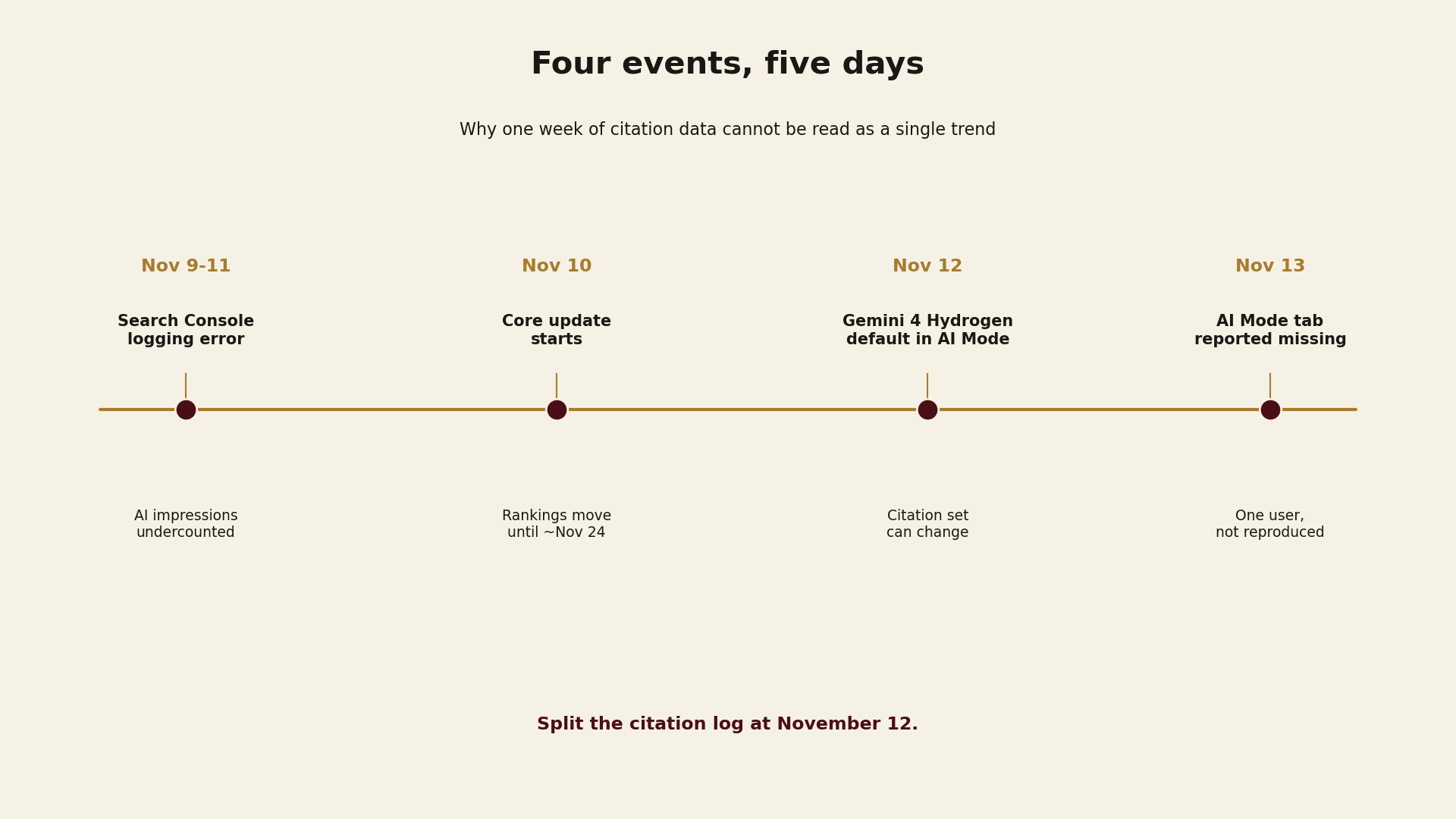
The Search Console error, confirmed on Google's data anomalies page, means any AI impression dip from November 9 to 11 is contaminated by the logging error and cannot be read as a real drop on its own. Rankings can keep moving until around November 24 while the core update runs, and Hydrogen can change the citation set with no ranking change at all. If the tab test is real, fewer people reach AI Mode through that tab.
Barry Schwartz's guess, as he put it, is that Hydrogen affects AI Overviews and AI Mode rather than core rankings, though he notes Google has said it folds core search signals into its AI experiences, so a citation move cannot be cleanly attributed to rankings or to the model switch. My November 11 post already set the core-update judgment date at December 3. Hydrogen adds a second date. November 12 is the day your citation baseline restarts.
The day after, the tab went missing for one user
Glenn Gabe posted screenshots on November 13 showing no AI Mode tab in the search tab bar and no "Ask anything" box at the bottom of an AI Overview. Search Engine Roundtable wrote it up the same day, and Schwartz could not reproduce it on his own searches.
On November 3, Search Engine Roundtable reported a single user's October 30 sighting of the AI Mode button missing from the search bar; Schwartz could not reproduce it. A homepage screenshot dated about November 3 showed the AI Mode button missing from the homepage.
Chris Long offered one reading, that AI Mode is no longer a separate experience, which would make the tab redundant. Run your own searches before you adopt it. If the tab is still in your results, the test has not reached you.
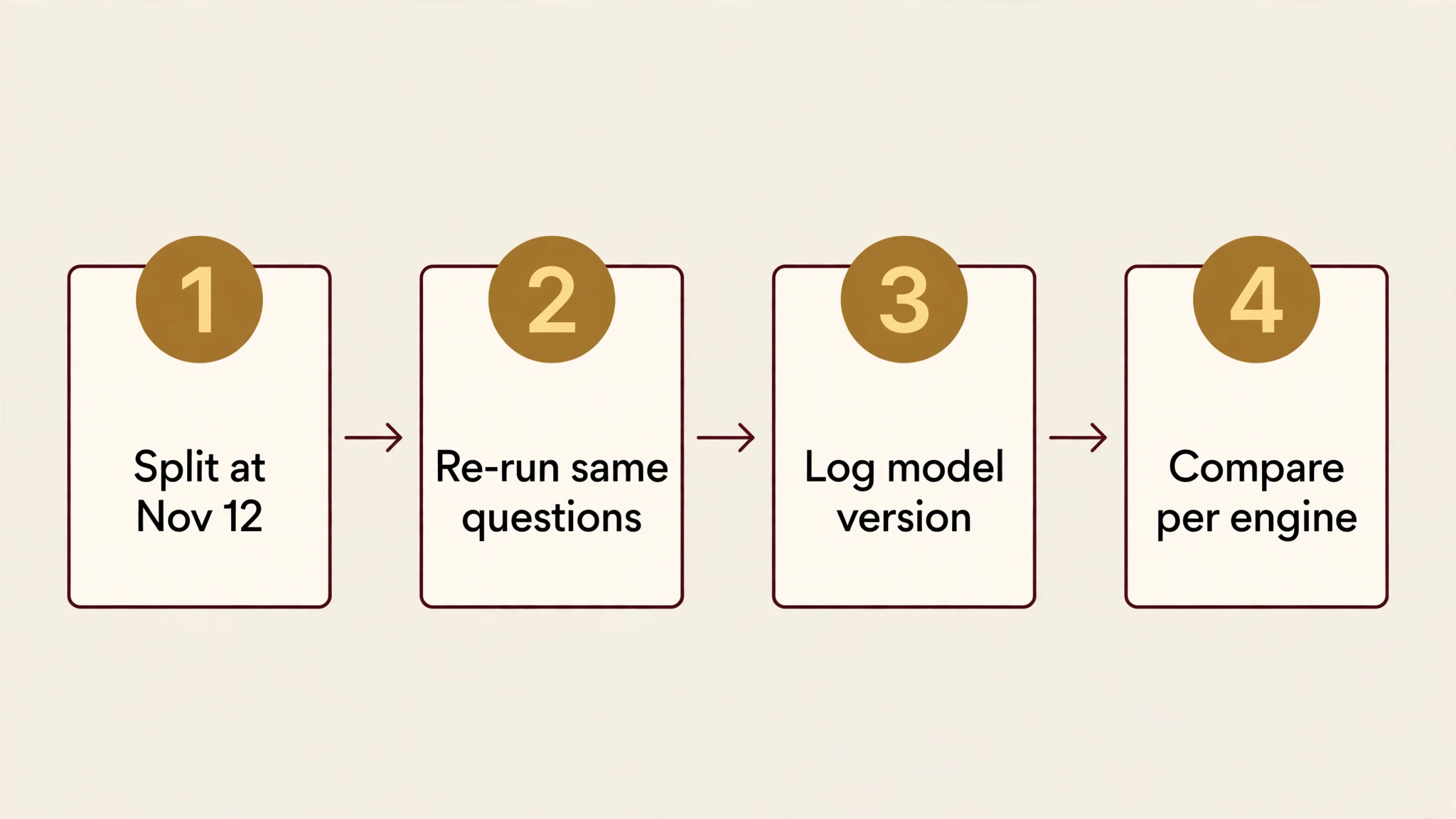
Re-run the panel in four steps
After Gemini 4 Argon arrived in AI Mode's model picker on October 13, I added a model-version column to the panel I run every Monday: five money questions, three samples each, four engines, logged in and logged out. Argon never forced a real before-and-after test, so the Hydrogen switch is the one the panel has to catch.
Step 1: split the log at November 12. Every citation row dated before it belongs to the old model. Do not average it with rows after it.
Step 2: re-run the same five questions this week, with the same samples, the same engines, logged in and logged out. Changing the questions changes what the comparison measures.
Step 3: record the model version from the AI Mode menu for every AI Mode run. A run that used Carbon belongs in a separate population.
Step 4: compare per engine and per question. Log each question as naming you, quoting you, or sending the reader to a competitor, and name the pages that gained a citation and the pages that lost one. A blended average hides the change. A move that appears only in AI Mode points to the model switch, but ChatGPT and Perplexity change their own models too, so they only cross-check the result.
Change nothing while the rollout runs, and treat a move as real only if it holds a full week after the rollout is declared complete.

About the author
Dalin de Graff is a digital marketing expert based in Winnipeg, Canada, with 9 years of experience across SEO, GEO, and AI search. At First Rank, he built the agency's GEO practice and leads its work on AI search and LLM visibility. His results include +311% organic clicks, +300% calls, and +98% AI search traffic in 30 days. He writes about search, AI, and marketing at dalindegraff.com.