Google's November Core Update Runs Straight Into Black Friday. Do Not Judge It Until December.
Google's November 2026 core update ends days before Black Friday. The first comparison week ends December 1, and it is a holiday week.
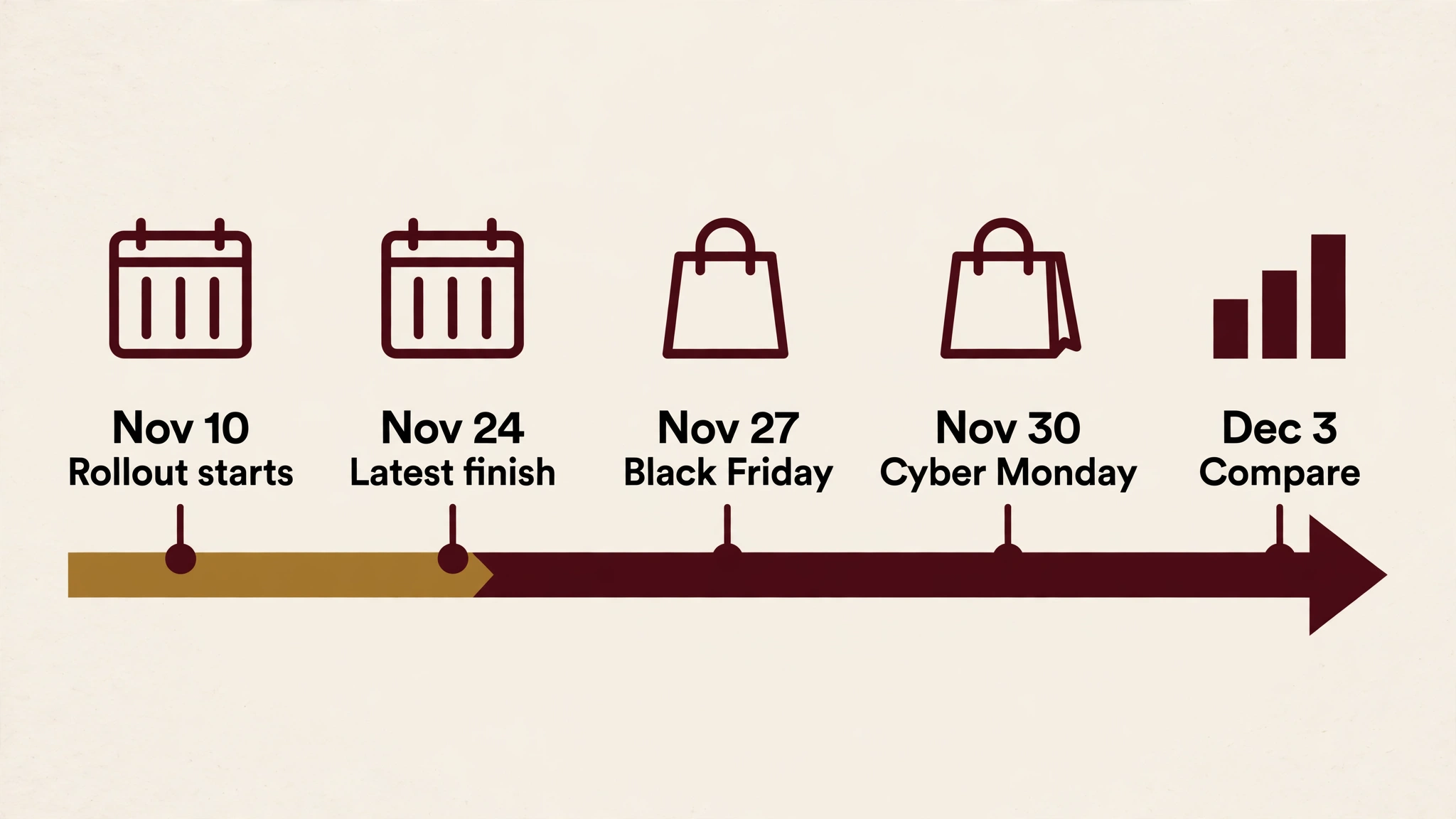
Google started its third core update of 2026 yesterday, November 10, at 10:06 a.m. Pacific. The rollout runs up to two weeks, which puts the latest finish on November 24. Black Friday is November 27.
The calendar decides when you can judge the update. Google said almost nothing about what this one changes. The problem is the calendar: the update finishes days before the biggest shopping week of the year, and Google's method for judging a core update points at a comparison week ending December 1, the day after Cyber Monday, and that week is a holiday week.
What Google announced
The dashboard entry is one line: "Released the November 2026 core update, which applies globally and to all languages. The rollout may take up to 2 weeks to complete." Search Central posted separately on LinkedIn, calling it "a regular update designed to better surface relevant, satisfying content for searchers from all types of sites." The announcement names no system, category, or new guidance.
This is the eighth ranking update this year and the first core update since May 21. March ran March 27 to April 8, twelve days and four hours; May ran May 21 to June 2, eleven days and twenty-one hours. Two weeks is a guide, not a cap.
The calendar breaks Google's own measurement method
Google's core update documentation tells site owners to wait at least a full week after a rollout finishes, then compare that week with a week from before the rollout began. Apply that to this calendar and it breaks.
| Week | What happens |
|---|---|
| Nov 3 to 9 | Baseline week, the last full week before the rollout |
| Nov 10 | Rollout starts |
| Nov 24 | Latest finish inside Google's two-week window |
| Nov 25 to Dec 1 | First full week after the rollout, per Google's method |
| Nov 26 | Thanksgiving in the US |
| Nov 27 | Black Friday |
| Nov 30 | Cyber Monday |
The first week Google's method allows covers Thanksgiving, Black Friday, Cyber Monday. Compare it with November 3 to 9 and you compare a holiday week with a normal week. A retailer whose clicks jump that week learned about its sale, not the update. A publisher whose clicks fall may have lost nothing at all. Its baseline week had no holiday in it.
What March says about the scale
March is the closest guide to how much moves. SE Ranking data for the March spam and core updates combined showed 79.5 percent of top-three URLs changed position during the March update, against 66.8 percent after the December 2025 update. About 24.1 percent of top-ten pages fell out of the top 100 entirely, against 14.7 percent in December. Aleyda Solis, reading Sistrix data, found aggregators, directories, and comparison sites lost the most.
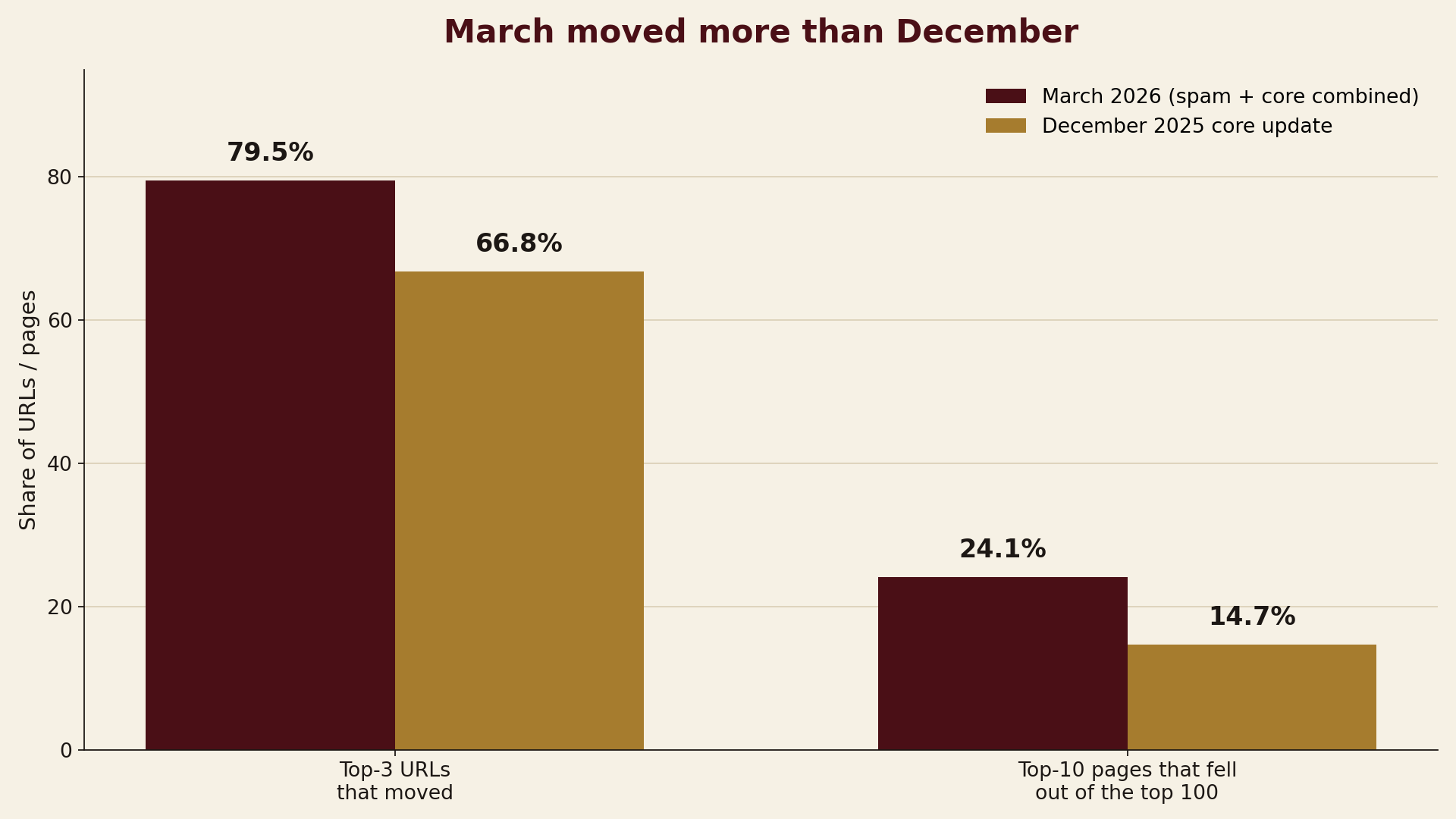
March moved most of the top three. If November moves like March, your rankings will swing while the rollout runs, and some swings will reverse before it ends. A page that drops on November 14 and returns on November 20 was caught mid-rollout, not demoted.
Why the early winner lists will be wrong
Two reasons to distrust the first wave of coverage. First, the volatility started before Google confirmed anything. Semrush's sensor hit 9.5 on US desktop on October 27 and stayed near 9.4 on UK desktop through November 2. Search Engine Roundtable reported ranking swings on October 16, 20 and 21, 24, and 27. Some of this week's movement started two weeks ago.
Second, the measuring instruments were degraded in September and October, and the current rate is contested. DemandSphere said about 11 percent of its daily checks came back spurious in early October, and under 2 percent remained by November, after detection and retries. Nozzle counted 8.0 percent of results pages as poisoned from September 13 to October 9, and published its method: 27.5 million pages, 49 countries, three device types. AccuRanker applied Nozzle's rule to its own data and measured 1.4 to 1.5 percent. DemandSphere published no method. Google has not commented on any of these figures. I wrote in October that rank tracker data broke for three weeks during the September spam update. The same caution applies here: a tracker that reports a drop may be reporting its own collection failure.
The playbook: four steps, nothing before December 3
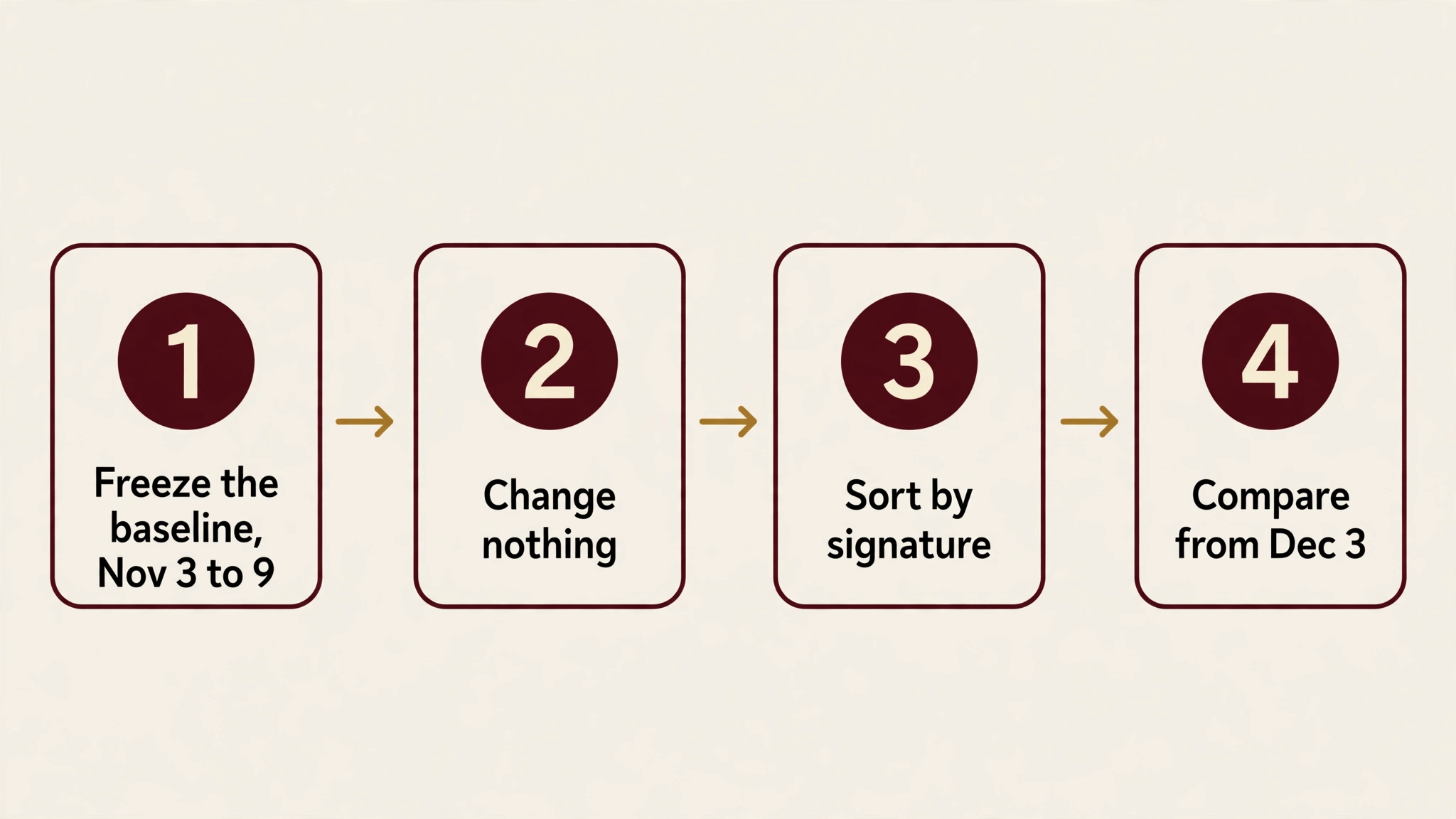
Step 1. Freeze the baseline today. Export clicks, impressions, and average position per page for November 3 to 9, at page level. Site totals hide the story: a category page down five positions and a blog post up three cancel each other out. Save the export now, before the rollout contaminates it.
Step 2. Change nothing while the rollout runs. Do not rewrite a page that drops. Do not "fix" a category that slips. Google's documentation says improvements after a decline can take days or months and are not guaranteed. A rewrite made mid-rollout is a change you cannot attribute. If the page recovers, you will not know whether the rewrite or the rollout did it.
Step 3. Sort movers by signature, not by size. This is the check I run across client sites during a rollout, the same one I used during the September tracker break. Ranktracker showed how it happens: a keyword at position 32 that ranks, disappears, then reappears across four days while the page never moved. That is what a collection failure looks like. A page that holds a new position a full week after the dashboard declares the rollout complete is a move worth acting on. The campaign I anchor on grew organic clicks 311 percent, in clicks, not ranks. In September, when the tracker and the clicks disagreed, the clicks were right every time. Size tells you nothing until the rollout ends. The pattern tells you whether to act at all.
Step 4. Compare from December 3, and compare positions on a fixed query set, not clicks. Search Console data lags two to three days, so the week ending December 1 is not complete until December 3. November 25 to December 1 against November 3 to 9 is a holiday week against a normal week, so clicks lie. Use Thanksgiving week 2025, November 24 to 30, as the control for clicks. Thanksgiving and Black Friday fell on Thursday and Friday, the same weekdays as this year. Judge the update on average position for the same queries both weeks. Position is less distorted than clicks, but holiday demand still moves it through the query mix, so fix the query set first. Search Console still pools AI Overview clicks into organic, so a click gain may be an answer click, not a ranking gain; I covered that gap in my post on the 40 percent click loss. Watch how many of your top-ten pages are still in the top 100 on December 3. The March spam and core updates combined put 24.1 percent of them outside the top 100.
Black Friday will tell you how your sale performed. It will tell you nothing about this update. Freeze the baseline, change nothing, and read the update from December 3.

About the author
Dalin de Graff is a digital marketing expert based in Winnipeg, Canada, with 9 years of experience across SEO, GEO, and AI search. At First Rank, he built the agency's GEO practice and leads its work on AI search and LLM visibility. His results include +311% organic clicks, +300% calls, and +98% AI search traffic in 30 days. He writes about search, AI, and marketing at dalindegraff.com.