Facebook Put 6 Million AI Pages in Google. Do Not Copy the Template.
Meta put 6 million AI-written pages into Google and took 40 million visits in October. Here is why the spam rule might not catch it, and what to check.
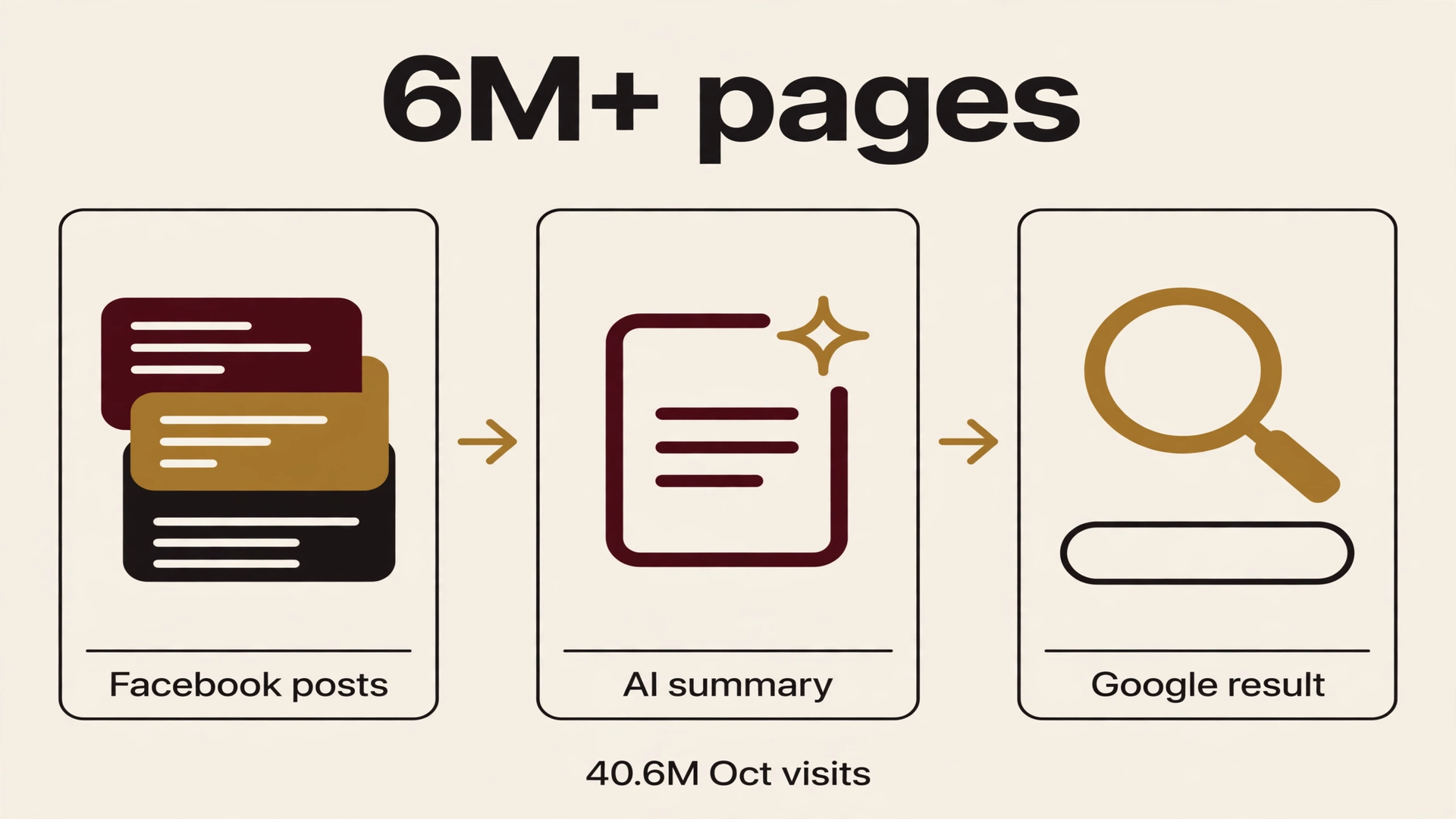
When Westbrook checked on November 4, the second result for "Amex Travel" was not American Express. It was a Facebook page. The page is an AI-written summary of Facebook posts about Amex travel cards, credited with about 23,900 visits a month by Semrush. Saul Westbrook of Peripheral Creative documented the directory behind it on November 4. It is facebook.com/fb-answers, millions of AI-generated pages built from public Facebook posts and left open for Google to index. Google now holds more than 6 million of them; in October they took an estimated 40.6 million visits.
Google's scaled-content-abuse rule has one live test that matters, and it is this directory. Copy the template and you are the kind of site this rule has already hit. The pages survive because Meta owns the raw material.
What Facebook built
Each page covers one question. It opens with a short AI-written summary and lists the public Facebook posts and pages it drew from. The pages link through a "More like this" box, and each asks the reader whether the result was good or bad. Westbrook writes that there "seems to have been no editorial oversight" for the content. He found more than 180 pages in English on Padel Tennis alone.
The Amex Travel page shows how the machine works. The query carries 368,000 searches a month, and the page sits at position 2 with about 23,900 visits a month on Semrush estimates Westbrook published. The same shape repeats: "Champions League Schedule" at position 9 on a million searches a month, "LAS Airport Location" at position 1, "Labcorp" at position 6 on 2.7 million. Every page is an AI summary of other people's posts, at a scale no editorial team could match.
Westbrook first noticed the pages in June 2026; Facebook started filling the directory in July. As of November 3, Facebook had not spoken publicly about the directory, and Westbrook's request for comment had gone unanswered.
The ramp
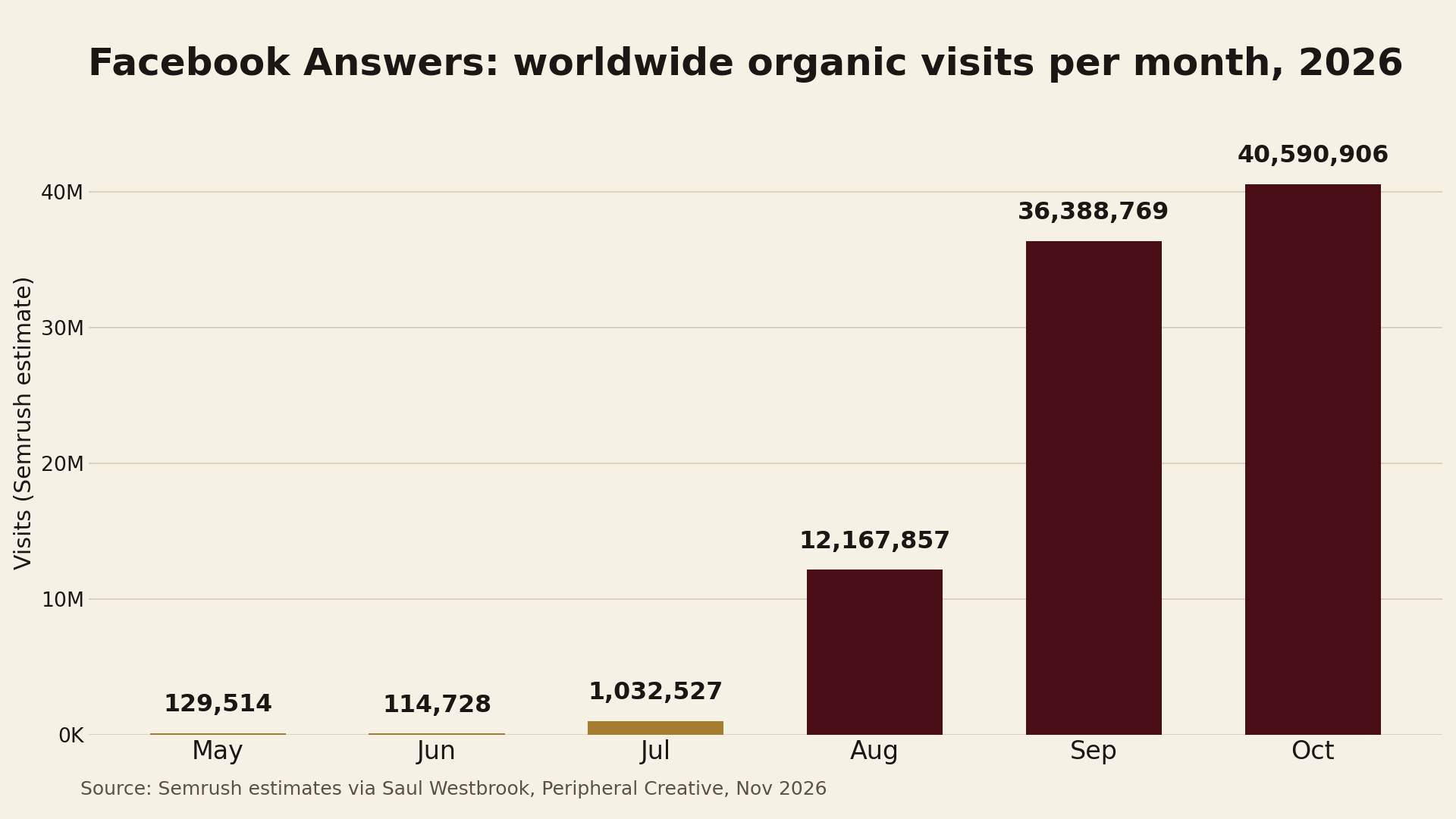
These are Semrush estimates, published by Westbrook:
| Month | Worldwide visits |
|---|---|
| May 2026 | 129,514 |
| June 2026 | 114,728 |
| July 2026 | 1,032,527 |
| August 2026 | 12,167,857 |
| September 2026 | 36,388,769 |
| October 2026 | 40,590,906 |
Between July and August, keywords with a Facebook Answers page ranking jumped from 4 million to 53 million. Westbrook puts the total since the summer at more than 100 million visits; Semrush estimates more than 39 million pages rank for at least one US keyword. That 39 million is a ranking estimate, not an index count; the indexed count is the 6 million figure. The two numbers measure different things.
For scale, Reddit still takes an estimated 1.8 billion monthly visits from Google. Facebook Answers took about 2 percent of that in October, and Facebook has only been filling the directory since July.
The rule it should break
Google's spam policy defines scaled content abuse as "many pages are generated for the primary purpose of manipulating search rankings and not helping users." The same policy forbids doorway abuse: pages "created to rank for specific, similar search queries." On paper it reads like both definitions: millions of pages, one per question, generated by AI, with no editorial pass Westbrook could find. But both definitions turn on purpose and value, and the purpose here is unproven. Westbrook's own read is only that the pages were probably set up to rank.
Sites get hit for this. Westbrook notes sites hit with scaled content abuse penalties in recent months, mostly for large numbers of AI-generated pages. The September 2026 spam update ran from September 24 to roughly October 8. I wrote at the time that scaled content abuse was the real test in that update. Facebook Answers came through that update intact.
Glenn Gabe called it plainly on November 5, in Search Engine Roundtable's coverage: "OK, if you are looking for another example of massive 'Scaled content abuse', then look no further than..... FACEBOOK." He noted the directory ranks across the ten blue links, AI Overviews, and AI Mode.
Why it might survive anyway
Westbrook offers one possible defence. Every page is sourced from Meta's own first-party data, posts and pages that live on Facebook. Google may judge that as genuine value, even at this scale. If that is the line, the lesson is narrow.
A Winnipeg therapy clinic grew calls 300 percent after we rebuilt its service pages around first-party detail no competitor could copy: actual clinicians, actual services, real patient reviews. Those pages rank because the material behind them is owned, not assembled. Meta's pages may survive for the same reason, at a scale a clinic will never reach.
A second twist sits inside AI search. Westbrook tried to get large language models to crawl the pages and could not, because Facebook blocks LLM crawlers from the directory. But Google's AI Overview cites the pages anyway, because it summarises search results and the pages are in them. The answer cites a summary of posts, not the posts. Westbrook found pages handing out crypto tips, medical advice, and gambling guidance sourced from individual posts, and one page promising London weather of 34-35 degrees in November. The information is unchecked, and it carries Google's citation.
What to check this week
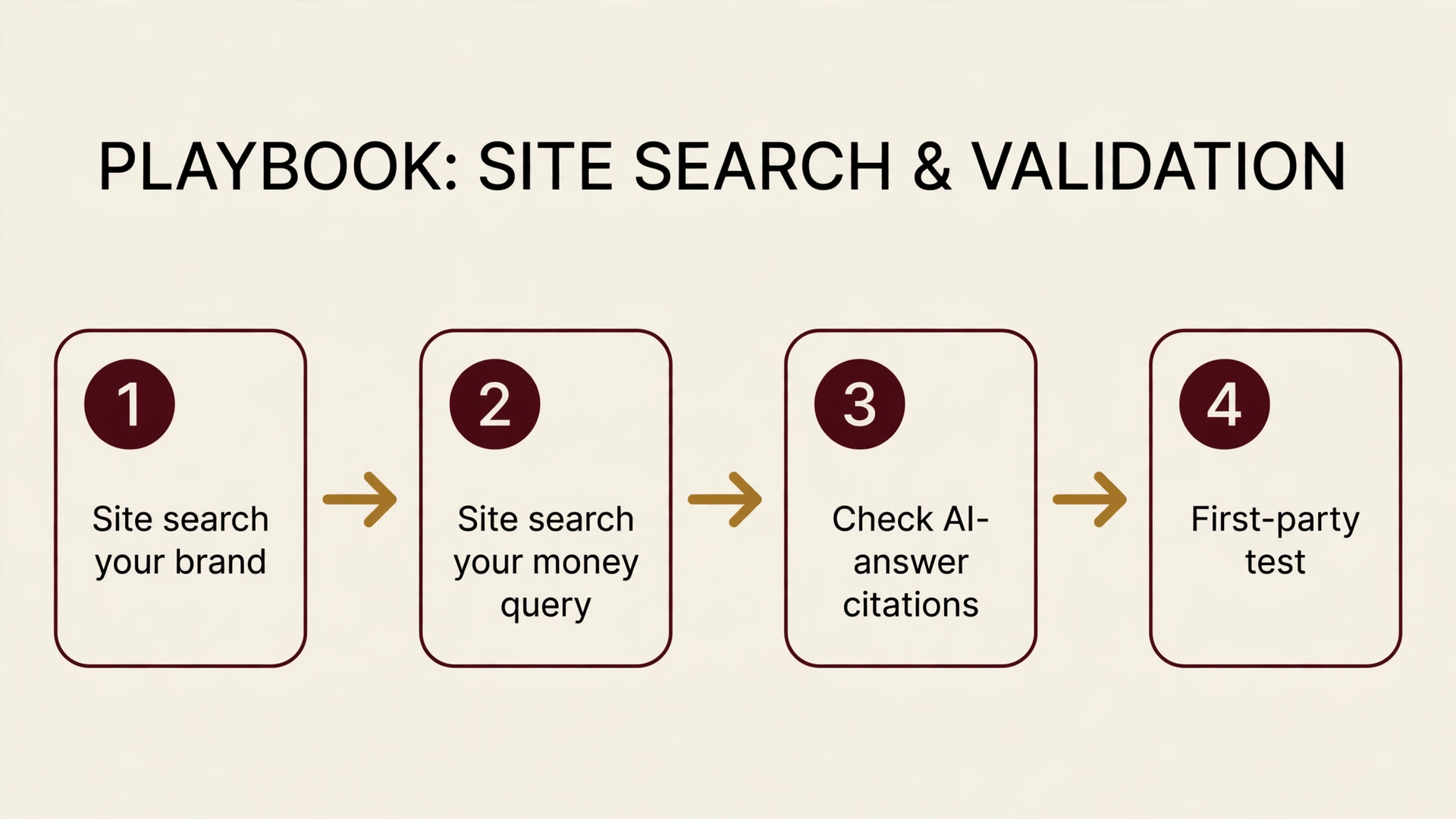
Do not copy the directory. Run four checks instead, and keep the results to re-run them monthly.
- Search
site:facebook.com/fb-answersplus your brand name, Westbrook's own method. If a page mentions you, read it, because that page can now show up in your brand's search results and in AI answers about you. - Run the same search with your top money query. If a Facebook Answers page ranks for it, note the position: a page you did not write and cannot edit is now competing for your query.
- Ask your money questions in ChatGPT, Gemini, and Perplexity and log whether a Facebook Answers page appears as a citation. The directory blocks LLM crawlers, so a citation here would arrive through the model's web-search layer, not through the model reading the page.
- Run the first-party test on your own content. For every page you plan to scale, point to the original material only you own: your data, your customers, your process, your photos. A page with none of that is the kind of page Google's rule was written for.
The test is the point
Meta may not have found a loophole at all. If first-party sourcing is what keeps these pages up, the lesson is narrow. If it is not, this directory is the biggest scaled-content-abuse case Google has ever had to rule on. If you do not own yours, do not scale it.

About the author
Dalin de Graff is a digital marketing expert based in Winnipeg, Canada, with 9 years of experience across SEO, GEO, and AI search. At First Rank, he built the agency's GEO practice and leads its work on AI search and LLM visibility. His results include +311% organic clicks, +300% calls, and +98% AI search traffic in 30 days. He writes about search, AI, and marketing at dalindegraff.com.