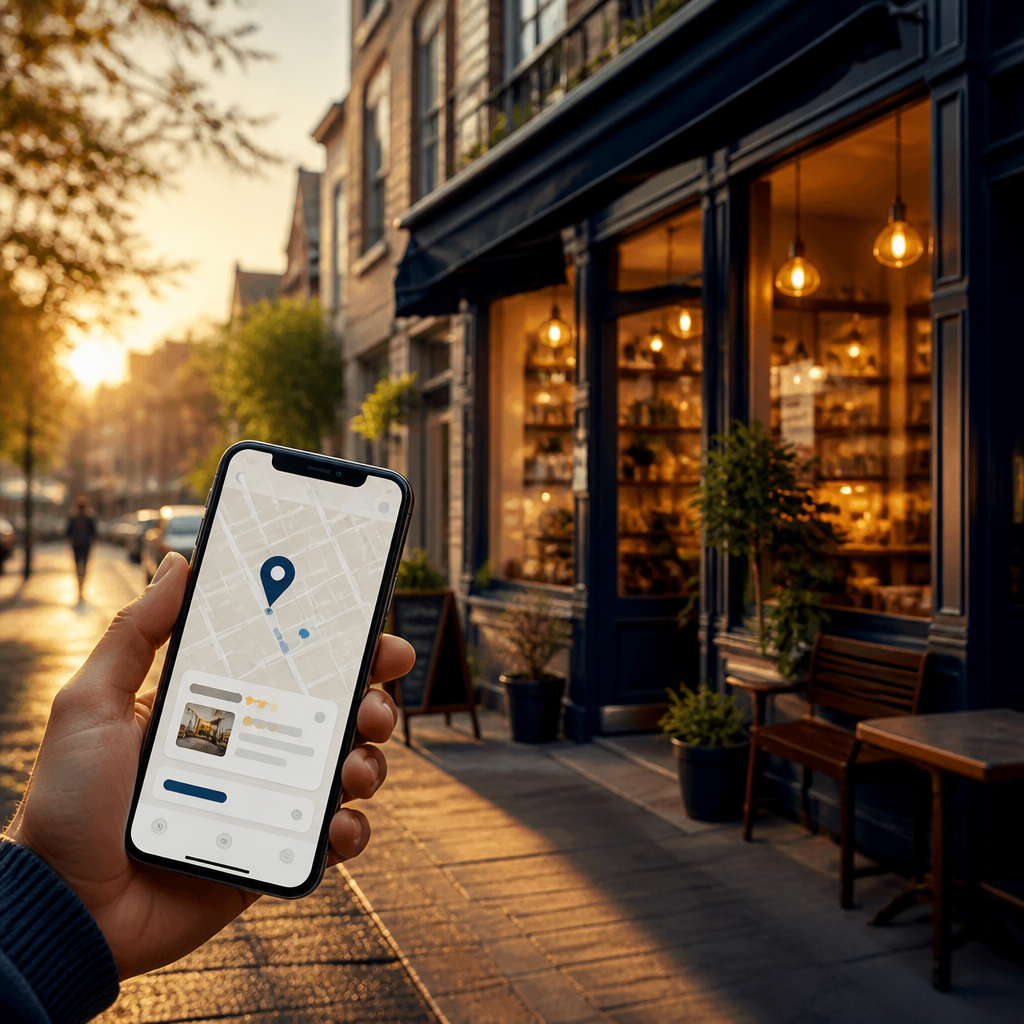
Your Google Business Profile Is Your Homepage Now
For local businesses, customers decide on your Google Business Profile before ever visiting your site. Here is how to win the zero-click local search.
Somebody searches for your business right now. They see your hours, your pricing, a handful of recent reviews, maybe an AI-generated summary of what you offer. They make a decision: call, visit, or move on. They never click through to your website.
From your analytics, nothing happened. No pageview, no session. But something absolutely did happen. A customer formed their entire impression of your business, and your website had nothing to do with it.
This is the zero-click reality of local search in 2026, and it changes what your most important web page is. For most local businesses, it is no longer the homepage. It is the Google Business Profile.
The zero-click local reality
The broad numbers are stark: 68% of Google searches now end without a click to any website, according to 2026 SparkToro research. Local searches skew even harder toward zero-click, because Google answers the core questions (hours, phone, directions, reviews) directly on the results page.
Think about your own behavior. When you search for a restaurant, a clinic, a plumber, how often do you visit their website versus just tapping call in the map pack? Your customers behave the same way. The local pack is three names. Miss it and you disappear.
Your Google Business Profile is the page showing up in the map pack, feeding AI Overviews, and getting read aloud by voice assistants. It is the single surface where discovery, evaluation, and conversion now happen in one place.
What your profile actually is now
Stop thinking of your profile as a directory listing. In 2026 it functions as four things at once:
Your first impression. Photos, ratings, review snippets, and business descriptions are the first things a searcher sees. Most will never scroll past them.
Your conversion page. Calls, direction requests, bookings, and messages all happen on the profile itself. These are the metrics that matter now, not website sessions.
Your AI citation source. Google's AI Overviews and AI Mode pull business facts from profiles. An incomplete profile does not just lose clicks; it can suppress your business from being cited in AI answers at all.
Your trust signal. Review count, recency, rating, and owner responses feed both the local ranking algorithm and the trust models behind AI recommendations.
What a fully optimized profile needs in 2026
Most profiles I audit are running at 40% capacity. Here is the complete checklist I use with clients:
Foundations. Claim and verify the listing. Get the primary category exactly right (this is the single highest-leverage field), add relevant secondary categories, and keep NAP (name, address, phone) perfectly consistent everywhere.
Completeness. Fill every field: hours including holiday hours, services with descriptions, products, attributes (women-owned, wheelchair accessible, and the rest), and a business description written for humans that includes what you actually do.
Photos and video. Add high-quality photos regularly: the storefront, the team, the work itself. Businesses with fresh, real photos consistently outperform stock-photo profiles. Short video is increasingly surfaced in local results.
Posts. Treat GBP posts as query interceptors, not social updates. One intent per post, one clear next step, one supporting photo. Match the post to a specific question a searcher has, and you intercept that query before it ever reaches a competitor.
Products and services. List packaged services, pricing where appropriate, and booking links. Every question you answer on the profile is a phone call your staff does not have to field.
Q&A. Anyone can ask or answer questions on your profile, which makes this both an asset and a risk. Seed it with real questions from your call logs and chat transcripts, answered in concise, factual language. Wrong answers left standing become a visible trust problem.
Messaging and booking. Enable messaging with fast responses, and connect direct booking where your category supports it. In a zero-click world, the profile has to function as a remote front desk.
Reviews are ranking fuel
Reviews deserve their own section because most businesses underinvest here. Review signals (count, velocity, recency, rating, and owner responses) influence local pack rankings directly, and they are increasingly what AI systems weigh when recommending a business.
The playbook is simple but relentless:
- Ask every satisfied customer. Build it into the transaction, not into a quarterly campaign.
- Respond to every review, positive and negative, with a consistent structure: gratitude, confirmation of the service, and a next step.
- Never incentivize reviews in ways that violate policy. Google has cracked down hard on suspicious review patterns, and losing your reviews is worse than growing them slowly.
A profile with 200 recent reviews and thoughtful owner responses will beat a technically perfect profile with 12 stale reviews. Trust is the ranking factor most businesses can actually control.
Proof it works
This is not theory. A Winnipeg therapy clinic came to us with a solid website and an afterthought of a profile. We rebuilt their local presence around the profile: categories corrected, services detailed, review generation systematized, posts running weekly, Q&A seeded.
Phone calls from their Google Business Profile increased 300% in 8 months.
The website did not change much. The profile did everything. That is the whole argument in one result.
Where to start this week
If your profile is half-finished, do not try to fix everything at once. Start here:
- Audit your categories. One wrong primary category can cost you the map pack.
- Upload 20 real photos this week. Storefront, team, work product.
- Write and answer your five most common customer questions in Q&A.
- Set up a review request habit: every happy customer, every time.
- Publish your first GBP post tied to one specific service and one clear next step.
Your website still matters. It validates, it converts the researchers, it houses the content AI cites. But the decision increasingly happens before anyone arrives there. In 2026, your Google Business Profile is not a supporting asset next to your homepage. For a huge share of your customers, it functionally is your homepage. Treat it like one.

About the author
Dalin de Graff is the LLM + Search Engine Marketing Specialist at First Rank, where he built the agency's Generative Engine Optimization (GEO) department.