Meta Paused Its AI Terms. Its Crawlers Never Stopped.
Meta's new business terms were due November 20. They never arrived. Five crawlers keep running, so here is the robots.txt decision to make now.
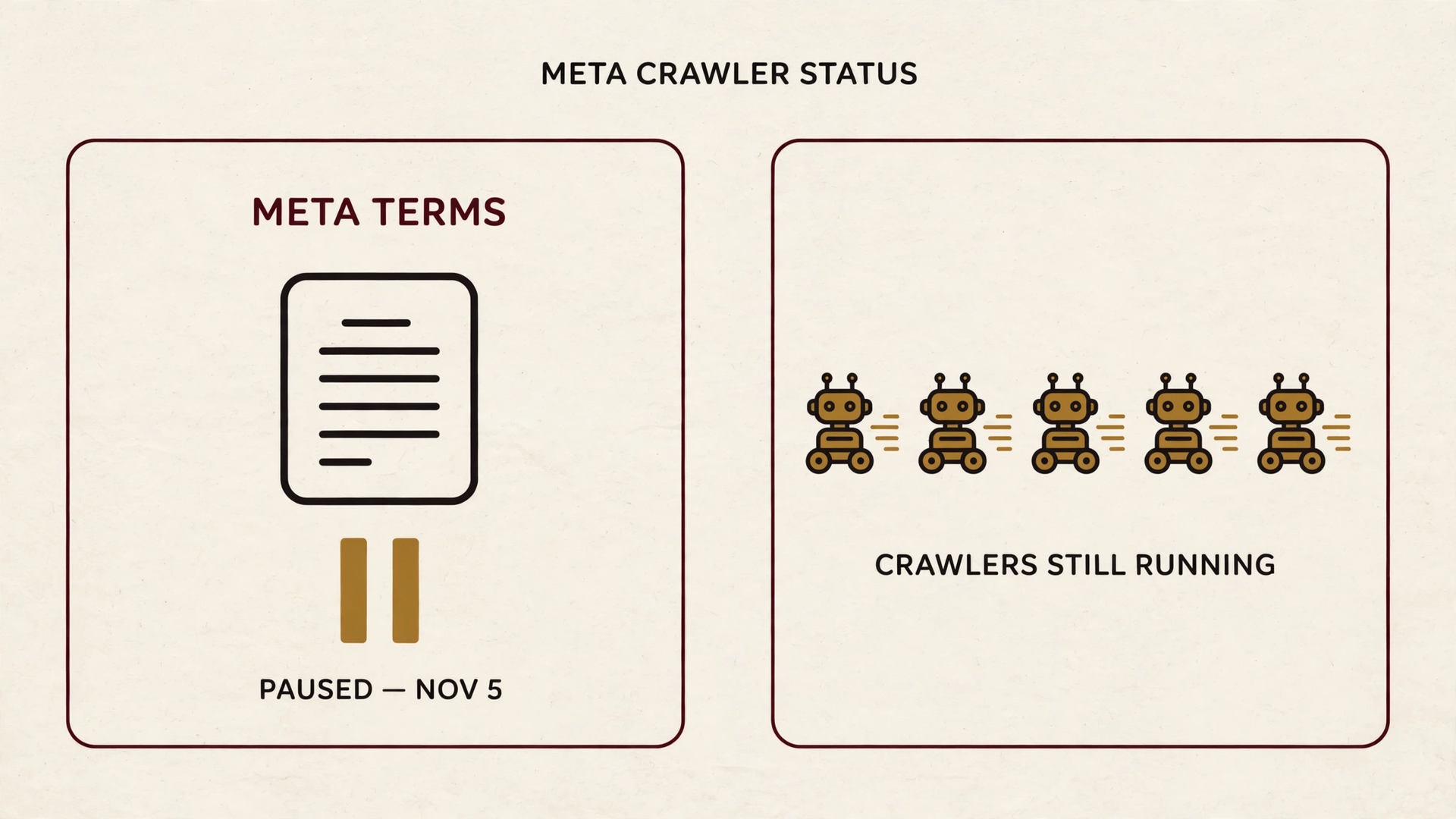
Yesterday was November 20, the day Meta's new business terms were supposed to take effect. Those terms would have let Meta send automated software to the website of any business on Facebook or Instagram. Nothing took effect. Meta paused the package on November 5, took down the preview, and on November 18 laid out consultation into 2027. The pause is real. It changes the contract, and it leaves the crawlers running.
I wrote about this fight in October, when Meta delayed the terms from October 30 to November 20.
What happened between October 15 and November 20
| Date | What happened |
|---|---|
| Oct 15 | Nieman Lab reports the terms: Meta could read websites tied to a business to "provide, develop, improve, research, train, and maintain" its products. |
| Oct 16 | Nieman Lab reports Meta removed "train" on Oct 16 and narrowed the purpose to advertising and business products. "Develop" stays. |
| Oct 28 | A court in Oslo temporarily bans Meta from enforcing the terms, pending a legality ruling. Ten Norwegian media groups brought the case. Meta promises to consult industry groups first. |
| Oct 30 | The UK Competition and Markets Authority opens a formal investigation into the terms. |
| Nov 3 | A São Paulo court suspends the crawling clause for members of Brazil's three national media associations, with a R$1m/day fine. |
| Nov 5 | Meta pauses all four sets of terms: they "will not take effect on November 20, 2026" and "our existing terms remain in effect." |
| Nov 18 | Meta publishes a three-phase consultation plan: listen for a few months, revise the language, then engage again in early 2027 before any rollout. |
| Nov 20 | Nothing takes effect. |
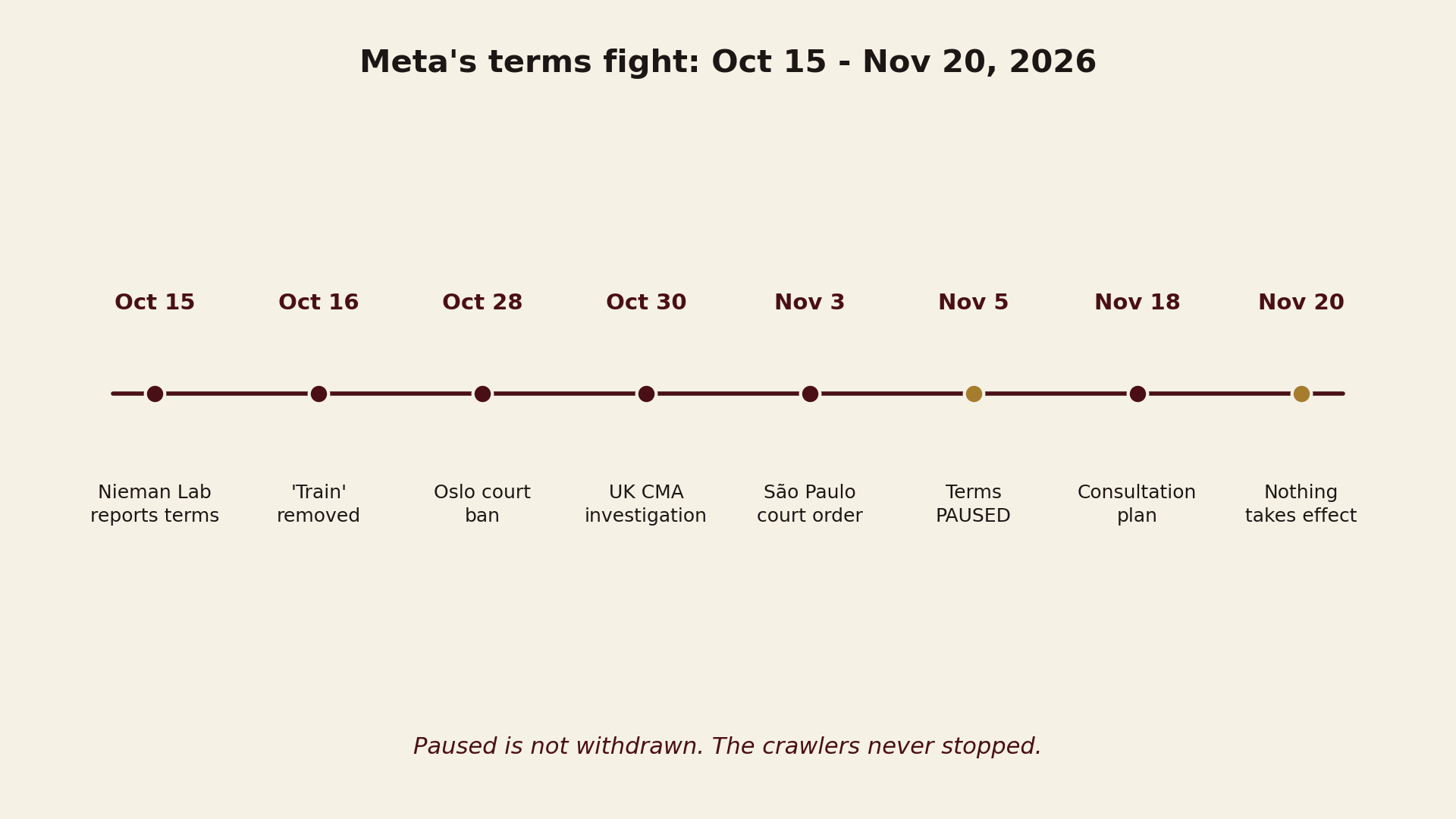
Search Engine Journal puts it plainly. Paused is not withdrawn. Meta has not said what comes back, or when. Neither court order has been reported as lifted. The CMA investigation is still open.
The pause changed the contract. The crawlers kept running.
The paused terms were a contract question. They set what a business agrees to by keeping a Page or running ads. The crawlers are a separate question, and they never stopped. Meta's November 18 post says it "follows the industry standard robots.txt mechanism," and a Meta spokesperson told Nieman Lab that robots.txt preferences are respected. The file that controls what Meta's software takes from your site is one you already own.
That control has a hole. The shared AI training opt-out token I wrote about on November 1 comes from Google, Microsoft, and OpenAI, and none of them honors it yet. Meta is not part of it, so its crawlers need their own lines, one per job.
Five crawlers, five separate decisions
A blanket block treats a training crawler and a link preview bot as the same thing. Block everything and your Facebook previews can break and Meta AI can stop citing you. Block nothing and your content trains Meta's models.
| Crawler | What it does | Robots.txt | Your call |
|---|---|---|---|
| facebookexternalhit | Builds the preview when someone shares your page on Facebook, Instagram, or Messenger | May bypass it for security checks | Keep open. This is how your links look when shared. |
| meta-webindexer | Improves Meta AI search results; allowing it helps Meta AI cite and link to you. | Honored | Keep open if you want Meta AI to name you. Close it to stay out of Meta AI answers. |
| meta-externalads | Reads the web for advertising and business products | Honored | Keep open if you run Meta ads. Blocking it has no documented effect on delivery, so test on one folder first. |
| meta-externalagent | Trains foundation AI models and indexes content directly | Honored | Block it, unless you have decided training is fine. This is the one the October fight was about. |
| meta-externalfetcher | Fetches links a user asks for, including agentic tasks | May bypass it | You cannot stop it in robots.txt; server-level blocking is the only route. |
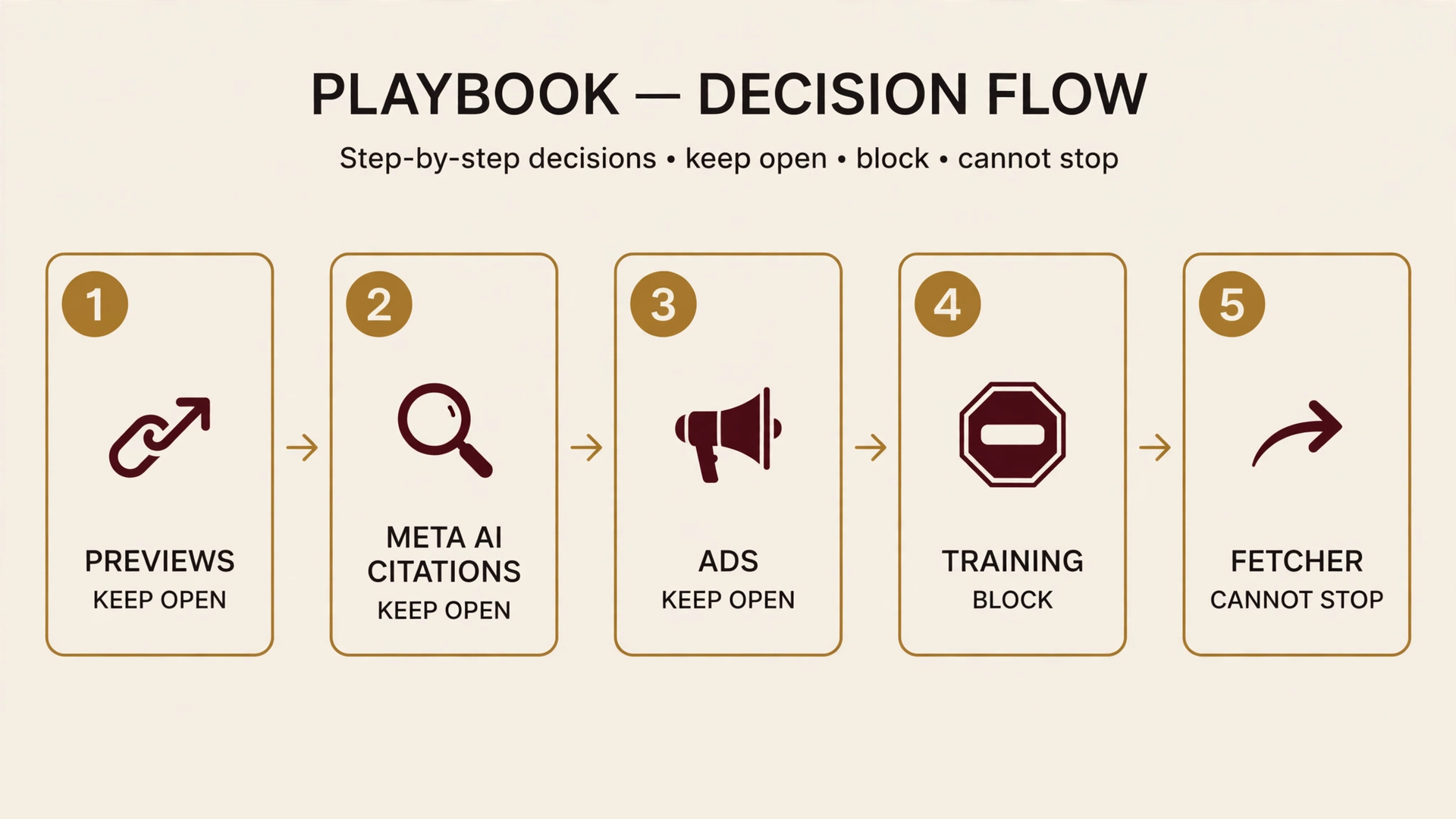
Meta does not say whether webindexer data ever feeds training, so do not assume the jobs are cleanly split.
Run the decision on one business
Take a local service business that gets bookings from Google and Facebook and runs Meta ads. A Winnipeg therapy clinic campaign I led at First Rank saw calls rise 300%. For a business shaped like that clinic, a broken preview or a lost citation is a booking that never happens. Facebookexternalhit stays open. Links with no preview get ignored, and ignored links do not book. Meta-webindexer stays open as well. When someone asks Meta AI for a therapist nearby, the clinic wants to be the named answer with a link. Meta-externalads stays open while the clinic runs Meta ads, and the effect of blocking it on delivery is undocumented, so a test would start on one folder, not a landing page. Block meta-externalagent. The clinic's service pages are its product, training value for Meta, zero for the clinic. Meta-externalfetcher gets accepted. A user asking Meta AI to fetch the booking page is a customer doing what the clinic wants.
If you cannot state the reason for a row in one sentence, you have copied someone else's blocklist.
The robots.txt block, and the two traps in it
The block for the common case is three lines:
User-agent: meta-externalagent
Disallow: /
Add an explicit allow for the citation crawler, so a future edit does not sweep it into a broad block:
User-agent: meta-webindexer
Allow: /
The block has two traps. First, Meta says crawlers may cache robots.txt for up to 24 hours, so check your logs for the meta-externalagent token the next day. Second, a fetcher request will still arrive, because meta-externalfetcher may bypass robots.txt when a user asks for a page. Do not read one of those hits as proof the block failed.
Run one more check in the same session. Ask Meta AI the money questions you track on the other engines: the service, the city, the comparison a buyer types. Log whether it names your business, quotes your page, or sends the booking elsewhere. I run the same check on ChatGPT, Gemini, and Perplexity. If your name disappears from Meta AI answers after you blocked webindexer, that is the trade working.
What to watch before early 2027
The consultation has three phases and no new effective date. Listening runs over the next few months, the revised language gets another round in early 2027, and Meta says it will notify account holders before any new terms take effect. Watch three things: the revised wording, because "develop" staying in keeps the training question open; the CMA investigation, because a regulator's decision will shape the final text more than the consultation; and your own server logs, because the crawlers never pause.
The file that controls what Meta takes from your site is yours to write. Write it this week, while nobody is watching.

About the author
Dalin de Graff is a digital marketing expert based in Winnipeg, Canada, with 9 years of experience across SEO, GEO, and AI search. At First Rank, he built the agency's GEO practice and leads its work on AI search and LLM visibility. His results include +311% organic clicks, +300% calls, and +98% AI search traffic in 30 days. He writes about search, AI, and marketing at dalindegraff.com.